
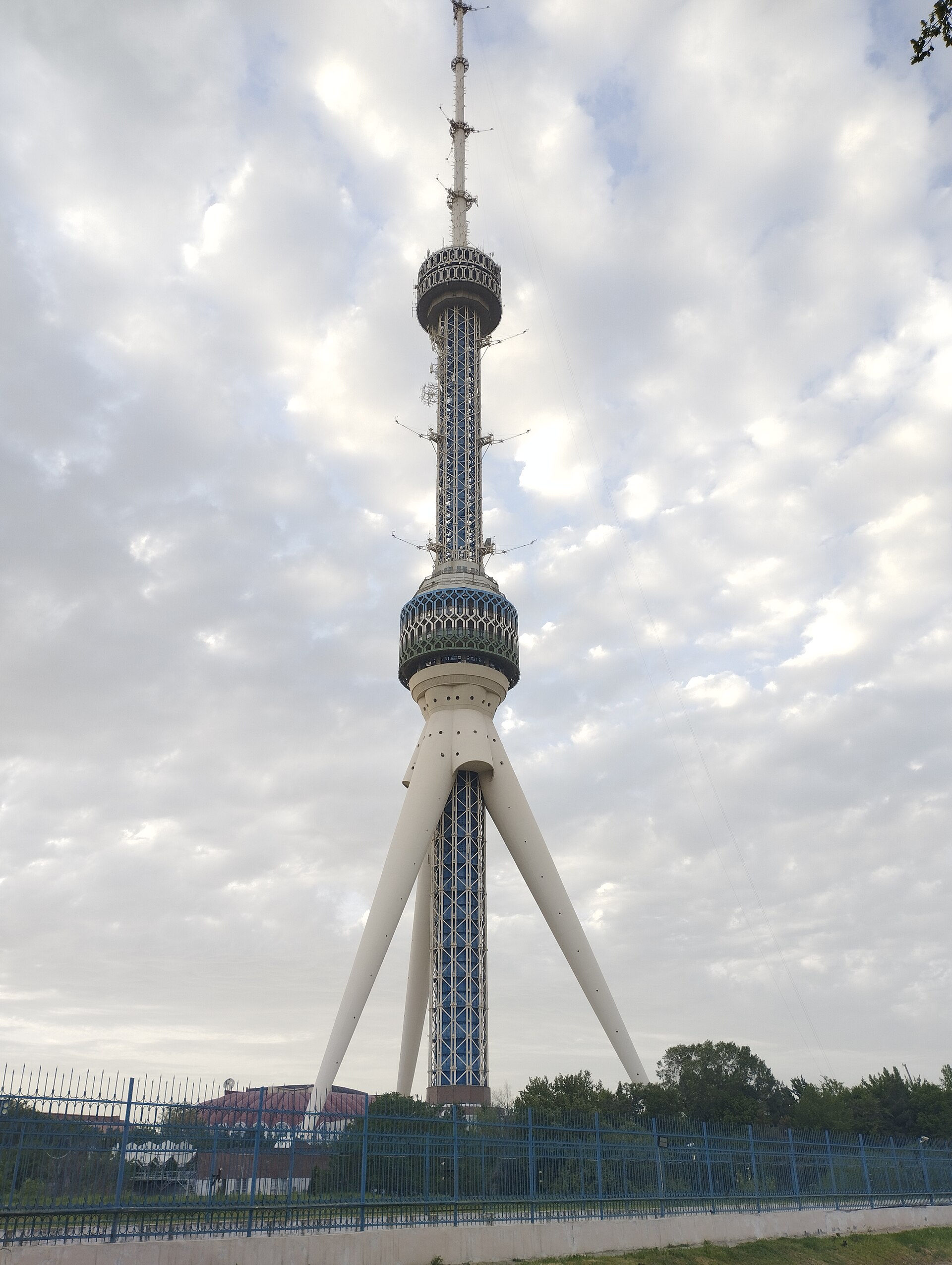
Tashkent TV Tower
About the Object
N. Terziev-Tsarukov, Yu. Semashko (Москва); V. Kim, V. Rusanov (Ташкент)
1985
Modernism
Public Building
Gallery (5)
Tashkent TV Tower
The Tashkent TV Tower is the city's tallest structure and one of its main silhouettes: its shaft rises 375 meters. At the time of its construction, it was one of the tallest TV towers in the world, and today the tower is a member of the World Federation of Great Towers. Construction began in 1978 and lasted for almost six years. The engineering task was not easy: a tower of such height, and in a region with high seismicity, required the participation of five design institutes at once. The main structure was developed in Moscow at the long-named institute TSNIIProektstalconstructsiya: initially, architect Nikolai Terziev-Tsarukov worked on the project, and after his death, Yuri Semashko. From the Tashkent side, architects V. Kim and Vladislav Rusanov participated in the work. Reinforced concrete TV towers were still a novelty back then: the world's first was built in Stuttgart in 1956, and the next in Johannesburg. The Tashkent tower took its place among the tallest of them; legend has it that the clients specifically wanted a tower taller than the Alma-Ata one, which had opened two years earlier. It was commissioned in 1985, although the exact date varies in sources, with both January and September being mentioned. Inside, around the central shaft, there is a circular monumental panel called "Symphony" with an area of about two hundred and fifty square meters. Higher up, there are two restaurants and an observation deck from which almost all of Tashkent is visible-such an "attraction" appeared on the very first large TV towers, like Moscow's Ostankino. Today, the TV tower still operates as a broadcasting center and remains the most prominent vertical in the city's skyline. You can still go up there today. It features an observation deck with a 360-degree panorama of the city and the mountains on the horizon, as well as the revolving restaurant "Koinot" with two halls-the Red Hall at a height of 104 meters and the Blue Hall at 98. Admission is inexpensive, around forty thousand soms (about four dollars), and the tower is open every day from roughly ten in the morning to eight in the evening; the nearest metro station is Bodomzor. It is best to go up in the evening towards sunset, when the city is especially clear.
AI translation · 🇬🇧 EN
Rate this review:
Flag at 375 meters
On December 8, 1977, it became known that the Council of Ministers of the republic had approved the design: early next year, the construction of a television tower "350 meters high and weighing nearly five thousand tons" would begin in Tashkent. There were still few such towers in the country: they were being built in Tallinn, Alma-Ata, and Riga, "while only one is operating so far, in Kyiv." The designers called the stability of the "giant structure with a relatively small support area and in conditions of high seismicity" the main difficulty. The solution had already been found: the shaft would be supported by three conical pillars, with almost seventy meters between them near the ground. The task that the authors set for themselves was formulated eight years later by one of them, Tashkent architect V. E. Rusanov: "not to repeat architectural and spatial solutions in Tashkent that were used in other cities; not to distort the silhouette of the historical two-thousand-year-old city." The tower turned out to consist of three parts: a lattice shaft twelve meters in diameter rises from a granite stylobate up to 225 meters, three inclined struts catch it at a height of one hundred meters, and a 155-meter antenna tapering upwards stands on top. Two tiers on the shaft are surrounded by a lattice, in the pattern of which, according to Rusanov, "elements of national decor are used." The construction was monitored literally meter by meter. The strut sections were brought from the Chelyabinsk plant, each weighing nearly forty tons, and nine of them went into one pillar. In the autumn of 1979, the builders handed over the foundation for the installation of the shaft. The tower was erected by Leningraders, the 26th management of the Spetsstalkonstruktsiya trust. In the summer of 1980, the shaft reached 101.6 meters, and in November, the third and final strut was raised: one hundred meters long and five hundred tons in weight. In March 1981, the 157-meter mark was reached, and at the construction site they promised to reach "the design mark of 350 meters" by December. In the autumn of 1981, the shaft was already at 270 meters, and self-climbing cranes that "'walk' up themselves" hoisted the parts upwards. On March 4, 1982, a short note appeared, "Flag over the TV tower": "A scarlet flag has fluttered over the Tashkent radio and television tower. The last twelve-meter section of the antenna part has been installed. The tower has reached the 375-meter design mark." A year earlier, the design figure was called 350. Site manager B. K. Yanchenko listed what could now be done "on a broad front": elevators, utilities, stained glass windows, equipment, and the dismantling of cranes. Rusanov explained directly why the observation deck and restaurants are at one hundred meters and not higher. The task was "to protect the visitor and those working on the tower from unpleasant sensations associated with the height and swaying of its shaft," which is why the halls were placed "not at the 200-meter, but at the 100-meter mark where the three metal supports meet." Sculptures made of colored glass were placed in front of the stained glass window of one of the halls, and they also worked for safety: they prevented people from approaching dangerous places. The bottom of the shaft was dressed in mosaics by artist A. Bukharbaev. Art critic Abdulkhay Umarov wrote in the same issue of the magazine that it was supposed to "emphasize the weight and monolithic power of the structural solution" and that the relief of tuff, basalt, and pumice is perceived "as a natural wall of natural rock formations." The transmitters went on air in early 1985. On March 29, a ceremonial rally was held in Tashkent, and the tower is beginning its "second profession": a complex for excursionists is about to open, where high-speed elevators will allow one to "soar above the city higher than a bird's flight."
AI translation · 🇬🇧 EN
📷 Монтаж последней секции антенного шпиля ведёт МУ-26 треста Спецстальконструкция. «Архитектура и строительство Узбекистана», 1985, № 8
📷 Металлический каркас здания ресторанов на отметке 93-117 м со смонтированными элементами солнцезащиты. «Архитектура и строительство Узбекистана», 1985, № 8, с. 24
📷 Ташкентская телебашня. «Архитектура и строительство Узбекистана», 1985, № 8, с. 12
📷 Барабан центрального вестибюля. «Архитектура и строительство Узбекистана», 1985, № 8
Rate this review:
Nearby and related
By the same architect
Close by in Tashkent
About the Object
N. Terziev-Tsarukov, Yu. Semashko (Москва); V. Kim, V. Rusanov (Ташкент)
1985
Modernism
Public Building
375 m
Visitor Information
40 000 UZS · ~$4
Sunset