
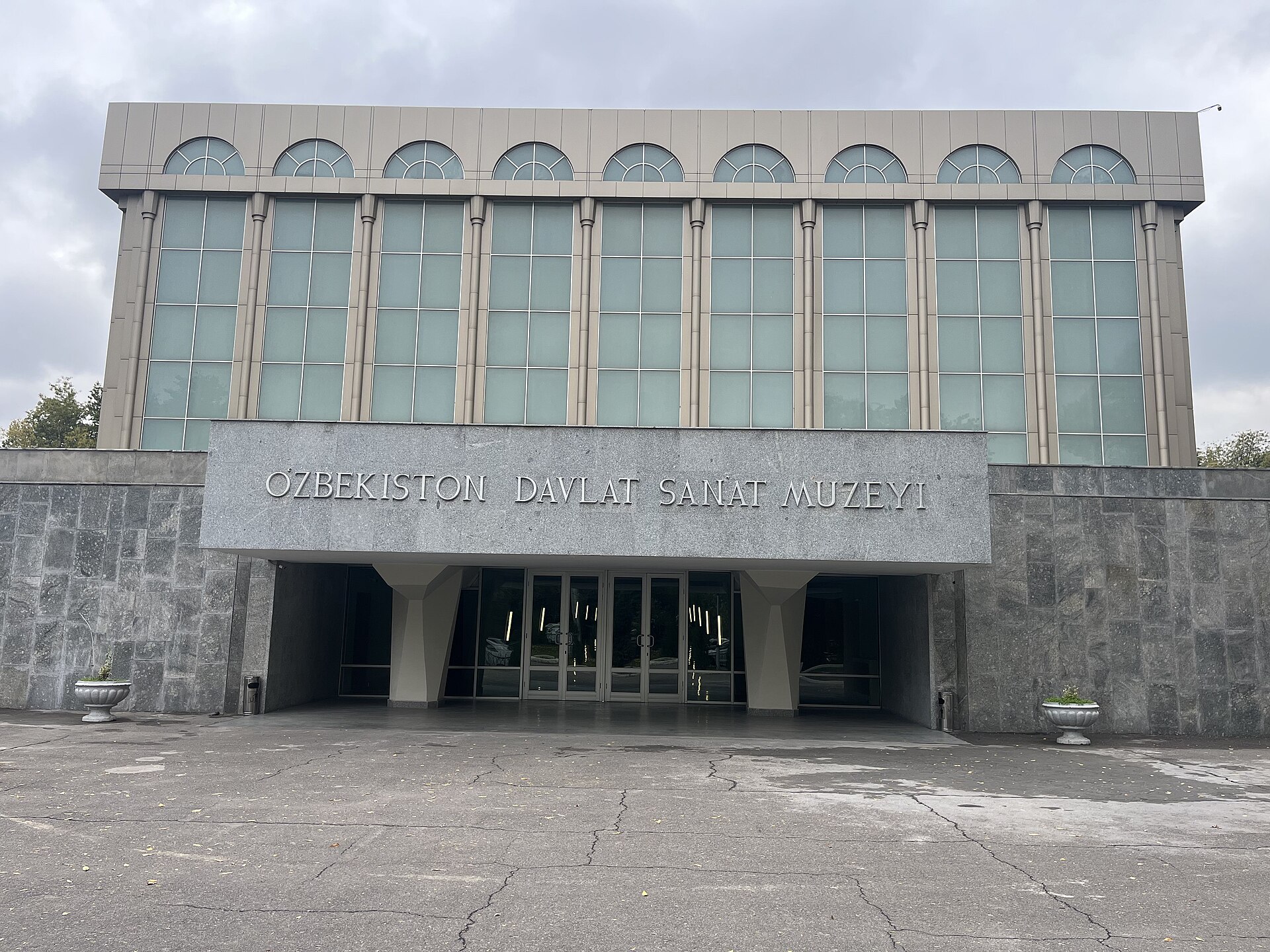
State Museum of Arts of Uzbekistan
Всемирное наследие ЮНЕСКОAbout the Object
S. Rozenblium, I. Abdulov, A. Nikiforov
1974
Modernism
Museum
Gallery (3)

State Museum of Arts of Uzbekistan
The State Museum of Arts of Uzbekistan is the country's largest art collection. As an institution, it traces its history back to 1918 and is considered one of the oldest art museums in Central Asia, while its current building, a monument of Soviet modernism, was erected in 1974. The site of the building has a history. Previously, the People's House stood here; after the 1966 earthquake, it was demolished, and a new museum was erected on the cleared space. The project was designed by architect Saveliy Rozenblyum along with co-authors. Rozenblyum is also known as the longtime partner of Ofeliya Aydinova, the author of the "Zhemchug" house: their creative tandem was jokingly nicknamed "Ofeblyum" by colleagues. In terms of architecture, the museum stood out noticeably from what was being built around it. In those years, Tashkent buildings were readily dressed in "oriental" sun-protection grilles and ornamentation, while Rozenblyum went in the opposite direction, toward a strict, purified form. Inside, the visitor is greeted by a austere concrete foyer in the spirit of brutalism-a movement that valued exposed concrete and large, heavy volumes. The building itself is embedded in a square where the obelisk to the "Turkestan Commissars" stands. The museum's collection includes painting, graphics, sculpture, and applied arts, ranging from Uzbek national to world art; in total, there are over a hundred thousand exhibits. The building itself may soon change its appearance. Back in 2019, the Art and Culture Development Foundation of Uzbekistan agreed with Japanese architect Tadao Ando on the reconstruction of the museum-his first work in Central Asia. The concept has grown into a major new museum: construction began in 2025, and the opening is planned for around 2028, with the 1974 modernist building slated to make way for Ando's structure. So the current museum is worth catching while it is still in its original form. The museum is still operating today: it is open every day except Monday, from approximately ten in the morning to five in the evening. A ticket for locals costs around thirty thousand soms, and is more expensive for foreigners. The nearest metro station is "Amir Temur Khiyoboni", about a ten-minute walk; the address is 16 Rashidov Street.
AI translation · 🇬🇧 EN
Rate this review:
Fifty halls and a glass cube
On February 13, 1974, Pravda Vostoka published a photograph of the new museum building: winter, bare trees, a bus in the foreground, and a solid wall of light-colored squares. The caption explained where it came from: "The old museum building could not withstand the earthquake. And now a beautiful new building has been erected in its place, providing excellent conditions for viewing and storing works of art." In October 1971, construction was already underway: the building was being erected by Trust No. 6 of Glavtashkentstroy. The museum opened on April 30, 1974, and the report on the housewarming was titled "Fifty halls of beauty. Happy housewarming, Art Museum!". The path through the building was described step by step: "A long, wide corridor whose ceiling is supported by massive columns." The walls of the corridor feature "openwork white... modern ganch panels," made by Mahmud Usmanov and his students. At the end of the corridor, a "spacious ground floor courtyard" opened up, where wall niches displayed ganch carving from Bukhara, Tashkent, the Fergana Valley, and Samarkand. In total, the new building had fifty halls across three floors, housing "several thousand works," including some that were previously "not exhibited due to lack of space." A lack of space was familiar to this collection. In 1989, A. Klinova calculated that over seventy years it "had to move eight times." It started in a princely mansion, where it was located from 1918 to 1929: the collection was based on the collection of Nikolai Konstantinovich Romanov, and his wife became its first curator. Then there was a small temporary space where paintings were hidden from viewers for four years because there was nowhere to exhibit them, and even a factory-kitchen building. After the earthquake, the collection was moved to a collective farm palace of culture. Klinova called the building the museum received in 1948 the most successful of these homes. According to her, it was built in 1874 as a stock exchange and rebuilt as a theater in 1900: "Old-timers of Tashkent probably remember it: columns, a portico, an Atlas supporting the celestial vault." The new building was initially conceived as an extension to it, "an additional exhibition pavilion." The old one was demolished, and Klinova writes about the demolition quite differently from the 1974 caption: "The signature of a powerful person outweighed the opinion of specialists." Her article was titled "Save the Museum," and it began in the storage facility: "A small, oblong room with water stains on the ceiling and walls. In the corner is a bucket where water drips." Nearby was published a note from the new museum's director, D. S. Ruzybayev, to the Central Committee of the Communist Party of Uzbekistan, essentially a list of how the building was unsuited for the museum. The halls are divided by partitions "not reaching the ceiling and floor," and streams of cold and warm air deform the canvases. "The exterior glass enclosure does not contribute to the preservation of the exhibits, and many applied art works have faded." The funds are stored in the basement, "above which water and sewage utilities run." The equipment has not changed for fifteen years, since the very opening, and half of the stored items need restoration. Klinova's conclusion was as follows: "And now a glass cube rises here, the very construction of which and its purpose as a museum, as is clear today, was a mistake." Fifteen years after the "housewarming," the Ministry of Culture, according to her, was going "already this year" to announce a competition for projects for a new building.
AI translation · 🇬🇧 EN
📷 Новое здание Государственного музея искусств Узбекистана. Фото Г. Григорьевой (УзТАГ). «Правда Востока», 13 февраля 1974, № 37, с. 4
Rate this review:
Nearby and related
By the same architect
Close by in Tashkent
About the Object
S. Rozenblium, I. Abdulov, A. Nikiforov
1974
Modernism
Museum
Visitor Information
30 000 UZS · ~$4
Anytime
