
Oybek Metro Station
About the Object
Architects S. Adylov (head), F. Muzaffarova, A. Tabibov, Ya. Mansurov, R. Fayzullaev (chief project architect); artists M. Mamadzhanov (ceramics), A. Khabibulin (panel)
1984
Modernism
Под проспектом Космонавтов на пересечении с улицей Лахути (АиСУз № 5, 1982)
Railway Station
Gallery (1)

A Station Assembled from Volumetric Blocks
At this station, the main feature is hidden in the structure rather than the finish. The 1982 design description begins as follows: at the "Oybek" station, which will be located under Kosmonavtov Avenue at the intersection with Lahuti Street, a new structure designed for regions with high seismicity is being used - made of large volumetric elements. This solution will reduce construction time and cost. The newspaper put it more bluntly. In August 1981, "Pravda Vostoka" wrote that for the first time in the practice of domestic metro construction, the station would be assembled from enlarged volumetric reinforced concrete elements, and "Tashmetroproekt" proposed bringing the prefabrication of structures up to ninety-eight percent. For a seismic city, this was not economy for the sake of economy: the fewer wet processes underground and the larger the factory-made elements, the more predictable the behavior of the structure during tremors. The station is arranged as follows. The column-type structure is covered by flat vaulted elements in the side spans; they smoothly transition into the track walls. The lighting is hidden: the fixtures are concealed in cornices that rest on two rows of openwork columns. The columns are faced with marble and ceramics. In the decoration of the lobbies and pedestrian underpasses, as in the platform, local natural materials - marble and granite - and durable glass and metal are used. It was built for a long time and in full view of the press. In June 1980, the team that finished the "Pushkinskaya" station moved to "Oybek" - a station that will be on the way from "Pakhtakor" towards the railway station. In September 1981, it was being built simultaneously with "Uzbekistan" and "Kosmonavtov Prospect". In December 1981, the underground excavation from the junction of "Navoi" and "Pakhtakor" to "Oybek" was almost completed - about two hundred meters remained; the running tunnel from "Oybek" to the station near the station "Tashkent" was already being conducted by the cut-and-cover method and was three-quarters complete. In February 1983, D. Z. Levin, secretary of the party committee of the "Tashmetrostroy" trust, spoke about the fact that ceramics are used for column decoration at the "Oybek" station and finishing work is in full swing. How successful the solution turned out to be can be seen from the fact that it was repeated. In 1988, an architectural magazine, analyzing the new "Tashselmash" station, wrote that its author varies the structural-spatial scheme of the "Oybek" station, combining the post-and-beam system of internal supports with the vaulted covering system. And immediately noted the difference not in favor of the new one: at "Oybek", the architrave beam carried hidden lamps illuminating the vaulted white ceilings, while at "Tashselmash", both the posts and beams were faced with red polished granite.
AI translation · 🇬🇧 EN
Rate this review:
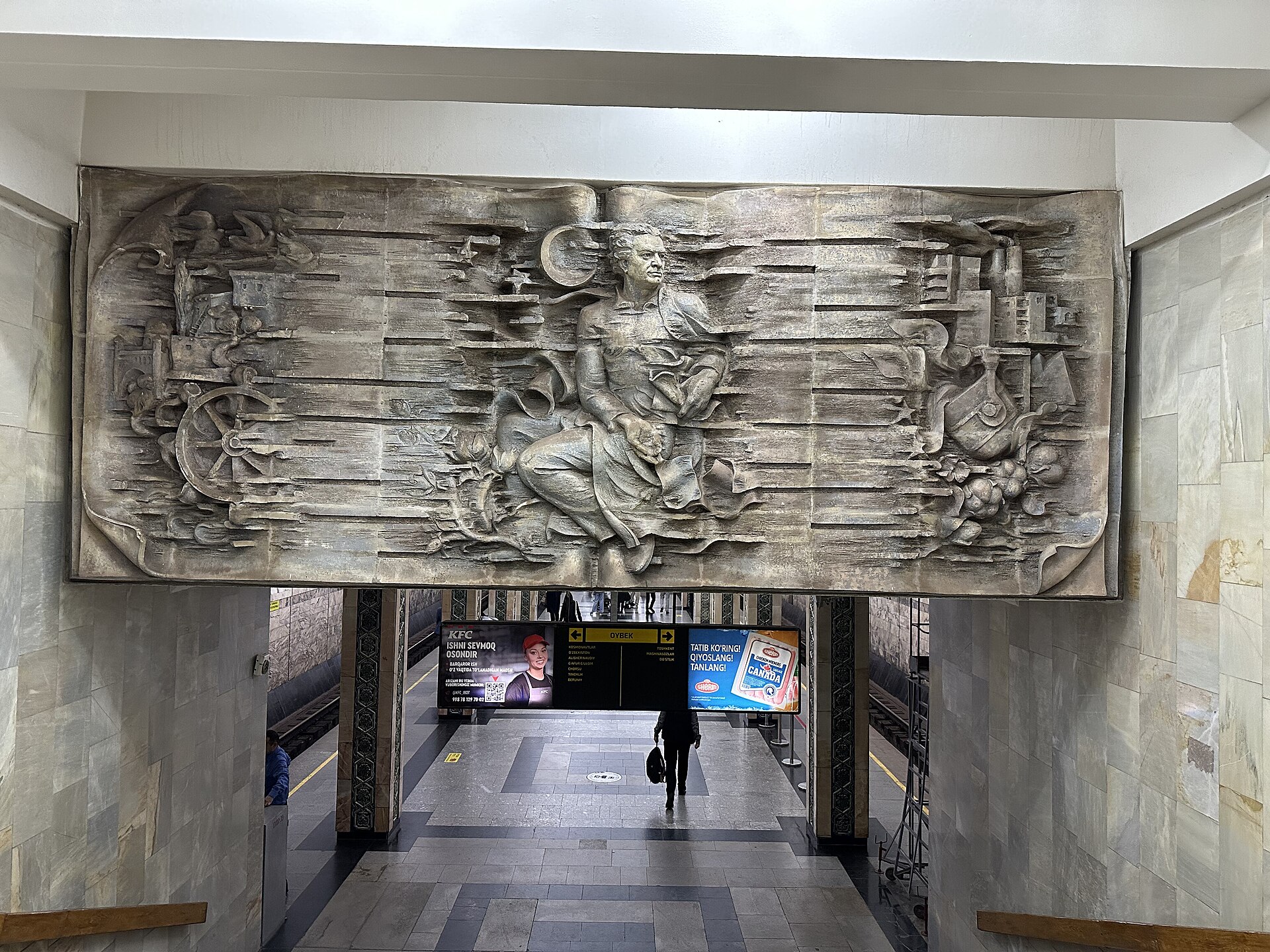
The Open Book
The station is named after Oybek, phrased by a magazine as the great son of the Uzbek people, writer and thinker. This name was everywhere in Tashkent: borne by a school, an institute, a street, the Museum of the History of the Peoples of Uzbekistan. A 1983 newspaper listed the names of metro stations - named after Maxim Gorky, Pushkin, Hamid Alimjan, Hamza, soon to be named after Navoi, Oybek, Gafur Gulyam - and asked: is this not a sign of our people's high respect for poetry, is this not a monument to great poets. The question of how to make a station about a writer was solved literally and, perhaps, successfully. Upon descending to the platform, artist A. Khabibulin designed a panel in the form of an open book, against the background of which the writer himself and characters from his works are depicted. Not a portrait in a medallion and not a quote on the wall, but a book you walk into. A second artist worked with the columns. M. Mamadjanov's ceramics are flat tiles with a relief ornament of violet color combined with golden shades. The combination is unusual: at that time in the Tashkent metro, white marble, red granite and blue glaze predominated, but here they took violet with gold. The magazine considered this ceramics worthy of a separate illustration - the May 1982 issue printed a fragment of the "Oybek" column ceramics. The station was designed by the Tashmetroproekt team led by S. Adylov: F. Muzaffarov, A. Tabibov, Ya. Mansurov, chief project architect R. Fayzullaev. The same names stand under neighboring stations of the line - "Uzbekistan" and the station-adjacent "Tashkent"; in essence, the entire first section of the second line was made by a single team, changing the leader and chief architect within it. Today the station is named "Oybek" - the same name, spelled in Uzbek.
AI translation · 🇬🇧 EN
Rate this review:
Nearby and related
By the same architect
Close by in Tashkent
About the Object
Architects S. Adylov (head), F. Muzaffarova, A. Tabibov, Ya. Mansurov, R. Fayzullaev (chief project architect); artists M. Mamadzhanov (ceramics), A. Khabibulin (panel)
1984
Modernism
Под проспектом Космонавтов на пересечении с улицей Лахути (АиСУз № 5, 1982)
Railway Station