
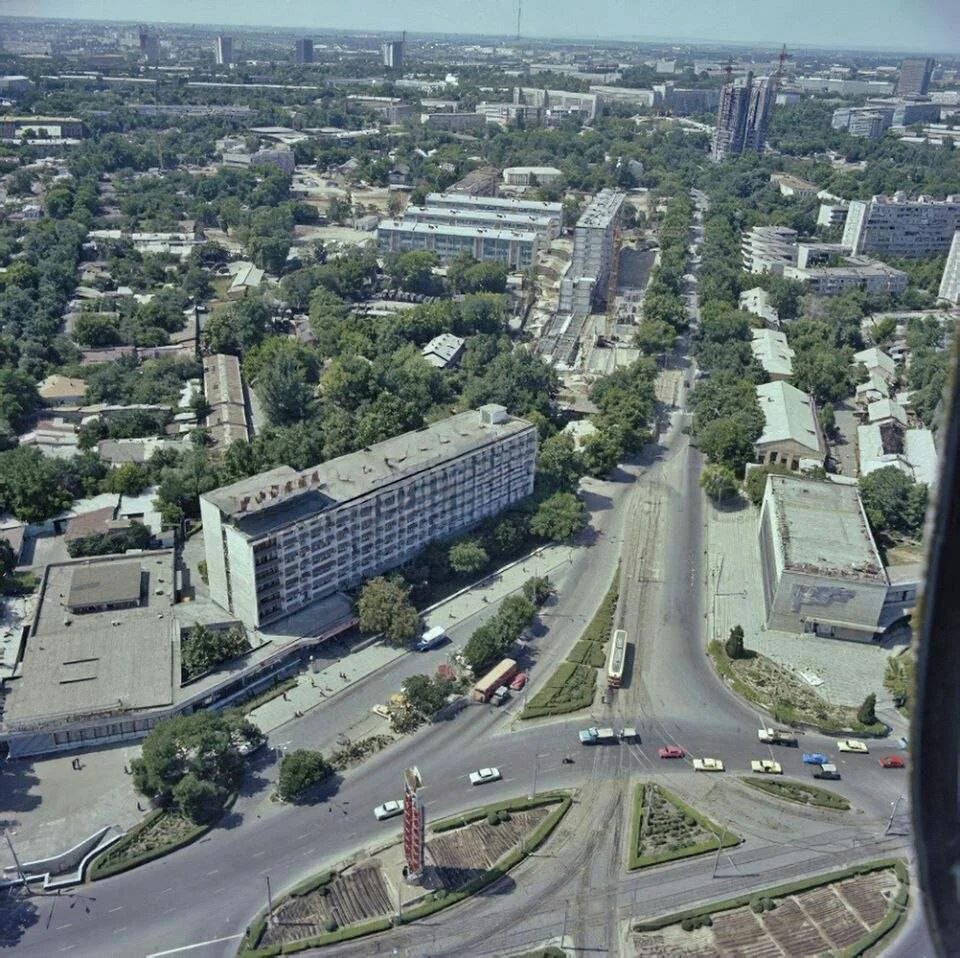
Sapernaya Square (Mirabad)
Частично утраченоAbout the Object
G. Aleksandrovich (residential tower and Aeroflot agency), engineer S. Berkovich; V. Muratov (lead), M. Perezhogin - Hotel Rossiya, engineers V. Parshin (chief), S. Berkovich; Muravyova - House of Fashion; mosaic by Alfred Mazitov, reliefs by Arnold Gan
1967
Modernism
Перекрёсток улиц Шота Руставели, Шахрисабз и Мирабад, Ташкент (Айбек, Мингурюк)
Square
Gallery (1)

A Square Built as a Window to the Future
Today it is an ordinary intersection with advertising and a stream of cars, and nothing on it screams. But in the sixties people came here to look at the future, and newspapers wrote about this place in a way no one writes about anything now. They began designing the square in 1962, encompassing three corners of the intersection of Sapernaya Street and Shota Rustaveli Street. Tashgiprogor developed a complex of three buildings: a nine-story residential building with the Civil Air Fleet Agency at the bottom, a seven-story hotel, and the House of Fashion. It is worth starting with the building because it was Tashkent's first nine-story tower. In December 1964, a correspondent wrote that this patch on Rustaveli is becoming a kind of laboratory: a few years ago the first two large-panel houses grew here, and now there are hundreds of them in Chilanzar - and right here they are starting the capital's first nine-story tower-type residential building developed by Tashkent architects. Next came a listing that breathes the era: the building will occupy only eighteen by eighteen meters with a height of thirty-two, it will have elevators, air conditioning units, air heating, gas, a garbage chute, sun protection devices, forty-eight apartments, each with a loggia, and the facade will be decorated from top to bottom with stained glass windows. The builder immediately complained that the lack of claydite-concrete panels from the plant was causing delays. In August 1966, the newspaper already promised: an end is coming not only to mudbrick, but also to single-story Tashkent, the capital is growing upward, the houses will rise to four, nine, and sixteen floors, and in the coming days the first high-rise building on Sapernaya Square will welcome new tenants. Downstairs, instead of the usual cafe, they placed the Aeroflot Agency - following the model of the city air terminals in Leningrad and Moscow. The idea was not just about ticket offices: it was assumed that a passenger would check in for a flight right here, drop off luggage, and go to the airport by express bus. The hotel was conceived as the center of the ensemble. The city's main hotel, Tashkent, was built in 1956 and by the mid-sixties was outdated morally rather than physically: what seemed acceptable at the turn from the Stalinist era to the Khrushchev era looked hopelessly old ten years later. The new one was built according to a Leningrad standard design, but substantially altered: load-bearing brick walls, suitable for central Russia, were replaced by a reinforced concrete frame - more reliable during an earthquake - and the share of factory-made parts was raised by a quarter compared to the standard version. The result was a building for three hundred and twenty seats with a restaurant, a cafe, a lounge with a billiard room, a hairdresser, a post office, a savings bank, a dry cleaner, a telegraph, and its own telephone exchange for three hundred numbers. Architect Vladimir Muratov protected himself from the sun without any pattern: by projecting loggias of varying widths, and marked the entrance with a four-story offset of improved layout rooms. On the roof remained a canopy that clearly hinted at a bar or a summer cafe in the Le Corbusier spirit. A rally in honor of the completion of construction gathered on September 2, 1966. The newspaper wrote: the seven-story beauty was named Russia, it grew on Sapernaya Square. The creators were greeted by the district committee secretary, and the authors themselves - specialists from the first workshop of Tashgiprogor Berkovich, Muratov, and Perezhogin - admired their creation. And then a phrase that dates the era better than any date: Russia is waiting for dear guests, the first will be Bulgarian pop artists who will soon arrive on tour. The third corner was occupied by the House of Fashion: a five-story sewing building with strip glazing and a two-story block with demonstration and exhibition halls, set at an angle to the first. The western wall was covered with vertical sun-protection ribs because it served as a background for the hotel, and the southern one was given over to a mosaic - it was supposed to become the monumental accent of the square. True, the sewing building itself had the same story as the shopping center in Chilanzar: the wide windows of the workshops faced southeast and were heated by the sun for most of the working day. The residential building was commissioned in August 1966, the hotel on September 2, and the House of Fashion was completed in 1967. To make the three different volumes read as a single whole, the areas in front of the hotel, air ticket offices, and the House of Fashion were paved identically, and an underground passage was built under Rustaveli Street. What is left. The Russia Hotel was rebuilt into the Grand Mir Hotel in 2003, completely changing its appearance and losing all monumental decor. The House of Fashion was covered with alucobond. The nine-story building stands, but the air ticket offices beneath it have become a shopping complex.
AI translation · 🇬🇧 EN
Rate this review:
Two walls and two disputes: the mosaic that was nearly smashed
On this square, there are two walls that people argued about - and they argued in different ways. The first is the southern end of the House of Fashion with a mosaic by Alfred Mazitov. Today it is shown as a landmark, but that has not always been the case. Right after its creation, the mosaic was harshly criticized at a conference of the Union of Artists of Uzbekistan on monumental art, and the complaint was not against the artist. A journalist who was present put it this way: the architect builds a building, ties it to the terrain, and then asks a monumentalist to draw something on the gray end wall; the artist tries hard, but can add very little because the drawing on the end wall does not compose with the ensemble. And the conclusion: in this case, it would have been more appropriate to leave the wall clean and gray, as it would have harmonized with the wide open square. Forty years passed, the fashion for Soviet mosaics returned, and when the House of Fashion began to be clad with alucobond, citizens intervened for this very wall. The mosaic was defended, the authorities intervened, and today it is open again. The wall that experts in the sixties suggested leaving alone turned out to be the only thing that survived from the building. The second wall is in the hotel lobby, and its fate is different. The same artist who made the concrete relief -Girl with Pomegranates- at the entrance to the restaurant - a restrained, graphic piece in the manner of the sixties, where the pomegranate, according to old Uzbekistani tradition, signifies fertility and love - gave himself full freedom in the lobby. Using the sgraffito technique, he laid out on the wall, which greeted foreign tourists, places of worship, camel caravans in the dunes, sultry beauties, and decorative utensils. In other words, he put his best foot forward. Critics did not forgive this for him. Architectural historian Tulkina Kadyrova wrote about the panel as suffering from poster-like quality, an abundance of details, and a superficial solution to the theme. Art critic Abdulkhay Umarov noted that the composition was initially supposed to be called -Uzbekistan-, but the artist started from the exoticism of the East, and in general this sgraffito has more of the spice of the East in general, the East of -One Thousand and One Nights-, than of Uzbekistan. The remark is accurate: the Intourist hotel got right at the entrance the exact picture that the tourist expected to see. This wall no longer exists - it vanished along with the appearance of the hotel during the remodeling of 2003. So out of the two disputed walls of the square, the one that was scolded more severely survived.
AI translation · 🇬🇧 EN
Rate this review:
Nearby and related
By the same architect
Close by in Tashkent
About the Object
G. Aleksandrovich (residential tower and Aeroflot agency), engineer S. Berkovich; V. Muratov (lead), M. Perezhogin - Hotel Rossiya, engineers V. Parshin (chief), S. Berkovich; Muravyova - House of Fashion; mosaic by Alfred Mazitov, reliefs by Arnold Gan
1967
Modernism
Перекрёсток улиц Шота Руставели, Шахрисабз и Мирабад, Ташкент (Айбек, Мингурюк)
Square