
Ulugbek Museum
About the Object
A. Babakhanov
1964
National Style
Холм Кухак, у обсерватории Улугбека, Самарканд
Museum
Gallery (2)

Tower by the Excavation Site
In the summer of 1961, a small building was already standing near the ruins of the observatory on Kukhak Hill, and people wrote about it: construction is wrapping up. Two years later, they wrote the same thing, "is coming to completion," and decided to open a museum for the fortieth anniversary of the republic, as a branch of the republican Museum of History, Culture, and Art. By November 1964, it was operating. Tashkent architect A. Babakhanov placed an octagon, a tower-type structure, next to the observatory. It was built in the forms of the 15th century, the century of Ulugh Beg, and among the new Samarkand buildings of those years, it turned out to be almost the only one that sought support in local tradition. The rest, architectural historians wrote, are modern, but they lack a southern character. The exhibition led from astrolabes to outer space: from the works of Ulugh Beg and his successors, Uzbek astronomers, to the final display case about the flight of Voskhod. A path of five centuries, people wrote back then.
AI translation · 🇬🇧 EN
Rate this review:
Akhmarov's Frieze
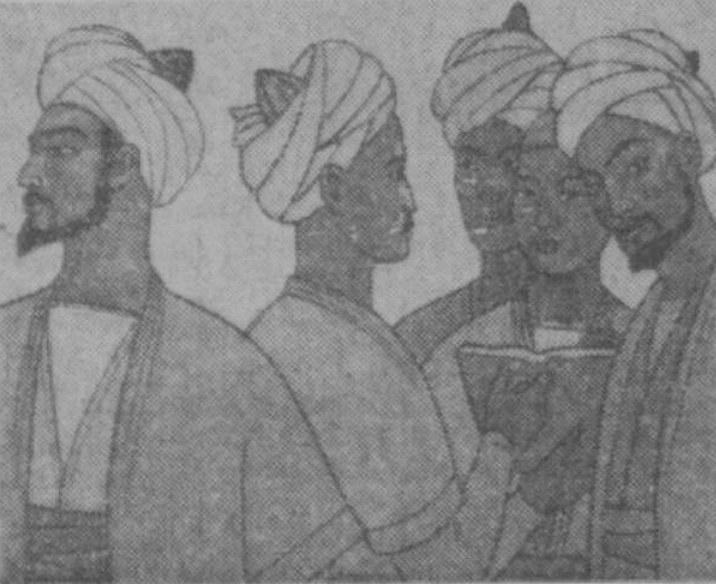
Inside the octagon, the walls were painted by Chingiz Akhmarov. The panels run along the hall one after another and read as a single frieze: “Ulugh Beg Receiving Scholars”, “Ulugh Beg Showing the Observatory Model to the Scholars of Samarkand”, “Alisher Navoi in the Ulugh Bek Madrasah”, “Poets' Competition”, “Ulugh Beg's Conflict with the Reactionaries”. Everything is painted in a gray-blue and brown palette. The last panel had the strongest impact. The head of the Naqshbandi order, Khoja Ahrar, rises against the scholar, and Akhmarov placed him with his back to the viewer. His face is not visible, but the mood is clear from the faces of the dervishes around and the stern faces of the warriors ready to “commit a vile deed”. Akhmarov was assisted by painters Mikhail Smirnov from Tashkent and Noumaz Sultanov from Samarkand. The painting of the Ulugh Beg Museum was considered a turning point in his work: in it, he found a new approach to monumental compositions. Three years later, it was called the place where his creative credo was expressed most vividly.
AI translation · 🇬🇧 EN
📷 Ч. Ахмаров, фрагмент панно «Соревнование поэтов» в музее Улугбека. «Правда Востока», 13 декабря 1964, № 288, с. 4
Rate this review:
About the Object
A. Babakhanov
1964
National Style
Холм Кухак, у обсерватории Улугбека, Самарканд
Museum