
Piazzale Michelangelo
About the Object
Giuseppe Poggi
c. 1869
Eclecticism
Piazzale Michelangelo, Firenze
Square
Gallery (2)

A viewpoint built not to look, but to be shown
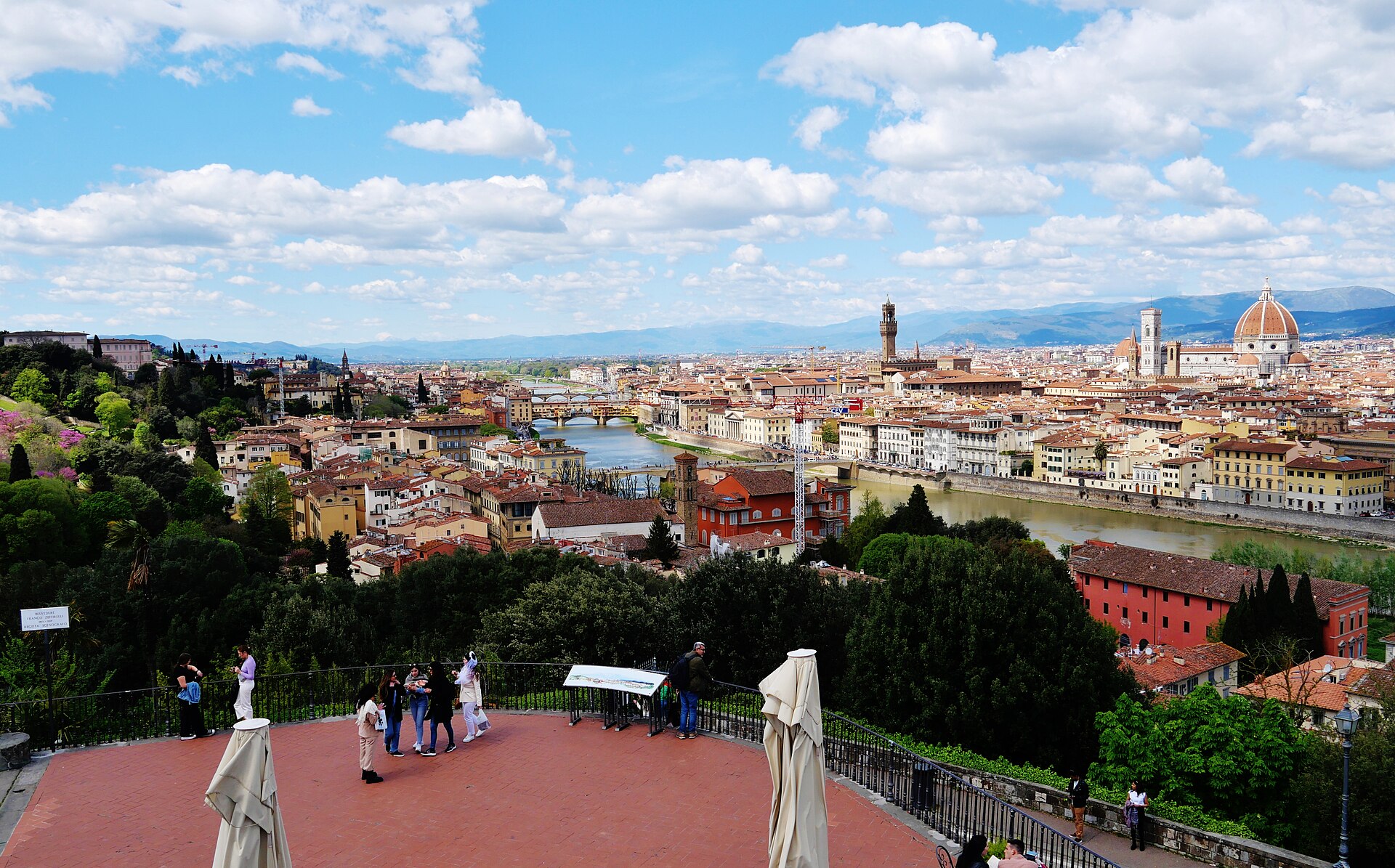
Piazzale Michelangelo is Florence's most famous viewpoint, and almost everyone comes here for the view. But it is worth starting with a different question: why does it even exist? It was laid out in the 1860s by Giuseppe Poggi, in those very years when Florence was the capital of a united Italy and was rebuilding itself for its new role. While the old market in the center was being demolished for the Piazza della Repubblica, the opposite was being done on this slope - building from scratch. Poggi laid out boulevards along the hills and created a terrace with a balustrade at the bend, offering a view of the entire city. That is, this square is not an ancient place where Florentines admired the city for centuries. It is a nineteenth-century structure, designed specifically so that the city could be seen as a whole and from an advantageous angle. The young capital needed not only a new center, but also a point from which it looked its best. The square is named after Michelangelo and set with copies of his statues, including a bronze David in the middle. Copies, not originals: the authentic David stands in the Accademia Gallery, where it was moved in 1873, rescuing it from the weather.
AI translation · 🇬🇧 EN
📷 Wikimedia Commons · Michael Wittwer · CC BY-SA 4.0 · https://commons.wikimedia.org/wiki/File:Blick_auf_und_vom_Piazzale_Michelangelo_(LM28908).jpg
Rate this review:
What you can see from here and where to go next
The view from here is the exact one you saw on postcards before arriving: Brunelleschi's dome, Giotto's bell tower, the tower of Palazzo Vecchio, the Ponte Vecchio on the river, and beyond all this, the Tuscan hills. No other spot in the city, including the dome and the bell tower themselves, gives such a panorama, because from them you cannot see the main thing - the dome itself. The best time is sunset: the sun sets behind the Arno, and the whole city turns a single color for a few minutes. Along with the sun, crowds and souvenir sellers come here, so this place cannot be called a romantic retreat. But the viewing platform has one advantage that people usually do not write about: it is convenient to leave from it. A few minutes uphill stands San Miniato al Monte, an eleventh-century Romanesque church, and it is worth the climb. A short but steep trail leads back down, and along the way lies a rose garden - three hundred and fifty varieties of roses and several sculptures among them. In spring, the platform itself has an iris garden in bloom; the iris is the flower of Florence, the very one that gave its name to the cathedral of Santa Maria del Fiore, "Saint Mary of the Flower". So plan not for half an hour for a photo, but for half a day for the whole slope. This is perhaps the only part of the city where you can walk around without visiting museums.
AI translation · 🇬🇧 EN
Rate this review:
Nearby and related
Close by in Florence
About the Object
Giuseppe Poggi
c. 1869
Eclecticism
Piazzale Michelangelo, Firenze
Square