
Uffizi Gallery (Galleria degli Uffizi)
Всемирное наследие ЮНЕСКОAbout the Object
Giorgio Vasari, Bernardo Buontalenti
1580
Renaissance
Piazzale degli Uffizi 6, Firenze
Museum
Gallery (2)

A Building Built for Offices, and the Glass Wall Made Possible by Iron
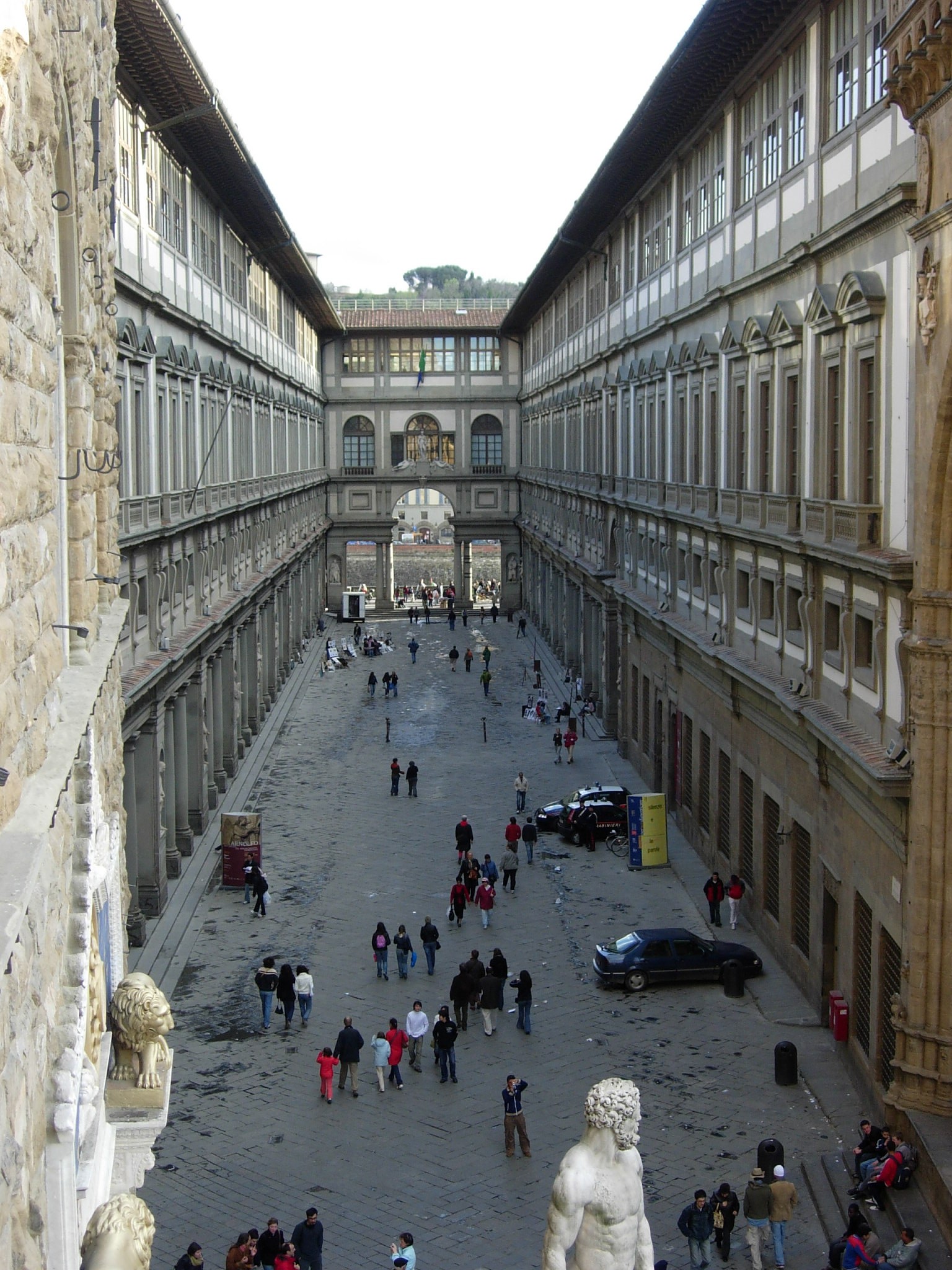
The name is worth translating because it explains everything: Uffizi means "offices," bureaus. The building was constructed between 1560 and 1580 not as a museum or a palace, but as administrative offices for Cosimo I de' Medici, by then the Grand Duke of Tuscany. The administration of the duchy sat here. The architect was Giorgio Vasari, and he did something far more interesting than it appears at first glance. Iron was introduced into the masonry as reinforcement. By itself, this is a technical minor detail, but it was precisely this that allowed his successor, Bernardo Buontalenti, to create an almost continuous glass wall on the upper tier. A sixteenth-century stone building with continuous glazing at the top is not a decorative whim; it is the consequence of a structural solution. Three hundred and fifty years later, everything would be built following this exact logic. The shape of the building is also read directly: two long, narrow galleries placed parallel to one another and closed off by a transverse block near the Arno. What resulted was neither a square nor a courtyard, but a long open-air corridor leading from the Palazzo Vecchio to the river. Walking through it is the main impression of the Uffizi from the outside, before any painting at all. And one more thing to keep in mind while standing in this corridor. The building of the republic-the Palazzo Vecchio-was built as a fortress with a bell to summon the citizens. The building of the duchy was built as an office with good lighting. The difference between the two eras is visible within a hundred-meter stretch.
AI translation · 🇬🇧 EN
Rate this review:
How an office became the world's first museum
The continuous glazing of the upper tier, engineered by Buontalenti, created a space flooded with even light. In 1581, the Medici began hanging their family painting collection there. This is the birthdate of the museum as a genre. The Uffizi is considered the oldest gallery in the world: not a palace with paintings on room walls, but a space specifically designated for the display of art. The difference is fundamental, and it stemmed from a practical reason: it was bright upstairs because the architect managed to replace a wall with glass. Today, the paintings are hung chronologically-from Gothic through the Renaissance and beyond, to clearly show the evolution of art. This was not always done: in the nearby Pitti Palace, which holds just as many paintings, the hanging style remains 19th-century, based on taste and room decor. Visiting both museums in one day, you will see two different ideas on why paintings are exhibited in the first place. Among the halls, the Gothic rooms deserve first mention-housing Giotto’s 1310 'Ognissanti Madonna', where angels and saints are painted with distinct facial expressions for the first time, ranging from reverence to bewilderment. Then there are the Botticelli rooms, featuring 'Primavera': its brightness is the result of Renaissance artists experimenting with new pigments for novel effects. Allocate plenty of time and book your ticket in advance. But if you are short on time, remember: the gallery itself, its corridor, and its windows are also an exhibit, and they are older than everything hanging inside.
AI translation · 🇬🇧 EN
📷 Wikimedia Commons · Francesco Bini · CC BY-SA 4.0 · https://commons.wikimedia.org/wiki/File:Uffizi%2C_corridoio_est%2C_veduta_02.jpg
Rate this review:
Nearby and related
By the same architect
Close by in Florence
About the Object
Giorgio Vasari, Bernardo Buontalenti
1580
Renaissance
Piazzale degli Uffizi 6, Firenze
Museum