
Piazza della Signoria
Всемирное наследие ЮНЕСКОAbout the Object
Unknown
c. 1299
Gothic
Piazza della Signoria, Firenze
Square
Gallery (1)

A Square Designed as a Counterweight to the Cathedral
Florence is organized around two centers, and this is visible on the map. One is the cathedral with the Baptistery, the sacred center. The second is this very square, the civic center. It took shape in the late thirteenth century precisely as a counterweight to the first: a city that had a strong church built itself a square to have a place where it could make its own decisions. What happened here for centuries: receptions of foreign ambassadors, tournaments, public executions, and the parlamento, a general assembly of the townspeople. It was summoned by a large bell from the palace tower, and in case of danger, people had to gather right here. That is, the square functioned as a state mechanism rather than as decoration. One side is occupied by the triple-arched Loggia dei Lanzi, built between 1376 and 1382, a canopy under which officials stood during ceremonies. Today it is called the Loggia dei Lanzi, after the unit of Landsknechts stationed here in the sixteenth century under Duke Cosimo I. And it is also called the Loggia di Orcagna, after the architect who did not build it: it was erected by Benci di Cione and Simone Talenti. And one detail for which it is worth looking under your feet. Ten steps from the Neptune Fountain, a slab is embedded in the pavement. It marks the spot where on May 23, 1498, Girolamo Savonarola and his two companions, Fra Domenico and Fra Silvestro, were burned. The very same Savonarola who four years earlier was in power on this very square. The square that made politics also ended them right here.
AI translation · 🇬🇧 EN
Rate this review:
An open-air museum where every statue is a political statement
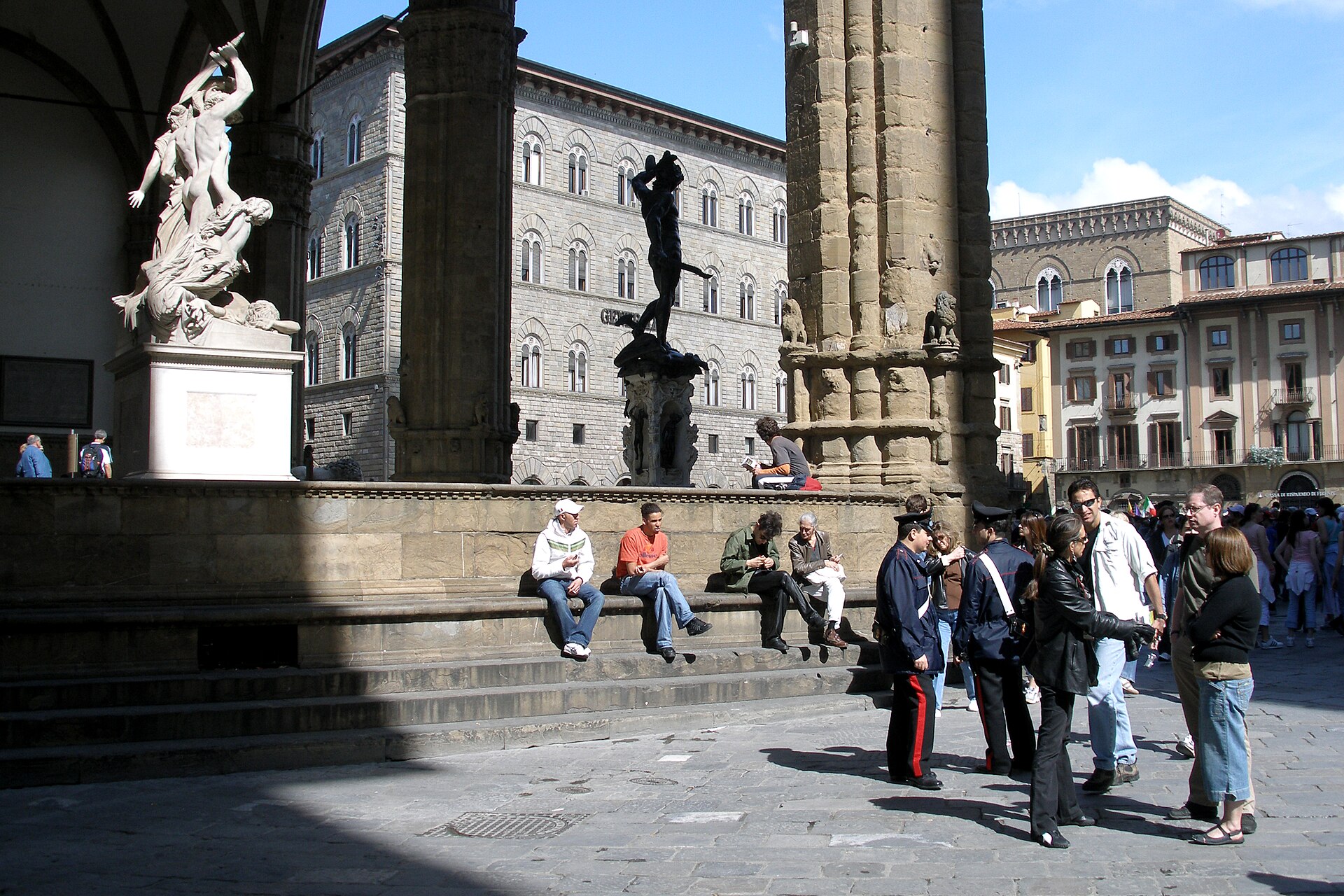
The sculpture on this square must be read, not just looked at. There is almost no "art for art's sake" here: every figure was erected as a statement about power. Donatello's "Judith and Holofernes". The biblical widow enters the enemy camp, pretends to be available, gets the enemy leader drunk, and when he falls asleep, takes his sword and cuts off his head. The group was apparently commissioned by Cosimo de' Medici: the earliest description, from the 1460s, places it in the garden of the newly completed Medici Palace. On the pedestal was a Latin inscription - "kingdoms fall by luxury, cities rise by virtues; behold the neck of pride cut by the hand of humility" - and Piero de' Medici added his own name to it. In 1495, after the expulsion of the Medici, the city confiscated the sculpture, and the inscription about humility conquering pride suddenly began to be read the other way around: pride was the Medici themselves. The Republic added its own spin: "citizens set this up as an example of the public good". The very same bronze managed to be both a monument to the Medici and a monument to their expulsion within thirty years. Benvenuto Cellini's "Perseus" (1554). The hero holds the severed head of Medusa. Commissioned by Duke Cosimo I, and the meaning is transparent: this is what happens to those who look at power the wrong way. Giambologna's "Rape of the Sabine Women" (1583). Three figures twisted in a spiral, and a subject of violence presented as the highest exercise in craftsmanship. Ammanati's Neptune Fountain (1575). Florentines, who never spared anyone's ego, nicknamed the central figure Biancone - "big white one" - for its lack of grace. Giambologna's Equestrian Monument of Cosimo I (1594). The Duke on a horse, in the center of the square where the parlamento used to be summoned. The point at which the republic finally ended. Important for the visitor: almost everything you see are copies. Michelangelo's "David" at the palace entrance is a copy, the original is in the Accademia Gallery. Marzocco, the heraldic lion with the Florentine lily, is a copy, the original is in the Bargello. Donatello's "Judith" is a copy, the original is inside the palace.
AI translation · 🇬🇧 EN
Rate this review:
Nearby and related
By the same architect
Close by in Florence
About the Object
Unknown
c. 1299
Gothic
Piazza della Signoria, Firenze
Square