
Museo dell'Opera del Duomo
Всемирное наследие ЮНЕСКОAbout the Object
Unknown
1891
Other
Piazza del Duomo 9, Firenze
Museum
Gallery (1)

The museum where everything real from the square was taken
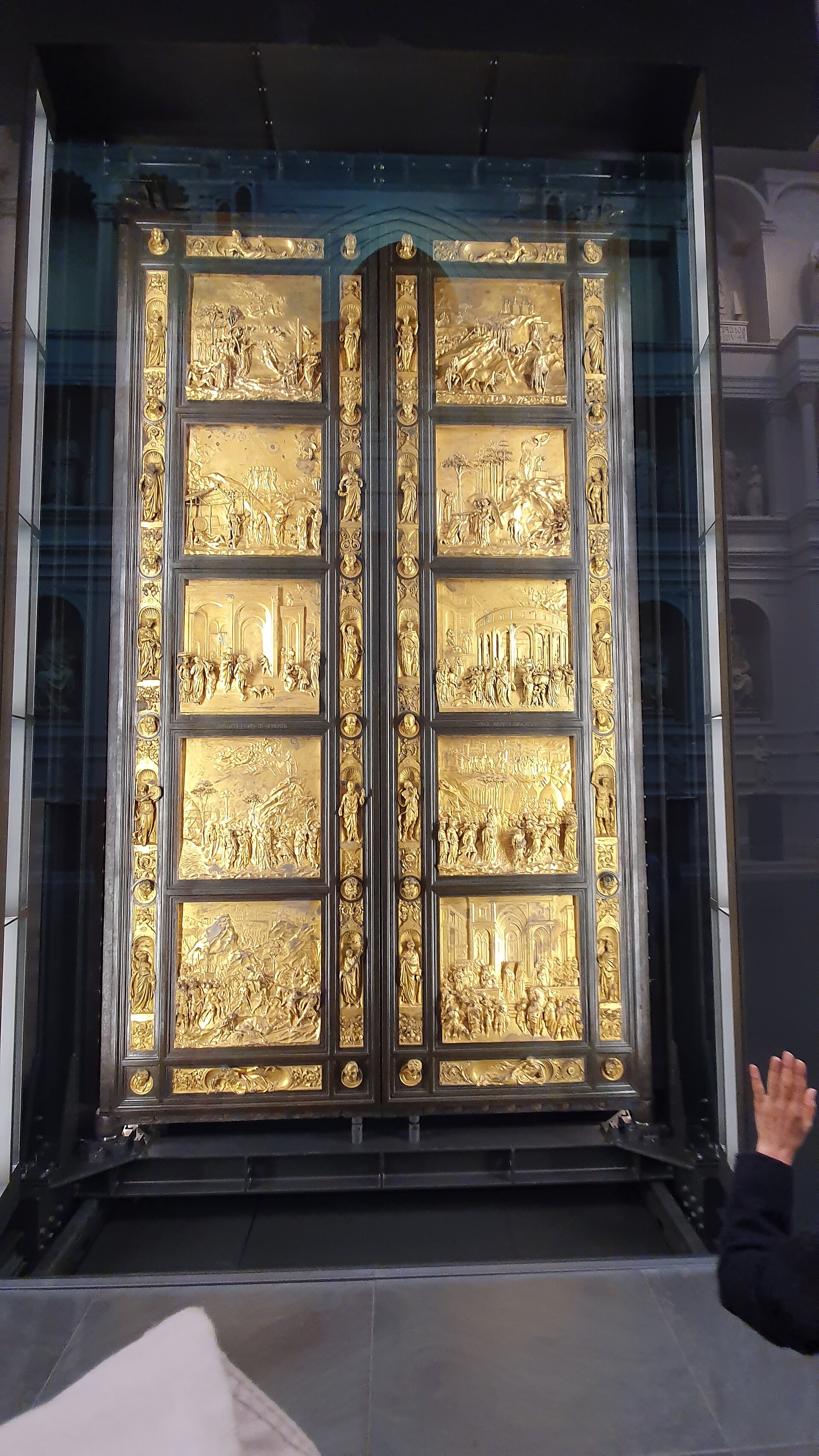
A simple rule for the Piazza del Duomo: almost everything admired on it are copies. The originals are here. Ghiberti's Gates of Paradise, the ten gilded panels he worked on from 1425 to 1452, stand in this museum; the Baptistery has had a copy since 1990. The lower-tier panels of the bell tower - "The Smithing Craft," "The Creation of Adam and Eve," the planets and the liberal arts by Andrea Pisano and his assistants - are also here. Sculptures by Arnolfo di Cambio, Donatello, and Nanni di Banco, removed from the old facade of the cathedral, are here. Fragments of the ancient baptismal font and the silver altar with the story of John the Baptist, a masterpiece of Florentine goldsmiths by Verrocchio and his pupils, are here. Two more things worth coming specifically for. Two cantorie - marble singing galleries: one by Luca della Robbia, 1438, the second by Donatello, 1439. They were made opposite each other, for the same cathedral, with a year's difference, and the difference between them is visible at once: in della Robbia's, the children sing neatly and clearly; in Donatello's, it's a bacchanal where faces can barely be distinguished. And Donatello's wooden "Penitent Magdalene," 1455, a mature work where nothing of beauty is left. On the middle of the staircase leading up stands Michelangelo's "Pietà" - the second of the three he made, around 1550. It is unfinished, and it is worth looking at while knowing two things. First: according to accounts, the sculptor himself attacked it in a rage. Second: he intended to place it over his own tomb.
AI translation · 🇬🇧 EN
Rate this review:
The tools that built the dome - and they look like torture instruments
Brunelleschi's machines occupy a separate room. This is Florence's most underrated exhibition. Here lie his tools and some of the mechanisms used to hoist and position the stone: an ox-driven hoist, a "lock" for moving loads horizontally, pulleys, clamps, and molds for shaped bricks. Judge Testa, author of a guide to Florentine art, describes the impression accurately: the machines preserved in this museum "look more like mysterious and gruesome instruments of torture than construction devices." It is not just about their appearance. How exactly they worked is often impossible to establish today: all his life, Brunelleschi was afraid his ideas would be stolen, left no blueprints, and made the carpenters who assembled the hoist swear an oath of silence. Even the commission that paid him for the construction did not understand how the machines worked - and simply trusted that he knew what he was doing. One side story. The young Leonardo da Vinci, working as an apprentice to Verrocchio - the very man who cast the bronze ball for the dome's lantern - sketched these machines. The drawings survived, and for several centuries Leonardo gained fame as their inventor. The machines were not his. Standing here, it is easy to understand the main thing about the dome: it was not "designed." It was invented together with the tools without which it could never have been put together. This is not an architectural project, but a manufacturing invention - and it rests in these display cases.
AI translation · 🇬🇧 EN
Rate this review:
Hall Guide: What to Look At and What to Walk Past
This museum is not set up like a gallery, but rather like a cathedral's storage room. Everything authentic that once stood outside on the square was brought in here over a hundred years ago, and copies were hung on the street. There is no sense of paintings on walls here. Here lies the cathedral itself, taken apart into pieces. The museum has an owner, and his name is in the title. The Opera del Duomo is neither an opera nor a museum. It is the cathedral's building authority, an institution founded to build the cathedral and which has outlived construction by six hundred years. Its officials were called operai, its chief architects capomaestri. It hired Brunelleschi and Ghiberti, argued with them about money, and commissioned statues from Donatello. Everything you will see inside was once ordered by this office. One episode tells you more about it than any description. In 1434, Brunelleschi demonstratively refused to pay dues to the stonemasons' and woodworkers' guild, and the guild put him in debtors' prison. This was the very prison where Brunelleschi himself, twenty-five years before, had tucked away the woodcarver Grasso for a famous prank. The Opera pulled him out of confinement because without him the construction would have ground to a halt. Irina Danilova adds an important detail to this: after 1434, when Cosimo de' Medici began cracking down on opponents, the Opera remained one of the few Florentine institutions that kept its independence. Practicalities. Twenty-eight halls, three floors, six thousand square meters, over seven hundred works. Allow an hour and a half to two hours. The museum is open from 8:30 to 19:00 and is closed on the first Tuesday of the month, which is the only day when coming here would be a waste of a trip. The museum itself reports that elevators go to all levels, there are benches in the halls, and toilets are located on several floors. You can get around with a stroller; the museum was remodeled by 2015 when the neighboring building of the old theater was annexed to it. The cheapest ticket that includes it is the Ghiberti Pass, which also grants access to the Baptistery and Santa Reparata. First Floor The entrance, courtyard, and corridor of names are passed through quickly, but not straight through. Portraits and names of the Opera's personnel over six centuries hang in the corridor. This is the only place in the museum that talks not about things, but about the office that commissioned all these things. After the prison story, looking at them is more interesting. Next is the introductory hall and sculpture gallery with fragments of the medieval decoration of the cathedral and baptistery. You can walk through here without stopping; this is just a warmup. Hall of Paradise. Start counting your time from here and do not hurry to leave. This is a double-height hall where the medieval facade of the cathedral is assembled at full scale. It was begun by Arnolfo di Cambio in 1296, they did not manage to finish it, and in 1587 Grand Duke Francesco I ordered it to be dismantled. The reconstruction was put together based on drawings from that era, and the authentic statues stand in it in their former places. Opposite the facade hang all three bronze doors of the baptistery. The South Doors by Andrea Pisano, and the North Doors and Gates of Paradise by Lorenzo Ghiberti. Copies have been on the actual baptistery outside since 1990. The middle of the hall is a special spot. This is the only place on earth where the doors can be seen as they were intended, meaning opposite the facade to which they faced. Just for this alone, building the museum was worth it. The hall of facade fragments follows. Here are the inlaid marble pieces of that very 1587 facade that was dismantled. The hall is quiet and usually empty, and this is the best half of the museum. Donatello's Magdalene stands in a separate small room. Wooden, late, around 1455. She is not pretty, and that was done on purpose. Donatello carved not a saint from an icon, but an exhausted human being, and after the hall of marble beauties, this knocks you off balance. The octagonal chapel of relics gathers precious reliquaries from the fourteenth to the eighteenth century. If jewels do not hold your attention, move on; what is further ahead is more important. Michelangelo's Pietà stands on its own tribune. He made it between 1547 and 1555 for his own tomb and left it unfinished. According to accounts, in a rage he attacked it himself and broke off a piece, but we have only one source for this, so I mention it cautiously. But the old man in a hood who is holding the body from behind is generally considered to be a self-portrait of Michelangelo in his old age. The first floor ends with a lapidary containing stone fragments, among which are parts of the old baptistery font. Second Floor On the new staircase hangs the preparatory cartoon for the mosaics above the cathedral doors. It is easy to miss while looking underfoot. Campanile Gallery, a long corridor. Here is everything that used to stand outside on Giotto's bell tower. Hexagonal reliefs with human trades below, diamond-shaped majolica inserts with heavenly powers above, and prophets and sibyls along the walls. Look for Donatello here. His prophet, whom Florence nicknamed Zuccone, meaning pumpkin-head, is actually Habakkuk. Nearby is his Jeremiah. These are faces, not types, and in the crowd of medieval statues they stand out immediately. Dome Gallery. This is what the architect comes here for. Wooden models of the dome and lantern, authentic tools and materials with which the dome was laid, and Brunelleschi's death mask. The tools look like torture instruments, and that is no exaggeration. Brunelleschi kept the design of his machines secret, carpenters gave their word to remain silent, and members of the board of overseers simply trusted that he knew what he was doing. It is worth knowing what he occupied that trust with. In 1418, he won the competition for centering, scaffolding, and hoists, made a model, and arranged a public strength test for it. A year later, the Opera summoned masters and engineers from all over the Christian world to decide how to erect such a vault at all. There Brunelleschi said that construction had to be done without scaffolding, could not prove it, and was laughed to scorn. He did not convince them, but he forced them to write down his method in the Opera's account book so he could not back out later. The models in this hall are the remnants of that dispute. They told him to work together with Ghiberti, and this was not help, but supervision. When it came down to business, Brunelleschi demanded that duties be divided and gave his rival a choice: either the new scaffolding or the first course of the dome. Ghiberti took the course as simpler work and did it in such a way that the expenses went to waste, along with thirty-six florins of his annual salary. Look at the dome through the window on the floor above and remember one more thing. In 1429, cracks appeared in the side walls of the cathedral, and experts decided that the dome was to blame. Brunelleschi believed that the cathedral body itself was at fault and proposed building side chapels as buttresses. The Wool Guild board did not want to pay, and instead of chapels, temporary iron tie rods were installed. "The newly installed braces in the nave of the church are very ugly," he wrote in 1434. The chapels were never built, and the tie rods are still there. The Belvedere of Paradise is a window from which you can see the Hall of Paradise and the facade assembled in it from above. The view from there is unexpected. The nave hall brings together fourteenth-century painting and sculpture removed from the cathedral. Gallery of the Cantoria. Two singing tribunes, by Luca della Robbia from 1438 and Donatello from 1439, stand opposite each other. Both hung above the doors of the two sacristies and were made at the same time, knowing the rival's work. One task and two opposite answers. In della Robbia's work, children sing from notes, neatly and in rows. In Donatello's, they dance and almost fall out of the frame. Right here is his relief with the Creation of Eve. And a small detail that connects this hall with the previous one. Brunelleschi himself hung these tribunes in the cathedral. Work in the cathedral did not boil down to the dome for him: he built the tomb of Saint Zenobius and the crypt under his altar, helped install a new organ, and secured both singing tribunes. The man from the dome gallery hung what you are standing under right now. The octagonal hall is occupied by choir reliefs by Baccio Bandinelli and Giovanni dell'Opera. The hall is transitional, and that is fine. Hall of the Baptistery Treasury. The main thing here is the silver front wall of the altar with the story of Saint John the Baptist, which was made for over a hundred years, from 1367 to 1483. Nearby is a silver cross with enamels by Antonio Pollaiuolo from 1457 and twenty-seven embroidered vestments, the so-called Parato di San Giovanni, embroidered between 1466 and 1488. Next, five halls in a row are devoted to the nineteenth-century competitions for the cathedral facade. Drawings, projects, sculpture sketches. The cathedral stood without a facade for almost three centuries, and these are rooms about how long Florence could not decide what it should look like. If time is running out, this is precisely where you need to speed up. Third Floor Large gallery of wooden models. Here are the facade models of the late sixteenth and seventeenth centuries by Buontalenti, Giambologna, and Giovanni Antonio Dosio. The same dispute as the floor below, only two hundred years earlier and in wood. The comparison room is cleverly arranged. From one window you can see the dome gallery below with the models, and from the other the dome itself outside. The model and the building constructed from it are in the two windows of the same room. A gallery with large sixteenth-century canvases and the vestments room follow. In the vestments room hangs Giotto's Madonna from San Giorgio alla Costa, and you certainly should not walk past it. The last room has a window into the Hall of Paradise again, now from the other side of the facade. Higher up is an open viewing platform with a view of the dome and the roofs of Florence. If you have only an hour Hall of Paradise, dome gallery, cantorie, viewing platform. Exactly in that order. Leave the rest for a second visit; the ticket is valid for seventy-two hours. If you are with a stroller Elevators go to all floors, and going through in order requires no steps. The bottlenecks are the relics chapel and the Magdalene room, both small. The Hall of Paradise and the dome gallery are spacious, and that is precisely where you will spend the most time.
AI translation · 🇬🇧 EN
Rate this review:
Nearby and related
By the same architect
Close by in Florence
About the Object
Unknown
1891
Other
Piazza del Duomo 9, Firenze
Museum