
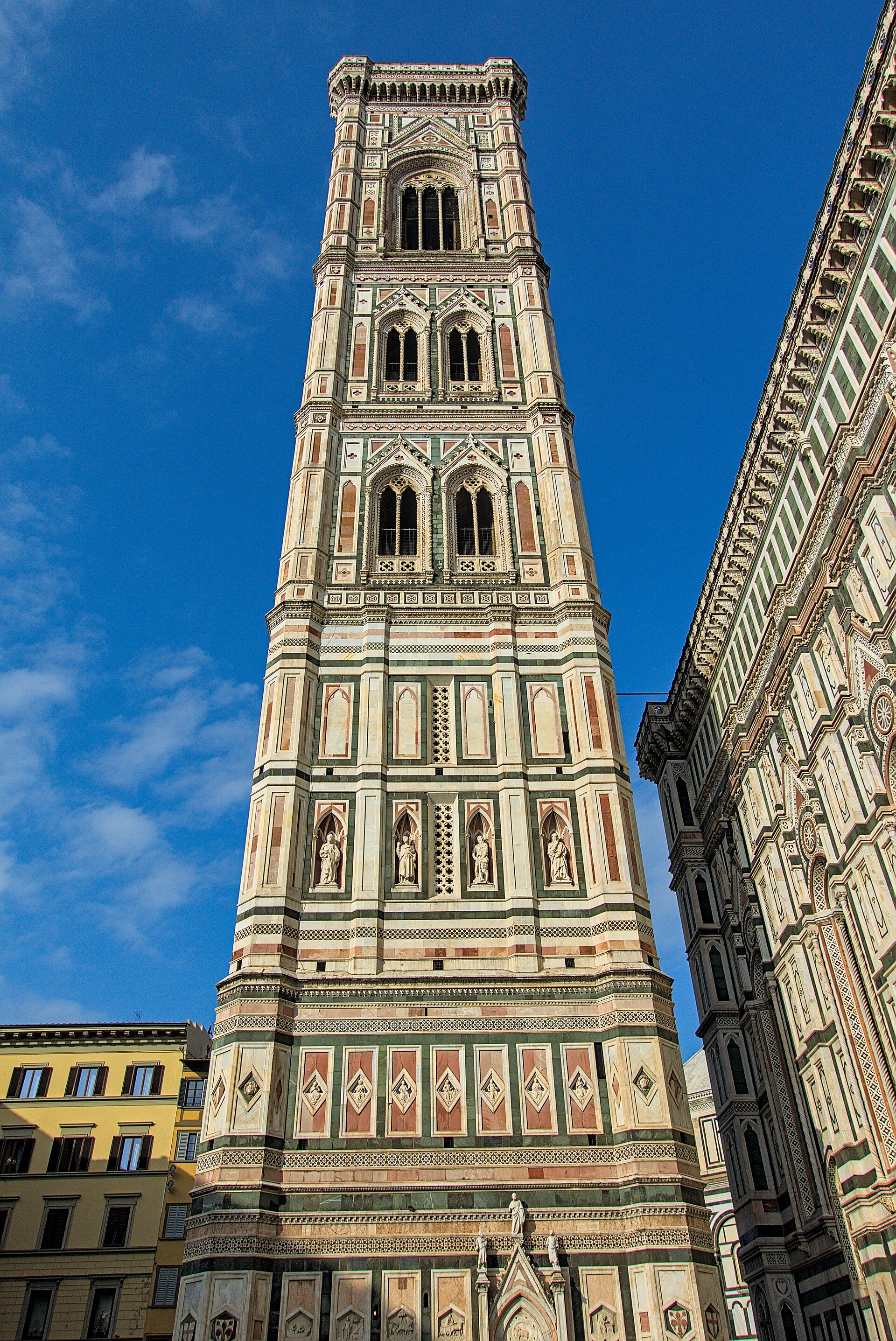
Giotto's Campanile (Campanile di Giotto)
Всемирное наследие ЮНЕСКОAbout the Object
Giotto di Bondone, Andrea Pisano, Francesco Talenti
1359
Gothic
Piazza del Duomo, Firenze
Tower
Gallery (1)
The bell tower everyone calls by the name of the man who built a single floor of it
In 1334 Giotto, by that time already a celebrated painter, held the post of city architect of Florence and received a commission for the cathedral bell tower. He died three years later. The bell tower was completed in 1359, twenty-two years after his death. What he managed to accomplish: the lower tier. After that, construction was led by Andrea Pisano - the very one whose bronze doors are on the Baptistery -, and Francesco Talenti brought the matter to the top. But the name attached to the tower remained Giotto's, and that is fairer than it seems: the design that holds the entire tower together - the vertical articulation, the colored marble panels in green, pink, and white - was set at the bottom, and the rest followed the given pattern. The Florentines called it the Lily of Florence. Eighty-five meters, four hundred and fourteen steps. And let us immediately clear up a mistake that circulates in guidebooks: this is not the second highest point in the city. The tower of the Palazzo Vecchio is ten meters higher - ninety-five -, so the cathedral bell tower is the third highest in the city. Now for something to realize while standing between the bell tower and the cathedral. The bell tower was ready in 1359. The dome was declared finished in 1436. That means for almost eighty years, a finished, revetted, ornate tower stood here - next to a cathedral that had a hole instead of a dome. Florence built itself a bell tower before it managed to roof its own temple. One more detail that can only be seen in the museum: the relief panels of the lower tier - The Blacksmith's Craft, The Creation of Adam and Eve, the planets, the liberal arts - are copies on the tower today. The originals by Andrea Pisano and his assistants are in the Museo dell'Opera del Duomo, two hundred meters away.
AI translation · 🇬🇧 EN
Rate this review:
Why climb up here when the dome is right next door
There are two viewpoints high above the city: Brunelleschi's dome and this bell tower. The tickets are different, your energy is limited, so I will tell you straight what the difference is. From the dome you see the city - but you do not see the dome. From the bell tower you see exactly what people come here for: the red bowl of the dome in its entirety, with its eight white ribs, drum and lantern, and the city beneath it. From here it is clear why they say the dome "covered Florence": it is larger than everything around it, including this tower you are standing on. Four hundred and fourteen steps, no elevator, the staircase is narrow and two-way. But the climb has stops: on each tier there is a platform with windows, and the city is revealed in portions - first the roofs, then the hills, then the Arno. The third view is from Piazzale Michelangelo, on the other bank: from there the cathedral, the bell tower and the dome finally come together into a single silhouette. Just keep in mind that this view is not medieval: the square was laid out in the 1860s, when Florence briefly became the capital of Italy, and it was specially designed so that the city would look beautiful from the hill.
AI translation · 🇬🇧 EN
Rate this review:
Nearby and related
By the same architect
Close by in Florence
About the Object
Giotto di Bondone, Andrea Pisano, Francesco Talenti
1359
Gothic
Piazza del Duomo, Firenze
Tower