
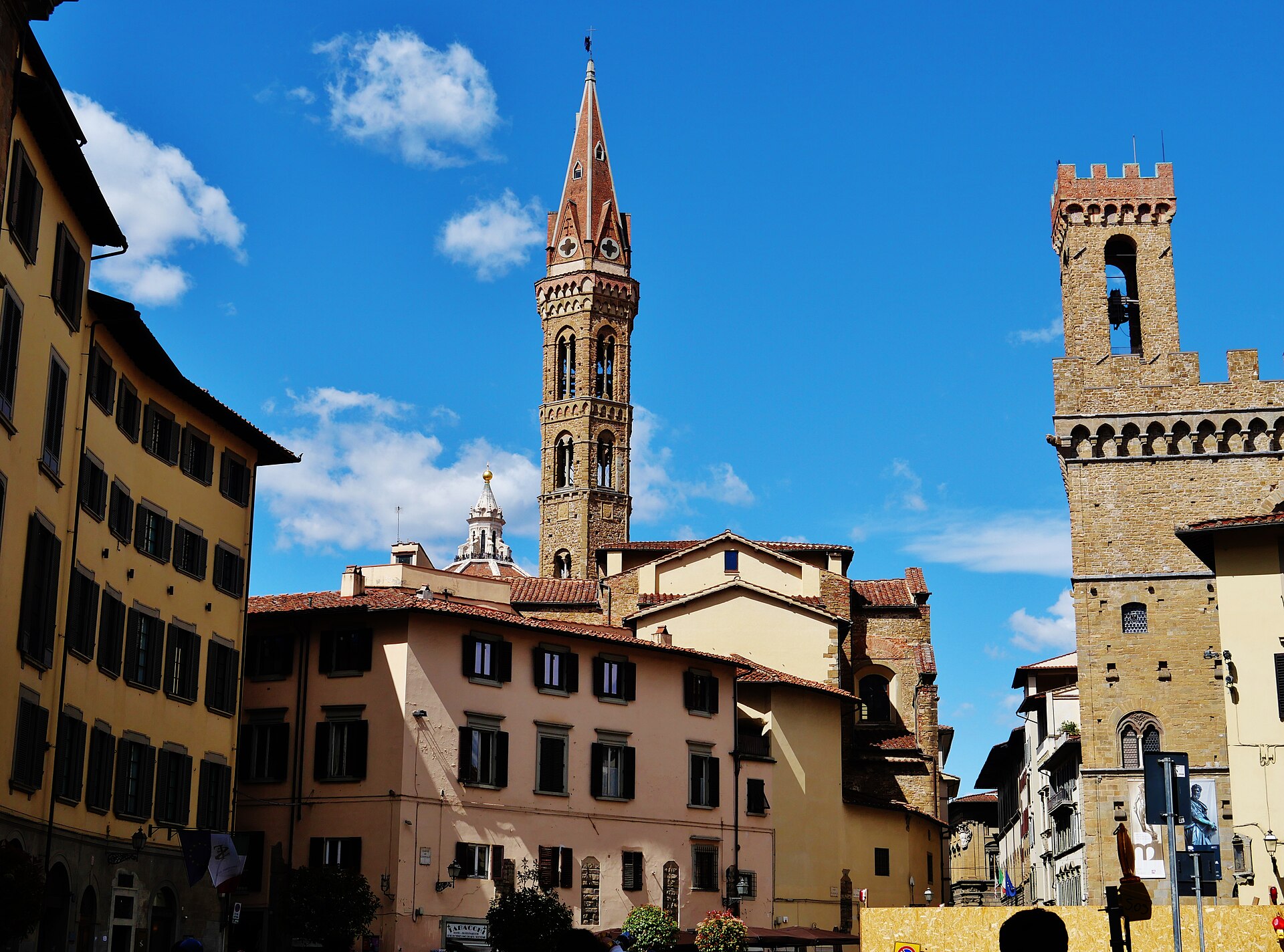
Badia Fiorentina
Всемирное наследие ЮНЕСКОAbout the Object
Unknown
c. 978
Gothic
Via del Proconsolo, Firenze
Religious Structure
Gallery (1)

The Abbey Founded by a Widow, and the Son Buried Twenty-Three Years Later
One of the oldest churches in Florence - and almost no one passing by lifts their eyes to it, because the Bargello is right across, and the Duomo is just around the corner. The abbey was founded in 978 by Willa, widow of Count Hugo of Tuscany. Her son, Count Hugo, was buried inside in 1001 - meaning that already in its third decade of life, the building served as a family mausoleum. His tomb, which stands there today, was made later, much later: by Mino da Fiesole, between 1469 and 1481. Half a millennium later, it was still important to the family what this grave looked like. To be honest, the interior is a bit heavy and gloomy. It is brought to life by a single painting: Filippino Lippi's "The Vision of Saint Bernard", 1485. The main thing here is not inside the church, but right next to it. Look for the door to the right of the altar: behind it lies the Chiostro degli Aranci, the "Cloister of the Orange Trees". The oranges that the monks used to grow here are long gone, but the early frescoes and the view of the hexagonal bell tower remain. The courtyard is open only on Monday afternoons and is not easy to find - I'm warning you in advance so you don't decide it doesn't exist.
AI translation · 🇬🇧 EN
Rate this review:
The bell tower by which Dante checked the time
Look at the bell tower - hexagonal, fourteenth-century. Dante mentions it in the Paradise, the third part of the Divine Comedy: for a bell tower that people walk past today without looking, getting into such a text is a rare fate. It is worth understanding what this means for the city. Dante wrote the Comedy in exile, from which he never returned - Florence is reconstructed from memory in his text. And in this memory, there was a place for the bell tower, which is a two-minute walk from the house they call his house. In the cathedral card we talked about a painting where Dante was finally brought home to the already completed dome. Here the story is the reverse: it is not the city that returned Dante, but Dante who preserved the city. The house they call Dante's house is two minutes from here - true, what you will see there was assembled in 1911 from the remnants of a thirteenth-century tower house. And a couple of steps further is the church of Santa Margherita dei Cerchi, eleventh-century, where, according to legend, he first saw Beatrice Portinari. So this neighborhood is worth walking through slowly: there is little great architecture here and a lot of what European poetry is made of.
AI translation · 🇬🇧 EN
Rate this review:
Nearby and related
By the same architect
Close by in Florence
About the Object
Unknown
c. 978
Gothic
Via del Proconsolo, Firenze
Religious Structure