
Orsanmichele
Всемирное наследие ЮНЕСКОAbout the Object
Francesco Talenti, Neri di Fioravanti, Benci di Cione
1337
Gothic
Via dell'Arte della Lana, Firenze
Religious Structure
Gallery (1)

Church, granary, and guild showcase - all in one building
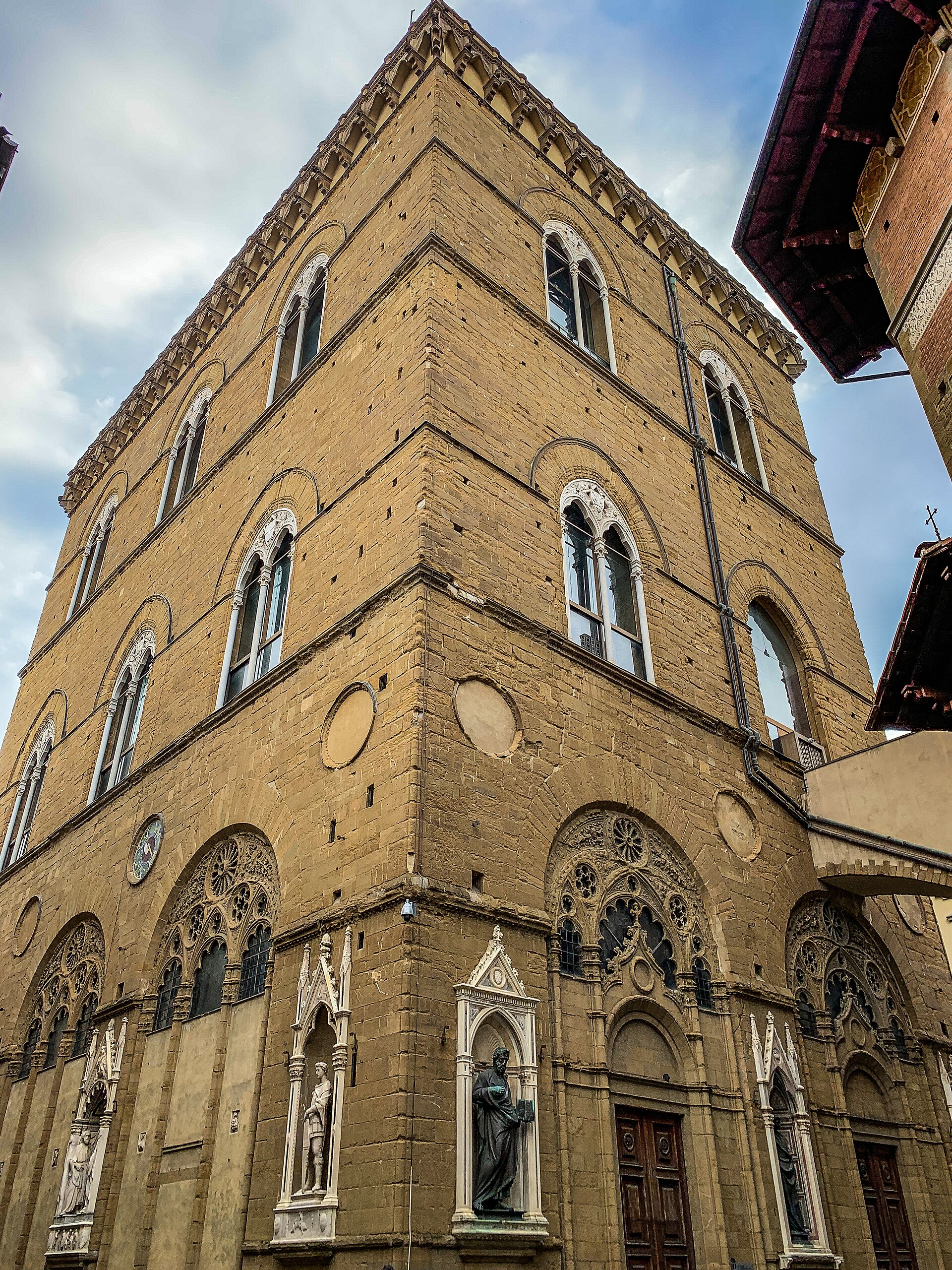
Let's start with the name, because all the history is in it. Standing on this spot was a small Benedictine monastery, founded around 750 and dedicated to the Archangel Michael. Nearby were kitchen gardens, so the monastery was called San Michele ad Hortum - 'Saint Michael in the Garden'. Latin turned into Italian, the name became San Michele in Orto, and then compressed to Orsanmichele. The monastery was demolished in 1239 during another civic brawl between factions. The site was right in the center, next to the two main grain markets, and the city acted pragmatically: it took the plot for itself. From 1240 it was the municipal grain market - and this decision made more than just commercial sense: by centralizing the sale of grain and flour in one spot, the authorities created a place where a citizen could always come for bread in hard times. In 1284, a loggia was built over the market - a roof for traders and goods. In memory of the vanished monastery, an Archangel Michael was painted on one of the brick piers, and a Madonna on another. Then what happened in Florence often happened: miracles began to be attributed to the image of the Madonna, gifts and offerings grew around it, and in 1291 a confraternity emerged that sang praises before it. In 1304, the loggia, along with the miraculous image and a piece of the city center, burned down in yet another internal conflict. They decided to rebuild in 1336. The civic decree stated why: the site is 'in the very heart of the city, where the image of the glorious Virgin Mary is venerated, and serves the many needs of the commune of Florence', and the new building 'will greatly contribute to the honor, beauty, and appearance of the city.' Supervision was given to the influential silk guild (Arte della Seta), and the project was led by three men - Francesco Talenti, Neri di Fioravanti, and Benci di Cione. The first stone was laid in 1337, and citizens threw gold medals and coins into the foundation for good luck. The layout was thus: on the ground floor, a shrine for the miraculous image; the two upper floors held grain for times of war or famine. In 1349, in the middle of the plague, the city commissioned Andrea Orcagna to make a huge decorated tabernacle for the new Madonna image painted by Bernardo Daddi in 1347: they hoped to regain favor and stop the epidemic. The epidemic eventually receded - taking almost two-thirds of the city, including Daddi himself. And in 1357, the grain market was evicted from the ground floor: the authorities decided it was unseemly to trade next to altars. Meanwhile, grain continued to be stored upstairs for another two hundred years. Thus emerged a building where people prayed on the ground floor and kept a strategic reserve on the second and third. Another political detail. On July 26, 1343, Florence got rid of Walter of Brienne, the 'Duke of Athens,' whom it had invited to rule a year earlier in the hope that he would pull the city out of its financial hole. He imposed heavy taxes on the rich, the poor proclaimed him lord for life, and then those who had invited him over overthrew him. Liberation was attributed to the Virgin and her mother, Saint Anne, whose feast day falls on July 26, and the city decreed the setup of two altars on the ground floor of Orsanmichele: to the Virgin and Saint Anne. The building became a shrine to two patronesses of a single idea - political freedom.
AI translation · 🇬🇧 EN
Rate this review:
Fourteen Niches: How Guild Rivalry Produced the Renaissance
All the main action is on the walls, all the way around. There are fourteen niches in them: four on the long north and south sides, three on the short east and west sides. They were built by the guilds and the Guelph party, each their own. Not a single one is like any other - each guild commissioned its niche to its own design. At first, the decree did not work. Throughout the entire fourteenth century, only three groups fulfilled the obligation: the silk merchants, the wool merchants, and the guild of doctors and apothecaries. The silk merchants made a niche in 1340, but the statue of Saint John the Evangelist was only placed around 1377 - hindered by the plague of 1348. The wool merchants finished their niche around 1341 and immediately installed the marble Saint Stephen by Andrea Pisano. The doctors and apothecaries finished by 1399. And then began what is called the "procession of the statues." At the beginning of the fifteenth century, Florence became truly terrified: Milan under Gian Galeazzo Visconti took almost all of northern Italy, held the roads to Rome, and cut off the city's access to the sea via Lucca and Pisa. It would seem that at such a moment, decorating public buildings is the last thing one should think about. It turned out the other way around. The city announced a competition for the Baptistery doors (the very one that started the history of the dome) and ordered the remaining guilds to finally put up their statues - under threat of losing their place on this building. The guilds set to work. Next, fate behaved strangely. In 1402, Gian Galeazzo died of the plague in his own military camp, and his realm crumbled. From 1408, the city was threatened from the south by the Neapolitan king Ladislaus - and in 1414, when he was close to his goal, earthquakes scared him, and then a fever struck him down. In 1420, Milan returned, now under Gian Galeazzo's son, and this time no miracle happened: the war dragged on for decades. All of this needs to be known for one reason: almost all the statues of Orsanmichele were made against the background of continuous war or the threat of it. This is not decoration of a peaceful city, but the statements of a city that is afraid of disappearing. If you walk in a circle, looking only at the figures, you can see how over several decades late Gothic sculpture becomes Renaissance - on a single building, in fourteen niches, erected by competing guilds. Prak-ticheskoye (Practical info): a significant part of the statues in the niches today are copies, the originals have been moved indoors - Donatello's Saint George, for example, is in the Bargello, five minutes away from here.
AI translation · 🇬🇧 EN
Rate this review:
Nearby and related
By the same architect
Close by in Florence
About the Object
Francesco Talenti, Neri di Fioravanti, Benci di Cione
1337
Gothic
Via dell'Arte della Lana, Firenze
Religious Structure