
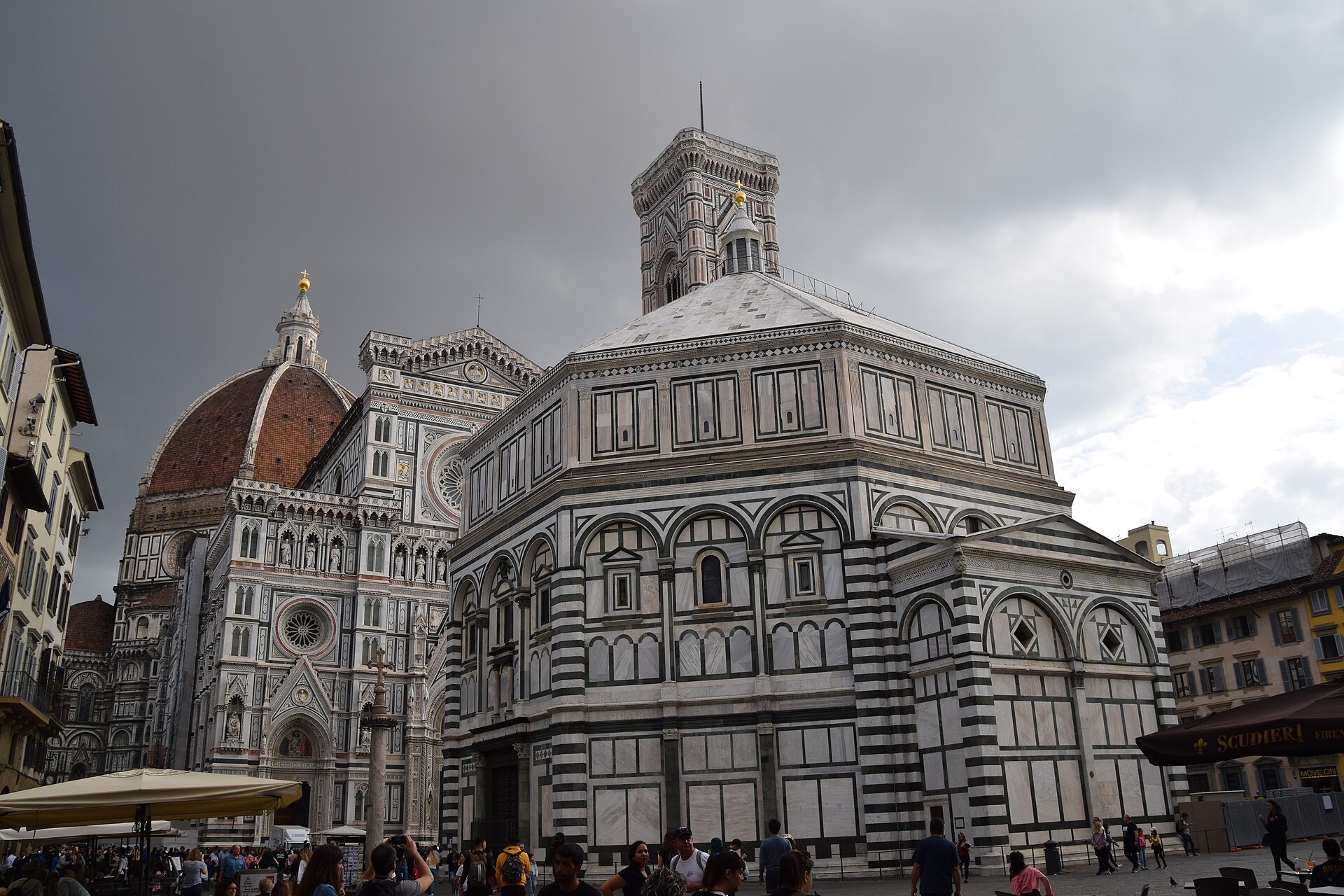
Florence Cathedral (Cattedrale di Santa Maria del Fiore)
Всемирное наследие ЮНЕСКОAbout the Object
Arnolfo di Cambio, Filippo Brunelleschi
1436
Renaissance
Piazza del Duomo, Firenze
Religious Structure
Gallery (1)

One hundred forty years of construction and a hole in the sky instead of a dome
The facade, if you see it as a whole, is deceiving. These white, green, and pink marble slabs are from the nineteenth century. The real cathedral is older by six centuries, and for almost all its history it stood with a bare brick face, because the cladding was started, abandoned, and then removed altogether. Construction began in 1296, on the site of the old church of Santa Reparata. The plans were made by Arnolfo di Cambio, a respected local architect, but in 1310 he died, and after that the cathedral was led by one architect after another, including Giotto. In 1348 the plague came to Florence and killed more than half the city, and construction stopped. When they returned to the blueprints in 1367, the city adopted a plan that was reckless to the point of folly: an octagonal double-shelled dome without external buttresses, which both French and northern Italian Gothic used to hold up vaults. The diameter is about forty-two meters. There was one detail: no one knew how to build such a dome. All arches of that time were laid over a wooden framework. A beam was thrown across the span, a temporary wooden structure was assembled on it, stone was laid over it, and when the mortar set, the wood was removed. This meant the width of the arch depended on the length of the log that could span the space. And in the vicinity of Florence, no tree grew that was capable of spanning forty-two meters. And even if one had grown, people believed back then, a structure of that size would have collapsed under its own weight before the first stone was laid on it. Therefore, the architects did anything except build the dome. By the beginning of the fifteenth century, the cathedral had been under construction for over a hundred years, and the result looked like this: a forty-meter leviathan covered by nothing. The naves and transepts were covered, the bell tower was standing, the side walls were faced with colored marble, and in the middle was a gaping hole, and the unfinished interior stood open to the weather like a ruin, not like a building about to be finished. The Florentines set out to build the biggest dome in the world to show their superiority, and were becoming the laughingstock of Tuscany, knowing that failure would bring even more mockery. The cathedral you see is the result of someone finally getting sick of this disgrace.
AI translation · 🇬🇧 EN
Rate this review:
The dome built without centring-and still the largest brick dome in the world
In 1401, the city held a competition-not for a dome, but for the bronze doors of the Baptistery opposite. The goldsmith Lorenzo Ghiberti won. The loser, also a goldsmith named Filippo Brunelleschi, was convinced the competition was rigged, abandoned his craft, and left for Rome to clamber over ancient ruins. He spent thirteen years there, off and on, sometimes with his friend, the sculptor Donatello. The two dug around in the ruins, measuring and drawing to such an extent that in Florence they were taken for treasure hunters. And they were indeed looking for a treasure, but an engineering one: how the Romans made their massive vaults. Brunelleschi never fully understood how the Pantheon's dome was constructed, and concluded that the Romans managed without a wooden framework. Historians have long proven that he was wrong. But the mistake turned out to be a fruitful one: it convinced him that it could be done. In 1418, the city announced another competition, this time for the dome. Of the eleven projects, some caused the committee to laugh-there was, for instance, a plan to fill the entire space beneath the future dome with earth, build the dome on top of the mound, and then spread a rumor that gold coins were hidden in the earth so that the Florentines would carry it away themselves in baskets. Brunelleschi won, but just in case, the committee appointed the very same Ghiberti as his co-director-seemingly so there would be someone to take over if the dome collapsed. Here is what he came up with. Two shells: the inner one slightly over two meters thick at the base and one and a half at the top, the outer one less than a meter at the bottom and about forty centimeters at the apex, with a gap of roughly a meter and a quarter between them. Eight ribs are visible on the exterior-those very white spokes of a giant umbrella-and another sixteen are hidden between the shells. The dome is girded with chains: not of links, but made of sandstone blocks laid in a circle and linked by short crossbars, like railroad ties; plus one wooden chain consisting of twenty-four chestnut beams tightened by oak and iron clamps. The chains act like belts, preventing the base from spreading outward. And most importantly-the method of masonry. The dome grows in horizontal rings, each resting on the previous one and, once closed, becoming the support for the next. No wooden framework: the structure holds itself up at every single step. When the walls leaned inward so much that the mortar stopped holding, Brunelleschi switched from stone to brick and laid it in a 'herringbone' pattern-a motif inspired by the Roman masonry he had measured in Rome. Work began at dawn on August 7, 1420. The masons, some of whom had never climbed higher than a couple of meters off the ground, were to lay an inclined wall at a height of seventy-five meters. To explain to them what the result would be, Brunelleschi bought a turnip at the market, cut it in half, laid it on the ground, and said: like this. So they wouldn't look down, he devised a portable railing around the working platforms-the cathedral documents explicitly state: 'so that the masons do not look down.' Only one person died during the entire construction. He designed the hoist himself; oxen were harnessed to turn the winch, and the machine was assembled by carpenters who swore to keep its design a secret. In the end, it lifted tens of thousands of tons of stone and brick, and riding it was forbidden by a special decree-such was its popularity among the townspeople. In 1426, he set up a kitchen with a latrine between the shells of the dome so the masons wouldn't have to go down for lunch: the climb to the workplace equaled twenty-five stories. The dome was declared finished in 1436. The lantern at the top was completed after Brunelleschi's death, and the bronze ball at the very top was hoisted in 1471 by a machine he called 'the castle'; the ball was cast by Andrea del Verrocchio, and the young Leonardo da Vinci was working as an apprentice in his workshop at the time. Leonardo later sketched the hoisting machines-and for several centuries gained the fame of their inventor. This dome remains the largest brick dome in the world.
AI translation · 🇬🇧 EN
Rate this review:
Inside: two mercenaries on the wall, Dante with a book, and a tomb found by accident
Inside, the cathedral is a bit empty and surprisingly cold - after the facade, that is almost disappointing. But there are three things here that make it worth stepping inside. The first is two equestrian frescoes on the left wall. These are condottieri, mercenary commanders in the service of the Republic. Giovanni Acuto - actually the Englishman John Hawkwood - was painted by Paolo Uccello in 1436, right when the dome was finished. Niccolò da Tolentino was painted by Andrea del Castagno twenty years later, in 1456. Both frescoes are made in a technique imitating stone: the city promised the mercenaries equestrian monuments, but delivered painted ones. Cheaper - and as it turned out, more durable. The second is a painting by Domenico di Michelino from 1465: Dante with the Divine Comedy in his hands, and behind him Florence with the already finished dome. The poet died over a hundred years before this dome appeared and never saw the city with a dome: he died in exile in Ravenna and never returned to Florence. In the painting, he was finally brought home. The third is down in the crypt. Beneath the cathedral lie the remains of Santa Reparata, the church that was demolished to build this one. There too is Brunelleschi's gravestone. It was only found in the seventies of the last century, during the excavations of Santa Reparata which ran from 1965 to 1973: the fact that the man who built the dome is buried right beneath it was known from documents - Danilova cites his funeral epitaph, where he is praised as the builder of the "marvelous dome" - but exactly where the slab lies had been forgotten for five centuries. And one more door that people usually do not look at: the New Sacristy, with its bronze panels and glazed lunette by Luca della Robbia. On April 26, 1478, during a solemn mass in this very cathedral, the Medici brothers were attacked all at once: the Pazzi conspiracy, backed by Pope Sixtus IV, was an attempt to end the family's power with a single blow. Giuliano was killed right here on the spot. Lorenzo fought off two attackers and managed to run into the sacristy, slamming this door behind him - and from there reached home. So the bronze panels of Luca della Robbia have not only an artistic biography: a man upon whom the fate of the city depended was once hidden behind them. Also, look up: the Last Judgment fresco covering the entire interior of the dome shell is by Giorgio Vasari and Federico Zuccari, sixteenth century. Brunelleschi had provided for seventy-two small windows in the shells, and some of the interior ones were bricked up precisely to make room for the painting. That is, the shell, conceived as a crown of light, was painted over with a subject about the end of the world.
AI translation · 🇬🇧 EN
Rate this review:
Nearby and related
By the same architect
Close by in Florence
About the Object
Arnolfo di Cambio, Filippo Brunelleschi
1436
Renaissance
Piazza del Duomo, Firenze
Religious Structure