
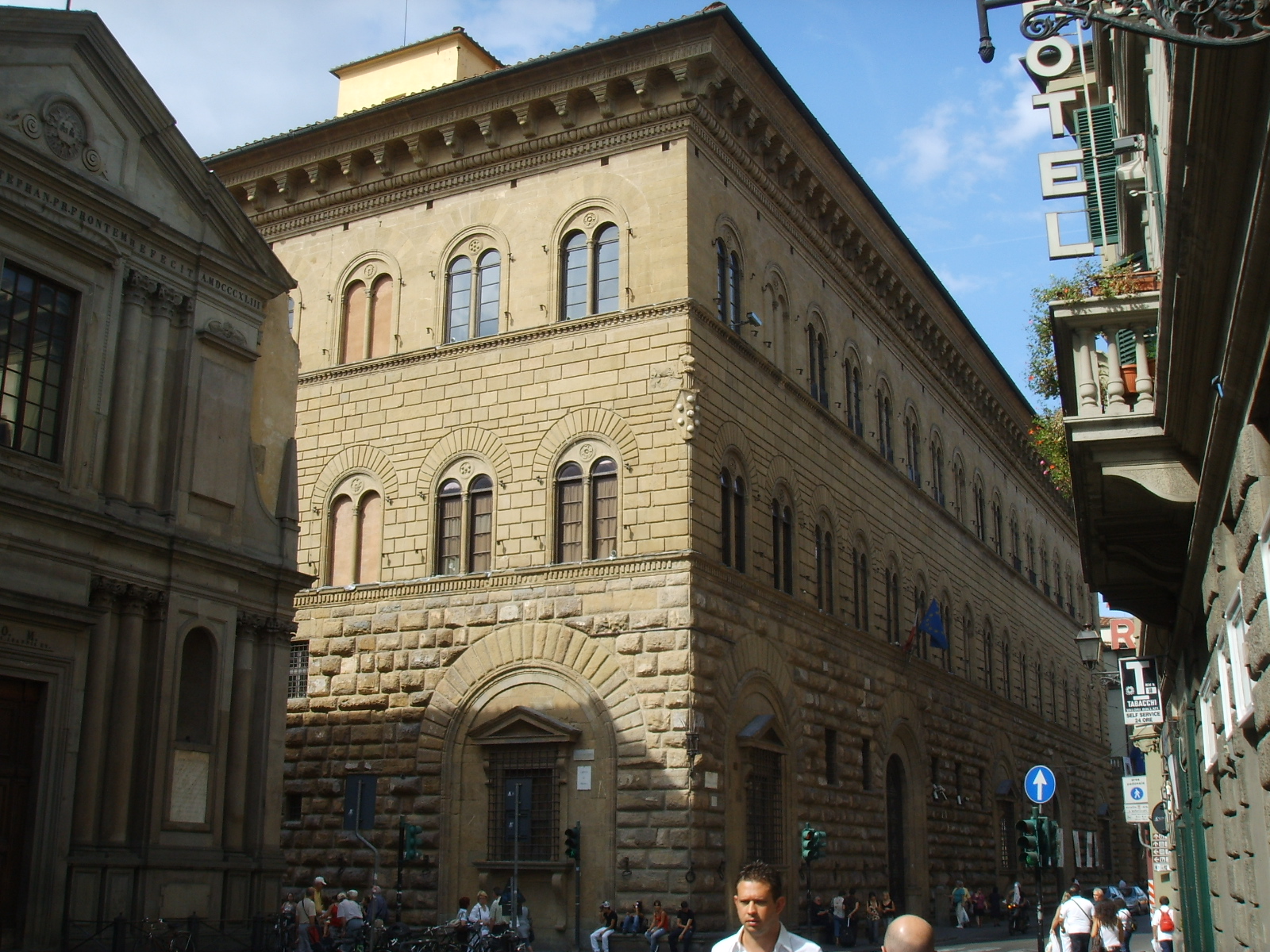
Palazzo Medici Riccardi
Всемирное наследие ЮНЕСКОAbout the Object
Michelozzo di Bartolommeo
1459
Renaissance
Via Cavour 1, Firenze
Public Building
Gallery (3)

The palace that the client ordered to be made more modest
The first thing to do on Via Cavour is sit down. Along the entire base run stone benches, five wide seats built into the wall's foundation. They have been there from the very beginning and were intended for anyone walking by. A house whose lower two meters are given over to the street starts a conversation with the passerby before the latter even raises their eyes. And raise them you should. The facade is composed of rough rusticated stone, in blocks like a fortress, but the higher it goes, the smoother and calmer the stone becomes, and the floors themselves are lower. The first tier is heavy and wild, the second smoothed out, the third almost smooth, and everything is crowned by a heavy cornice. The building seems to gradually calm down, rising from the pavement to the sky. It was commissioned by Cosimo de' Medici the Elder, and commissioned in 1444, when the family was the richest in Florence while remaining formally private citizens in the republic. The first project was done by Brunelleschi. Cosimo rejected it: too luxurious. He did not want to show off his wealth, and the job went to Michelozzo di Bartolomeo, who made a deliberately austere version. It is worth pausing here: the richest man in the city rejected the project of the era's best architect not because it was bad, but because it was too good. In a city that considered itself a republic, ostentatious wealth was a political mistake. Michelozzo was not an accidental replacement. After Brunelleschi's death, he took his place as head of works at the cathedral. And in the courtyard of the palace, it is clear whose student he is: arches on slender columns with Corinthian capitals almost verbatim repeat the loggia of the Spedale degli Innocenti. Outside a fortress, inside a light arcade with Medici emblems in the spandrels above the columns. Two different messages in one building, and both intentional. Beyond the main door, the courtyard walls are completely covered with pieces of ancient Roman carving. This is also a statement, just a different one. A family of bankers without a single drop of noble blood collected fragments of imperial Rome and inserted them into the walls of their home.
AI translation · 🇬🇧 EN
Rate this review:
The Magi Chapel: A family portrait disguised as a biblical procession
They only let you into a few rooms, and the main one is tiny. The Magi Chapel is a household oratory about the size of a room, and all four of its walls are covered with a single continuous painted procession. It was painted by Benozzo Gozzoli in 1459-1460. The subject is biblical: the Magi are traveling to worship the infant Christ. However, they are riding through Tuscan hills in clothes contemporary to the artist, and members of the Medici family can be recognized in the entourage. Luxurious fabrics, horses in caparisons with heraldic balls, hunting dogs, falcons. The patrons placed themselves right inside the sacred narrative, and they did so not with a subtle hint, but across the entire wall. This is precisely when it becomes clear why the austerity on the outside was necessary. The Medici were bankers who had risen from modest origins, without a drop of royal or noble blood, and they wanted to be reckoned with as dukes and kings. The facade told the city "we are just like you", while the painting in the private chapel told guests the opposite. Judith Testa, whose guidebook to Florentine art we read for this card, calls these frescoes a document of unquenchable political ambition, and it is hard to argue with that. The Florentines, however, understood everything even without art historians: some citizen grumbled that the Medici were trying to shove their wretched balls down everyone's throats. Two more things that are useful to know while standing here. Donatello's bronze David once stood in the courtyard, the very one now in the Bargello; in its place today is Bandinelli's marble Orpheus. And in 1642 the palace was bought by the Riccardi family, which is why it bears a double name. The new owners expanded it: in 1680 they added six more window axes, carefully, in the manner of Michelozzo, so that the addition is barely discernible from the outside. Their taste is also visible in the hall painted by the Neapolitan Luca Giordano in 1683: the "Apotheosis of the Medici", lush Baroque, a ceiling in clouds and allegories. Between the restrained fifteenth-century chapel and this ceiling lie two hundred years, during which the family transformed from bankers who hid their wealth into a dynasty that was supposed to be depicted ascending to heaven.
AI translation · 🇬🇧 EN
📷 Wikimedia Commons · Julian Lupyan · CC0 · https://commons.wikimedia.org/wiki/File:Magi_Chapel%2C_Palazzo_Medici_Riccardi%2C_Florence%2C_Italy.jpg
📷 Wikimedia Commons · Yair Haklai · CC BY-SA 4.0 · https://commons.wikimedia.org/wiki/File:Detail-Procession_of_the_Youngest_King_by_Benozzo_Gozzoli-Cappella_dei_Magi-Palazzo_Medici_Riccardi-Florence.jpg
Rate this review:
Nearby and related
Close by in Florence
About the Object
Michelozzo di Bartolommeo
1459
Renaissance
Via Cavour 1, Firenze
Public Building