
Medici Chapels and Laurentian Library (Cappelle Medicee, Biblioteca Laurenziana)
Всемирное наследие ЮНЕСКОAbout the Object
Michelangelo Buonarroti
c. 1534
Renaissance
Piazza di Madonna degli Aldobrandini, Firenze
Museum
Gallery (2)

New Sacristy: Four figures that remained unfinished
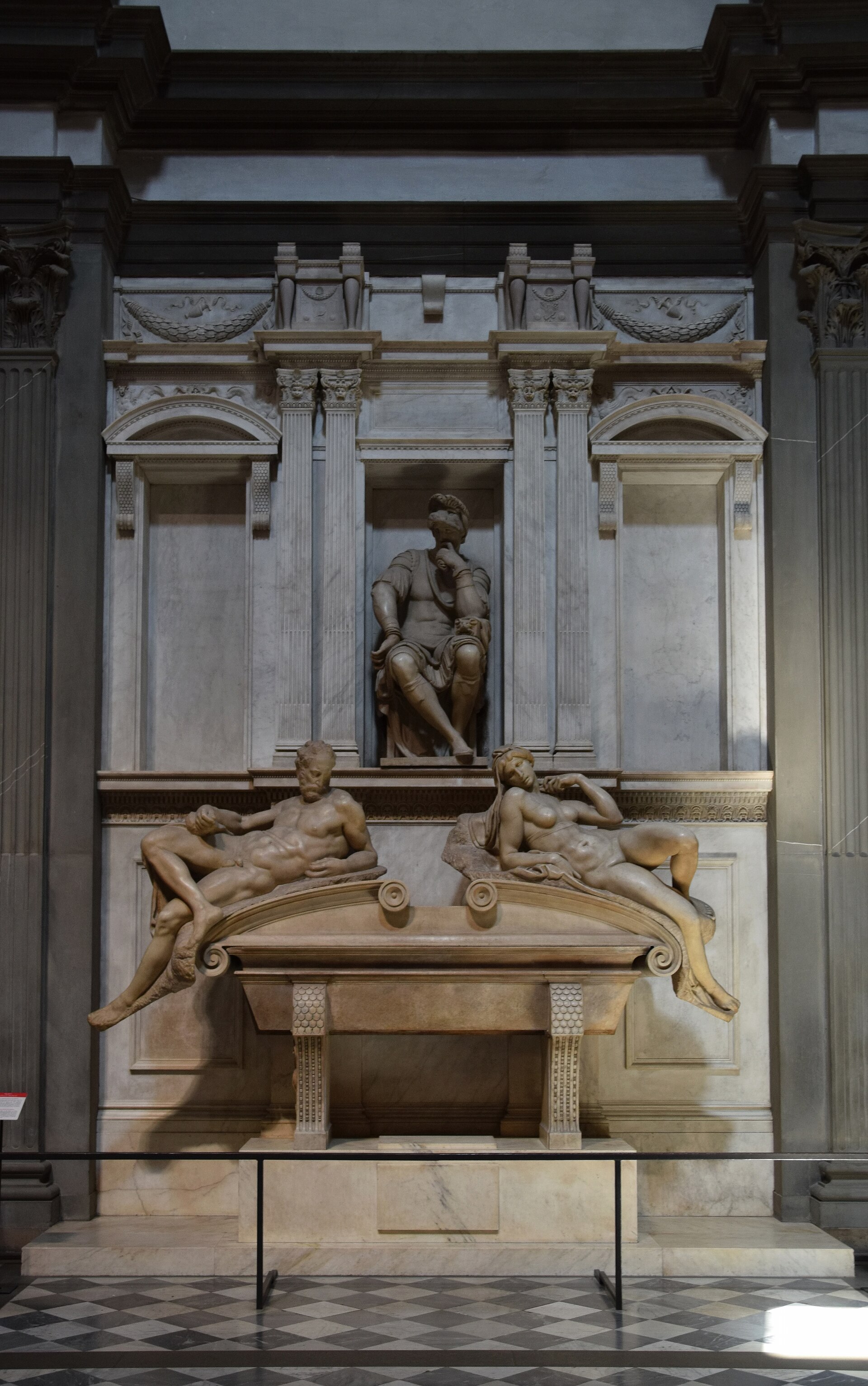
In 1520, Michelangelo undertook the Medici tombs, and the work stretched over a decade and a half. The result is a space known as the New Sacristy, paired with the Old Sacristy created a century earlier in the same church by Brunelleschi. Inside are four allegorical figures: Dawn, Dusk, Day, and Night. To look at them properly, one must know one thing: they are not fully polished. The surface is left rough in places, chisel marks are visible, and this is not the damage of time, but the state in which the work stopped. Michelangelo has many such pieces-the "Pratives", whose copies stand today in the Boboli Grotto, are of the same breed. Unfinishedness here serves the meaning. The figures lie on the sarcophagi in awkward, slipping poses, as if they had just been placed there and are about to slide off. Time, named after parts of the day, is depicted by bodies that cannot find rest. For a tomb of the ruling family, this is a rather grim statement. It is also worth remembering the circumstances. Michelangelo worked on these tombs during the years when Florence made its last attempt to restore the republic and lost, and the Medici returned as dukes. In 1534, he left for Rome and never returned to Florence, leaving the work as it was. One more thing: in the neighboring Chapel of the Princes lie six grand dukes. The contrast between the two spaces is instructive. The Chapel of the Princes is ornate, heavy, and faced with precious stone. The New Sacristy is white, empty, and austere. The first was made to impress. The second, it seems, was not.
AI translation · 🇬🇧 EN
Rate this review:
A staircase that doesn't act like a staircase
Starting in 1524, Michelangelo designed the Laurentian Library right here to house the family collection of manuscripts. The reading room is serene and elongated, but the vestibule before it is well worth traveling across town for. Imagine: a tall, cramped room where the staircase takes up almost all the space. It flows downward in three streams of steps, the middle one with rounded edges, as if the stone were liquid. The walls are articulated with columns, but the columns do not stand in front of the wall; they are recessed into it, meaning they are not the ones bearing the weight. Beneath them are brackets that support nothing at all. All of this was created by a man who knew the rules to perfection: those very classical orders that Alberti deployed across the Colosseum and the facade of the Rucellai Palace. Here, the rules are deliberately subverted. Architectural details pretend to work while doing nothing; the staircase transforms from a means of ascent into an obstacle that must be overcome to reach the books. This is what is known as Mannerism, and the Laurentian staircase is its most famous example. Guidebooks call it one of Michelangelo's most innovative solutions, and it is worth understanding wherein the novelty lies: not in the form, but in the fact that architecture for the first time permitted itself to speak not of order, but of tension. Thirty years later, Ammanati would apply this exact same logic to create the rustic courtyard at the Pitti Palace, and even later, such things would become the norm. It all begins in this small room beside the church.
AI translation · 🇬🇧 EN
📷 Wikimedia Commons · sailko · CC BY-SA 3.0 · https://commons.wikimedia.org/wiki/File:Biblioteca_laurenziana%2C_vestibolo%2C_scalinata_03.JPG
Rate this review:
Nearby and related
Close by in Florence
About the Object
Michelangelo Buonarroti
c. 1534
Renaissance
Piazza di Madonna degli Aldobrandini, Firenze
Museum