
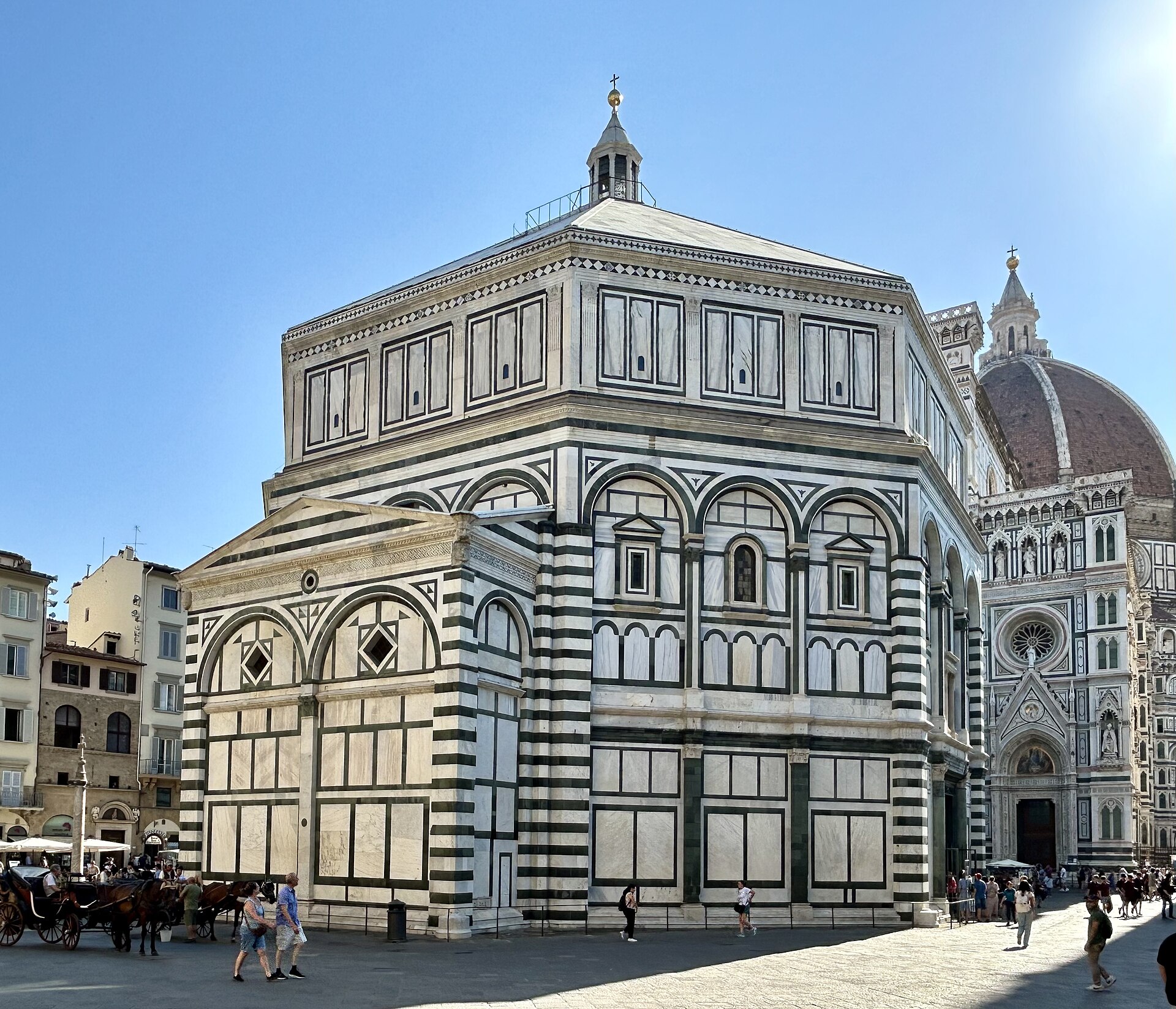
Florence Baptistery (Battistero di San Giovanni)
Всемирное наследие ЮНЕСКОAbout the Object
Unknown
c. 1059
Romanesque
Piazza San Giovanni, Firenze
Religious Structure
Gallery (1)

The Florentines believed it was an ancient temple, and they were wrong
The octagonal building in green and white marble opposite the cathedral is the oldest and most revered structure in Florence. Renaissance Florentines were certain it was an ancient Roman temple later adapted for Christian worship. Eighteen massive classical columns inside convinced them of this. Science has long since refuted this version, but notice what happened: a city that lacked a Roman past of the necessary scale invented one for itself - and believed it. The exact foundation date remains unknown to this day. Most likely the sixth or seventh century, possibly even earlier - the fourth or fifth. There is only one firm date: in 1059 the building was remodeled, and between that year and the thirteenth century its exterior was faced with a geometric pattern of colored marble - the one you see. Inside, the main thing is above your head. The dome is covered with thirteenth-century mosaics depicting the Old and New Testaments and the Last Judgment. This is the only such mosaic cycle in Florence: the city that became the capital of painting preserved its Byzantine mosaic only here. And one more thing, which explains why they undertook the decoration of this very building first, as soon as the fifteenth century began. In 1400, the cathedral opposite was an unfinished shell without a dome, while the Baptistery was functioning. Everyone brought their children here to be baptized - from the banker to the wool fuller - and the rite meant entry into two communities at once: the church and the commune of Florence. The heart of the city was not the cathedral. The heart of the city was this baptismal font.
AI translation · 🇬🇧 EN
Rate this review:
The 1401 Competition: The Doors Went to the Jeweler, and the Dome to the Loser
The Baptistery has three bronze doors, and all three are worth telling apart. The Southern doors, by Andrea Pisano, 1330-1336. The oldest ones. Twenty episodes from the life of John the Baptist, patron saint of Florence, plus eight panels with virtues. You need to read them from top to bottom, first the left leaf, then the right: on the left is the preaching, on the right the martyrdom and burial. The author signed his name across the top of the doors, and the signature has survived: "ANDREAS UGOLINI NINI DE PISIS ME FECIT A D MCCCXXX" - "Andrea, son of Ugolino, son of Nino, from Pisa, made me in the year of our Lord 1330". At first they stood at the main, eastern entrance, then they were moved to the southern one - and today they are on the southern one. The Northern doors, by Lorenzo Ghiberti, following the competition of 1401. This is where the main story begins. The commission was managed by the Calimala wool guild, judged by a committee of thirty-four people - clergymen and businessmen. The task was the same for everyone: a bronze relief of "The Sacrifice of Isaac". Seven works were submitted, five of the participants were non-Florentines, and choosing an outsider for a building around which all local patriotism revolved was politically impossible. In the final, two locals remained: Lorenzo Ghiberti, who was about twenty-two, the youngest of all, and Filippo Brunelleschi, older than him by a few years. Ghiberti won. No records of how the judges argued have survived, but it is known that his panel was a third lighter and, except for the figure of Isaac, cast in one piece; Brunelleschi's work was heavier and made up of several parts. That is, perhaps it was calculation rather than art that decided it: less expensive material and a more durable result. Brunelleschi, who did not know how to lose, claimed that Ghiberti had rigged everything. You can judge for yourself: both competition panels are intact and displayed side by side in the Bargello. What happened next is more important than the doors themselves. Ghiberti spent half a century working on the bronze for the Baptistery, while an offended Brunelleschi abandoned sculpture and left for Rome - to measure and draw ancient vaults. If he had won back then, the cathedral dome, most likely, would not have existed at all. How much it cost: according to Ghiberti's own account, twenty-two thousand florins. The historian Antonio Paolucci says that this equaled Florence's annual defense budget and was only slightly less than the amount for which the city bought itself an entire Sansepolcro a few years later. Ghiberti signed the contract on November 23, 1403: two hundred florins a year for him, all materials and auxiliary labor at the guild's expense. And there he also learned that the subject had been changed: instead of the Old Testament - the life of Christ, twenty-eight panels, each just under two feet, each inscribed in a quatrefoil. The Eastern doors, also known as the "Gates of Paradise", by Ghiberti, 1425-1452. His second set of doors, now without a competition and without quatrefoils: ten large gilded panels with perspective, depth, landscape. The name comes from a phrase by Michelangelo recorded by Vasari in his "Lives of the Artists" of 1550: he was asked what he thought of this work, and he replied - "they are so beautiful that they could well be the gates of paradise". Important for the visitor: the doors themselves now carry copies. The original ten panels are in the Museo dell'Opera del Duomo, two hundred meters from here, and it is worth going there right after the Baptistery.
AI translation · 🇬🇧 EN
Rate this review:
Nearby and related
By the same architect
Close by in Florence
About the Object
Unknown
c. 1059
Romanesque
Piazza San Giovanni, Firenze
Religious Structure