
Piazza della Repubblica
Всемирное наследие ЮНЕСКОAbout the Object
1895
Eclecticism
Piazza della Repubblica, Firenze
Square
Gallery (2)

The square built at the cost of demolishing the heart of the old town
This square is younger than everything surrounding it, and it appeared on a site that served as the city center for two thousand years. Here stood the Roman forum. Later, in the Middle Ages and beyond, the Mercato Vecchio—the Old Market—operated in its place, surrounded by a dense historic quarter. All of this was demolished: the current square was laid out by 1890, and it, along with the surrounding streets, is the result of nineteenth-century urban restructuring. In those years, Florence was briefly the capital of a unified Italy, from 1865 to 1871, and its capital status demanded a different kind of center: wide streets, grand squares, respectable facades. Exactly what was lost along with the old quarter is hard to gauge today—only photographs and maps remain, while in their place stands a spacious square filled with cafes. It is worth understanding that this was not an isolated episode, but a standard operation for that era: the exact same thing was done in Paris, Vienna, and Moscow. The Florentine case differs only in that they demolished the very things the city now earns its living from. Walking across this square, it is useful to remember: the preserved old town you see around you is the result of the restructuring being halted. They might not have stopped.
AI translation · 🇬🇧 EN
📷 Wikimedia Commons · photographer unknown, before 1890 · Public domain · https://commons.wikimedia.org/wiki/File:Piazza_della_repubblica_in_1883%2C_torre_dei_caponsacchi.jpg
Rate this review:
The Column of Abundance, the arch in honor of the capital, and the waiters' red jackets
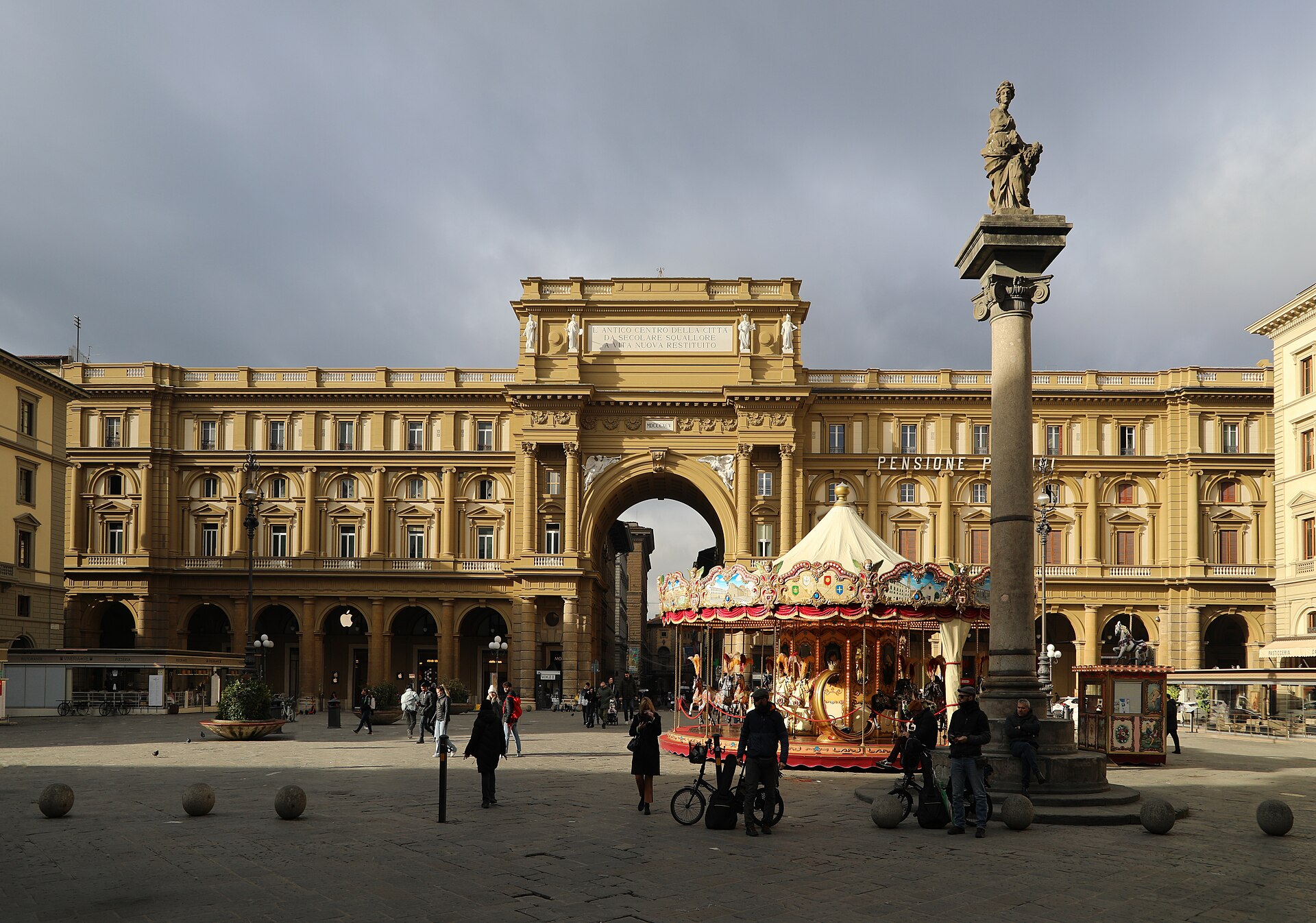
There are several things standing on the square, each with its own history. First is the lonely column. It remains from the Old Market—that is, from what was here before the demolition—and atop it is an eighteenth-century statue of Abundance. The only surviving object from the former square, and now it stands in the middle of the new one. Second is the triumphal arch on the western side, erected in 1895 to commemorate Florence having been the capital of Italy. This arch conveys through its appearance precisely what the entire urban redevelopment was initiated for: the city wanted to look like a European capital and built itself a matching façade. The third thing is not architectural. The square is lined with cafés, and one of them, "Giubbe Rosse," got its name from the waiters' red jackets. At the beginning of the twentieth century, it was a gathering place for writers and artists, including the Italian futurists—the very ones who called to burn down museums and rebuild the city anew. An amusing coincidence: the people who demanded the demolition of the old sat on a square for the sake of which the old had just been demolished. Today there is a carousel, tourists, and a great many tables. It is a noisy place and, to many tastes, the least Florentine place in Florence. But it is worth dropping by for at least ten minutes—as the city's only point where you can see what Florence wanted to become and never did.
AI translation · 🇬🇧 EN
Rate this review:
Nearby and related
Close by in Florence
About the Object
1895
Eclecticism
Piazza della Repubblica, Firenze
Square