
Palazzo Strozzi
Всемирное наследие ЮНЕСКОAbout the Object
Benedetto da Maiano, Giuliano da Sangallo, Simone del Pollaiuolo
1536
Renaissance
Piazza Strozzi, Firenze
Public Building
Gallery (2)

The Palace for Which Astrologers Were Consulted, and Which the Client Never Saw
Filippo Strozzi belonged to a family that the Medici had already broken once: his relatives had been sent into exile. He made his fortune in Naples, returned to Florence, and came back with one goal-to build a palace larger and more magnificent than that of his Medici rivals. The method to achieve this goal was straightforward. Strozzi bought up and demolished fifteen houses around his own dwelling, clearing a site for himself in the city center. Then comes a detail worth knowing: before laying the first stone, he summoned astrologers to determine the most auspicious day. The day was determined, and the stone was laid in 1489. Two years later, Filippo Strozzi died. His heirs were left with a foundation pit and a design they could not afford: the construction costs turned out to be exorbitant. The palace took another forty-five years to complete and was finished in 1536. That is, the man who conceived the building as proof of his supremacy never lived in it for a single day, and his family nearly went bankrupt because of it. This story is not unique in fifteenth-century Florence, and that is its true meaning. Building a palace was a way to make a statement, but the statement cost more than it seemed. In the neighboring quarter, Giovanni Rucellai assembled his palace from already existing houses and did not go bankrupt. Strozzi demolished fifteen houses and bankrupted his heirs. Both wanted the exact same thing.
AI translation · 🇬🇧 EN
📷 Wikimedia Commons · sailko · CC BY 2.5 · https://commons.wikimedia.org/wiki/File:Palazzo_strozzi%2C_cornicione_interrotto.JPG
Rate this review:
Three floors standing six high, and horse rings on the corners
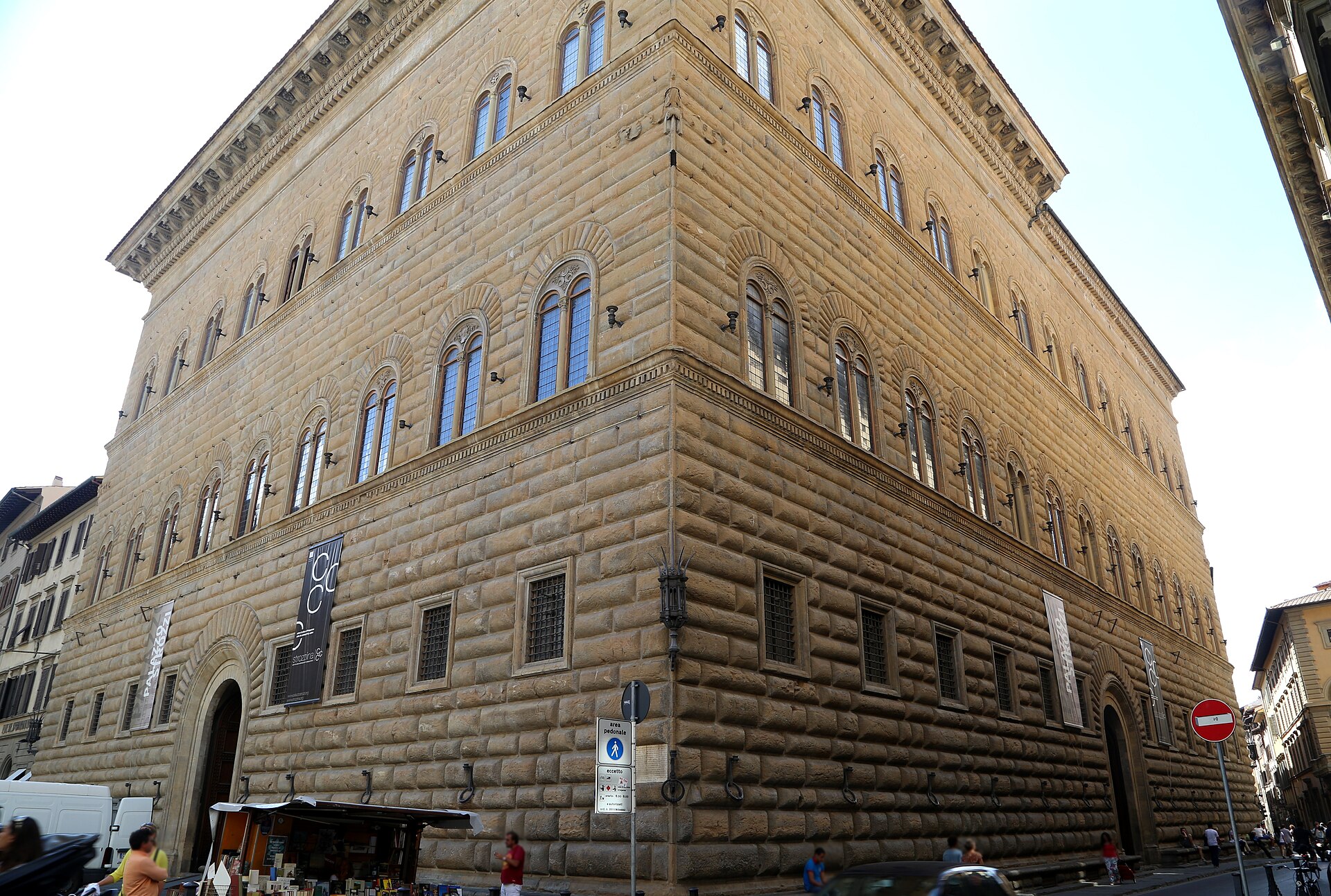
The first impression of this palace is its size, and it does not deceive. There are only three floors, but each is as high as a whole floor of a normal palazzo, so the building turns out twice as high as its neighbors with the same number of tiers. It is built of huge rusticated blocks, roughly hewn, with a convex front side. The wall reads like a fortress wall, only this fortress was built by a banker for himself. Up close, on the corners and in the lower part of the facade, something else is visible. Original Renaissance torch holders, lanterns, and rings to which horses were tied have been preserved there. This is a rarity: such things are usually cut off first. Here they are in place, and through them, better than anything else, it is understood how this palace worked: they rode up to it on horseback, torches burned by it, it was not a monument, but a functioning home of a rich man. There are three authors of the building: Benedetto da Maiano, Giuliano da Sangallo, and Simone del Pollaiuolo. Forty-seven years of construction and three names - it is difficult today to divide who exactly did what, and guidebooks simply name them together. It is worth going inside. Now the palace houses an exhibition center, and the exhibitions here are of the first rank. But if there is no exhibition, only the courtyard is open - and, honestly, the courtyard is enough: it makes it clear that a completely different mood was hidden behind this fortress wall.
AI translation · 🇬🇧 EN
Rate this review:
Nearby and related
By the same architect
Close by in Florence
About the Object
Benedetto da Maiano, Giuliano da Sangallo, Simone del Pollaiuolo
1536
Renaissance
Piazza Strozzi, Firenze
Public Building