
Palazzo Rucellai
Всемирное наследие ЮНЕСКОAbout the Object
Leon Battista Alberti
1451
Renaissance
Via della Vigna Nuova 18, Firenze
Residential Building
Gallery (2)

The Man Who Could Not Enter Government and Built Himself a Facade
This family's surname comes from a dye. The Rucellais imported a rare and expensive red dye extracted from a lichen that grows only on Mallorca; the dye was called oricello, hence the name. On this, and later on wool and banking, the family made its fortune. Giovanni Rucellais, who built this palace, had a difficult start. His father died when the boy was three years old, leaving a nineteen-year-old widow with four sons; all four were born within forty months. The mother refused to remarry and took the children to distant relatives in the very neighborhood where, decades later, her son would build his palace. After that, everything went well and badly at the same time. In 1431, Giovanni married the daughter of Palla Strozzi, one of the wealthiest men in the city, and entered high Florentine society. Three years later, the Medicis sent Palla Strozzi into exile, and his son-in-law found himself under suspicion. He was neither tried nor banished, but the road to politics was closed to him. He was a man without patrons: no father, no influential relatives, and his father-in-law in exile. And at the same time, he knew how to make money. In 1427, when income tax was first collected in Florence, Giovanni was simply well-off. By 1458, he was the third richest man in the city, after Cosimo de Medici and the manager of the Medici bank. Seven wool shops, shares in banks. Economic historians cite him as an exemplary figure of early capitalism, and he left us the "Zibaldone", a household notebook where he recorded his thoughts on his life and affairs for decades, so we know an indecent amount about him for a fifteenth-century man. The richer he got, the less joy it brought him. He wanted offices, recognition, a share in governance, and every time he ran into the fact that the Medicis held the strings in the city, while he was the son-in-law of an exile. In 1450, he went to Rome for the jubilee year and returned a different man: the ruins of imperial Rome made a strong impression on him. Before the trip, he had thought of building a modest chapel at a neighboring monastery. After the trip, he decided to build a palace. In his notebook, there is an excerpt from Cicero, paraphrased in his own words: a certain wealthy man "won great honor because he built a wonderful palace", and this brought him the favor and respect of his fellow citizens. Thus, a man who was barred from politics found another way to take his place in the city. A house instead of an office.
AI translation · 🇬🇧 EN
📷 Wikimedia Commons · Francesco Bini · CC BY-SA 4.0 · https://commons.wikimedia.org/wiki/File:Via_della_Vigna_Nuova_18%2C_palazzo_rucellai%2C_ordine_ionico_01.jpg
Rate this review:
Ragged Edge on the Right: How a Neighbor Ruined This Facade Forever
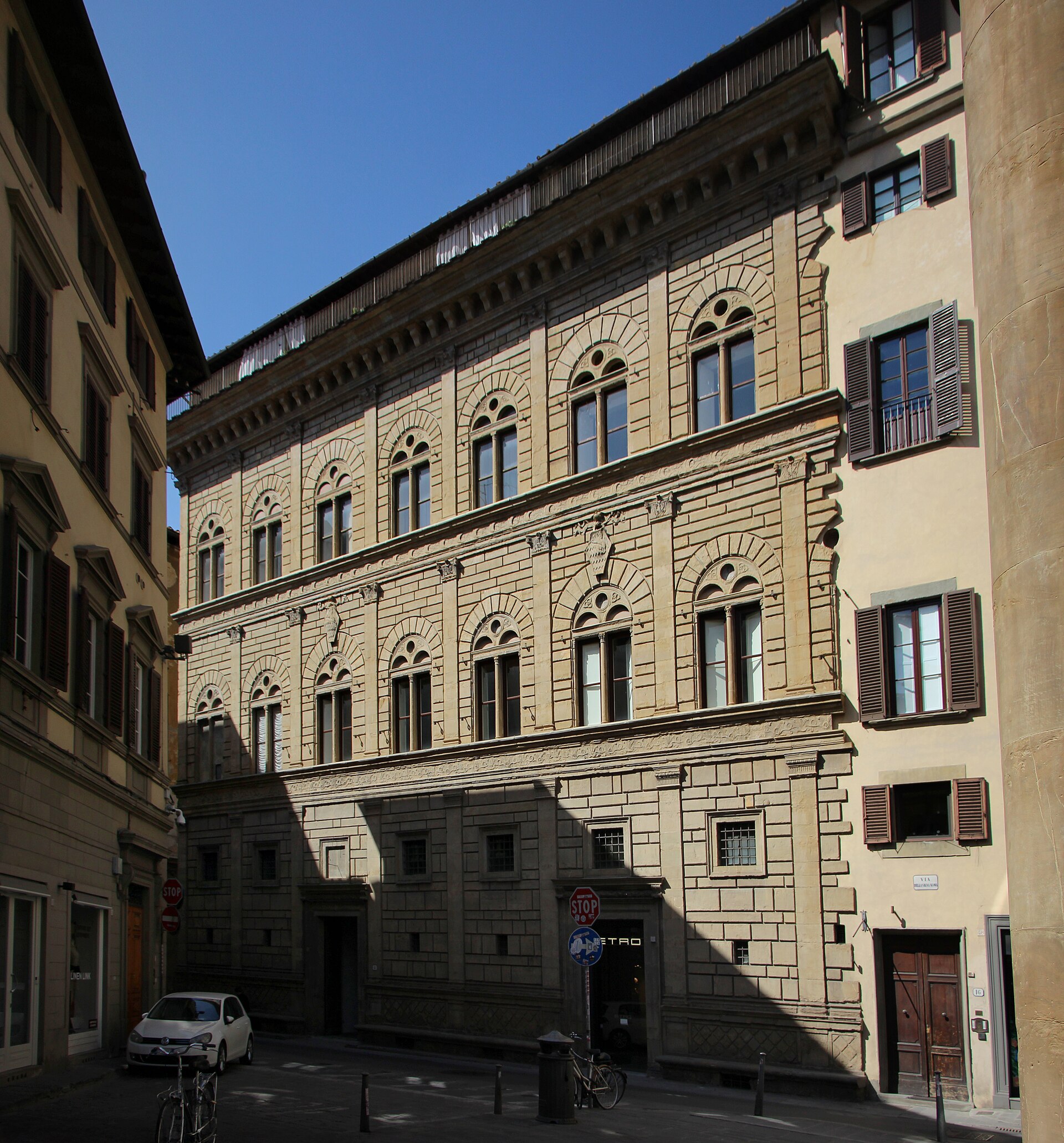
From the narrow Via della Vigna Nuova, opposite the palace, the right edge of the facade is clearly visible. There the masonry breaks off in jagged teeth, as if the building was about to bite the neighboring house and did not quite make it. This is neither destruction nor alteration. It is the mark of a defeat, and it is worth telling about it in order. First, about what lies behind this facade. Rucellai did not demolish anything. Starting in 1428, he gradually bought up neighboring houses, mostly from his own numerous relatives, and was not in a hurry so as not to spoil relations. He later connected six separate houses from the inside - he punched through walls, added passages and staircases. Inside, a mess resulted, and the facade was devised as a clever mask concealing all of it. Cosimo de Medici acted differently in those same years: he started his palace from scratch, demolishing everything that stood on the site. An unspoken competition of the richest families was underway between the two buildings, and Rucellai found himself in a delicate position. Openly competing with the Medici was dangerous; Alberti himself wrote that it is wise to imitate superiors, but not to surpass them. The Rucellai Palace is three times smaller than the Medici Palace and is emphatically not a fortress. Giovanni did not name the author anywhere, neither in his notebook nor in the accounts. No document linking Alberti to this house exists. But Brunelleschi died in 1446, and the best architect of the city in the mid-forties was Leon Battista Alberti, and there is no doubt about the authorship. Perhaps the silence is explained by the then-current belief, which Cosimo de Medici also adhered to - the real father of the building is the patron, not the designer. Now the facade itself. It looks drawn - so fine is its design. The wall is built like this: a thick cushion of mortar hides the irregularities of the old houses, and smooth stone blocks are embedded into it. Vertically, the facade is divided by pilasters - flat columns that support nothing and serve as decoration, a purely Roman technique. Alberti arranged the orders according to the rule of the Colosseum: at the bottom are Doric ones, the simplest, because simplicity means strength; higher up are Ionic ones; at the top, where only the roof needs to be supported, are Corinthian ones, the most ornate. Three tiers of windows, a heavy cornice: the scheme is the same as the Medici's, but the result is the opposite. Two signs are carved into the cornice: a wind-blown sail, Giovanni's favorite symbol meaning good luck, and a ring with a stone, taken from the Medici, with whom he became related through his son. And here is the edge. Study of the facade showed that it was conceived with only five bays, with a single entrance in the middle. Then Rucellai bought another house and decided to stretch the facade by three bays to the right. To finish building the third and get symmetry, he needed to buy out the house of yet another relative. He refused, and moreover - inscribed in his will a ban on selling or renting this house to Giovanni and his descendants for ever and ever. Symmetry did not happen. The masonry teeth keep sticking out. By the way, the palace is still residential, and the direct descendants of the builder live in it - a rarity even for Florence. They do not let people inside, but all the main things are here on the outside anyway.
AI translation · 🇬🇧 EN
Rate this review:
Nearby and related
By the same architect
Close by in Florence
About the Object
Leon Battista Alberti
1451
Renaissance
Via della Vigna Nuova 18, Firenze
Residential Building