
Santa Maria Novella
Всемирное наследие ЮНЕСКОAbout the Object
Leon Battista Alberti
1357
Gothic
Piazza di Santa Maria Novella, Firenze
Religious Structure
Gallery (2)

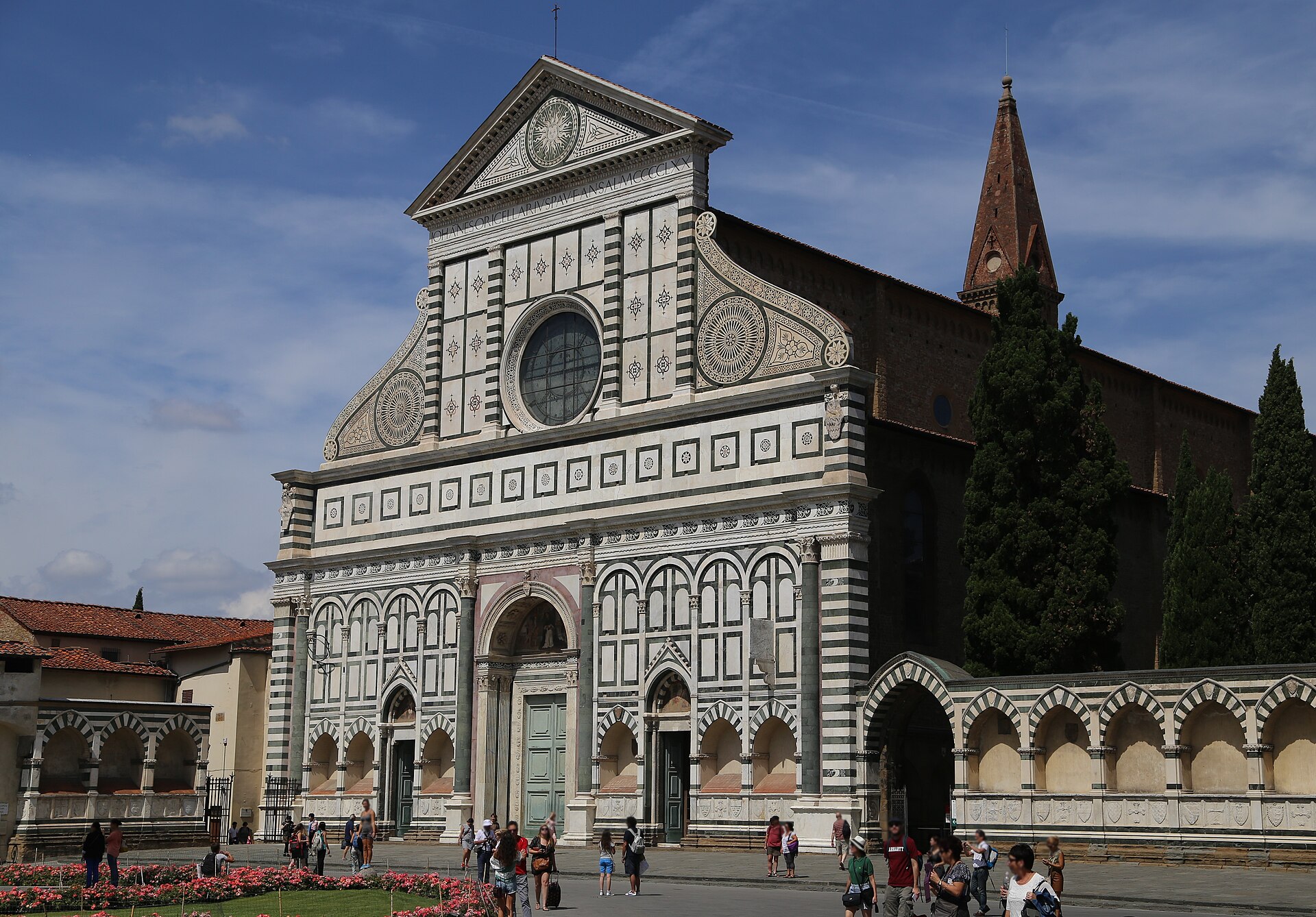
The facade where the patron wrote his name instead of a saint's
The church was built by the Dominicans between 1279 and 1357. It is Gothic, and on the outside this is visible in everything except one thing: the facade, which looks completely different. Geometric green and white marble, calm circles and squares, nothing pointed. The reason is simple: the church is Gothic, but its facade was redressed. It was finished over a hundred years after the church itself, and it was finished with private money. In the late 1450s Giovanni Rucellai - the very one whose palace stands a few blocks away - agreed to pay for the completion of the facade of the city's largest and most important church after the cathedral. He hired the same architect, Leon Battista Alberti. And now raise your eyes to the upper part of the facade. There is a Latin inscription in large Roman letters. It mentions neither the Dominican order nor the Virgin Mary, to whom the church is dedicated. The inscription says: "Giovanni Rucellai, son of Paolo, 1470". It is worth pausing on this. On his own palace, Rucellai did not even name the architect and left his name nowhere - everything there is expressed by form. On someone else's church, having paid for its face, he wrote himself across the facade in capital letters. The palace told the city "I am just like you"; the inscription on the temple said "I made this". The patron was nearly seventy by that time. Four years later, several of his wool companies would collapse, and he would have to sell his country estate to Lorenzo de' Medici - that very family which once blocked his path to politics and with whom he had by then become related through his son. He died in 1481, at seventy-eight, in his palace, surrounded by his family. The name remained on the church. Another thing people walk past: along the facade and the wall behind it stretch avelli niches, that is, tomb niches. The church stands in a cemetery surrounded by them, and they are visible right from the square.
AI translation · 🇬🇧 EN
Rate this review:
Inside: a crucifix that looks longer than it is, and the hounds of the Lord
Inside, the church is different: tall, Gothic, dark. And it is arranged with a focus that is worth checking out for yourself. From the entrance, along the nave, Giotto's crucifix hangs in the middle. It looks implausibly elongated. It is not about the crucifix itself: the nave pillars are not placed at equal distances, but get progressively closer toward the altar. Because of this, the space seems longer than it is, and the eye is deceived even before you notice anything. This is the thirteenth century, long before any theories of perspective. And a hundred and fifty years later, a fresco appeared here, with which perspective is generally considered to begin. Masaccio's Trinity, around 1427: the architecture painted on the wall recedes into the depth so convincingly that the wall ceases to be a wall. The figures are arranged in a triangle, the eye is led upward to Christ and God the Father. The Virgin Mary and John are painted as living people, rather than ideal images. And below, on the sides, the patron Lorenzo Lenzi and his wife are kneeling - once again the patron, once again in the frame. Moving on to the chapels. In the Strozzi Chapel, the brothers Nardo di Cione and Andrea Orcagna painted the walls with scenes from Dante's Divine Comedy. In the Tornabuoni Chapel, scenes from the life of John the Baptist are painted. And be sure to make it to the Spanish Chapel in the cloister. There, on the frescoes, the Dominicans are depicted as lean hounds, herding stray sheep into the flock. This is not a mockery of the order, but its own joke: "Dominicans" in Latin sounds like domini canes, "hounds of the Lord", and the order embraced this image willingly. Rarely is theological wordplay brought to the state of mural painting.
AI translation · 🇬🇧 EN
📷 Wikimedia Commons · Zairon · CC BY 4.0 · https://commons.wikimedia.org/wiki/File:Firenze_Basilica_di_Santa_Maria_Novella_Interno_Navata_Sud_2.jpg
Rate this review:
Nearby and related
By the same architect
Close by in Florence
About the Object
Leon Battista Alberti
1357
Gothic
Piazza di Santa Maria Novella, Firenze
Religious Structure