
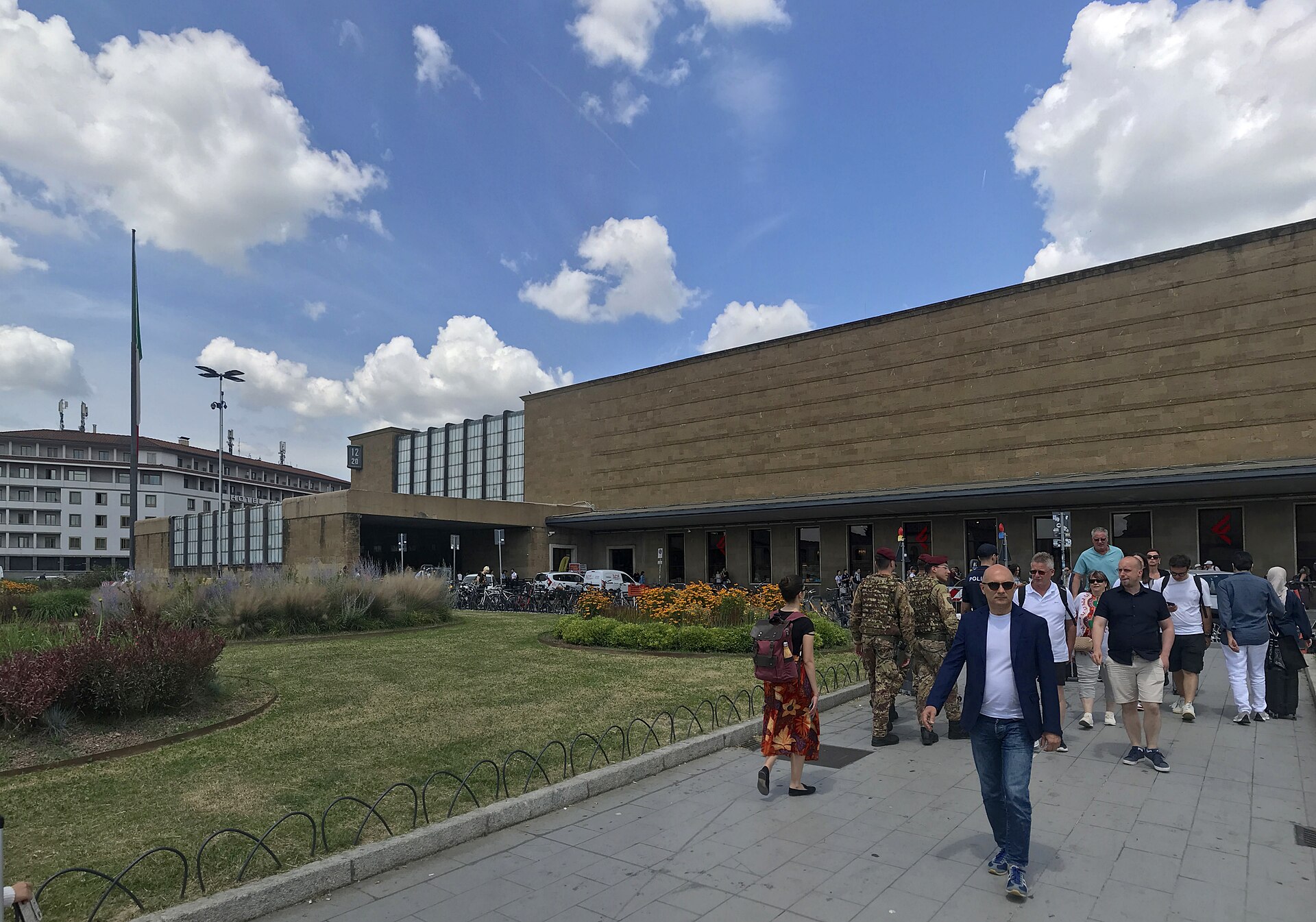
Santa Maria Novella Railway Station
Всемирное наследие ЮНЕСКОAbout the Object
Giovanni Michelucci
1936
Rationalism
Piazza della Stazione, Firenze
Railway Station
Gallery (2)

The Station Built Under Mussolini That Refused to Look Like Ancient Rome
If you arrived in Florence by train, this was the first building in the city you saw. And it looks like nothing else around it: low, horizontal, stone-faced, with no columns, no arches, and not a single reference to the Renaissance. In a city that lives in its fifteenth century, this feels more like a challenge. Here is the history. In 1932, a competition was announced for a new station to replace the old 19th-century one. The project was designed by a group of architects led by Giovanni Michelucci, and it was built by 1936, at the height of the Fascist two decades. Now, there is something that needs to be understood correctly. Mussolini promised the country buildings and cities to rival those of Ancient Rome-and, logically, one would expect him to demand columns and eagles. But unlike Hitler, he did not insist on neoclassical style and accepted what Michelucci called rationalism. Thus, in 1930s Italy, alongside pompous Roman imitations, works like this appeared: modern, understated, and free of historical masquerade. Mentally compare this with the Milan Central Station, built around the same time: there, you have a giant cliff-like facade seventy meters high. Here, it is a long, low building that doesn't try to overpower anyone. Two different answers to the exact same state commission.
AI translation · 🇬🇧 EN
Rate this review:
Why it is still comfortable: stone, light, and utility
It is worth going inside, even if you do not need a train. The main hall is low, elongated, and clad in local stone, and the first impression is one of calm. This is the result of calculation, not chance. Michelucci built in a style that was neither modern in the sense of that time nor classical, and it relied on three things: good proportions, the way light and shadow fall, and direct utility. Not on ornamentation, of which there is almost none, and not on historical quotes, of which there are none at all. The building succeeds precisely because of this - it is emphatically horizontal, strong, and practical. Testing this is easy: the station is nearly ninety years old, it handles a passenger volume that was unimaginable in the thirties, and yet it is used without having been remodeled. Few buildings from those years have passed such a test. Another detail for those who love sequels. An underground body with a glass roof was built beneath the station, designed by Norman Foster and Arup engineers; in the 2006 architectural guide, it was listed as expected by 2008. How it all ended, our sources do not say: the guide was published ahead of the completion deadline. And finally. Michelucci lived to be a hundred, from 1891 to 1991, spanning from the era when facades were still being finished in Florence in a historicist spirit, to the end of the twentieth century. He created this station when he was forty-five.
AI translation · 🇬🇧 EN
📷 Wikimedia Commons · Freepenguin · Public domain · https://commons.wikimedia.org/wiki/File:Interior_of_Firenze_Santa_Maria_Novella_railway_station_8.JPG
Rate this review:
Nearby and related
Close by in Florence
About the Object
Giovanni Michelucci
1936
Rationalism
Piazza della Stazione, Firenze
Railway Station