
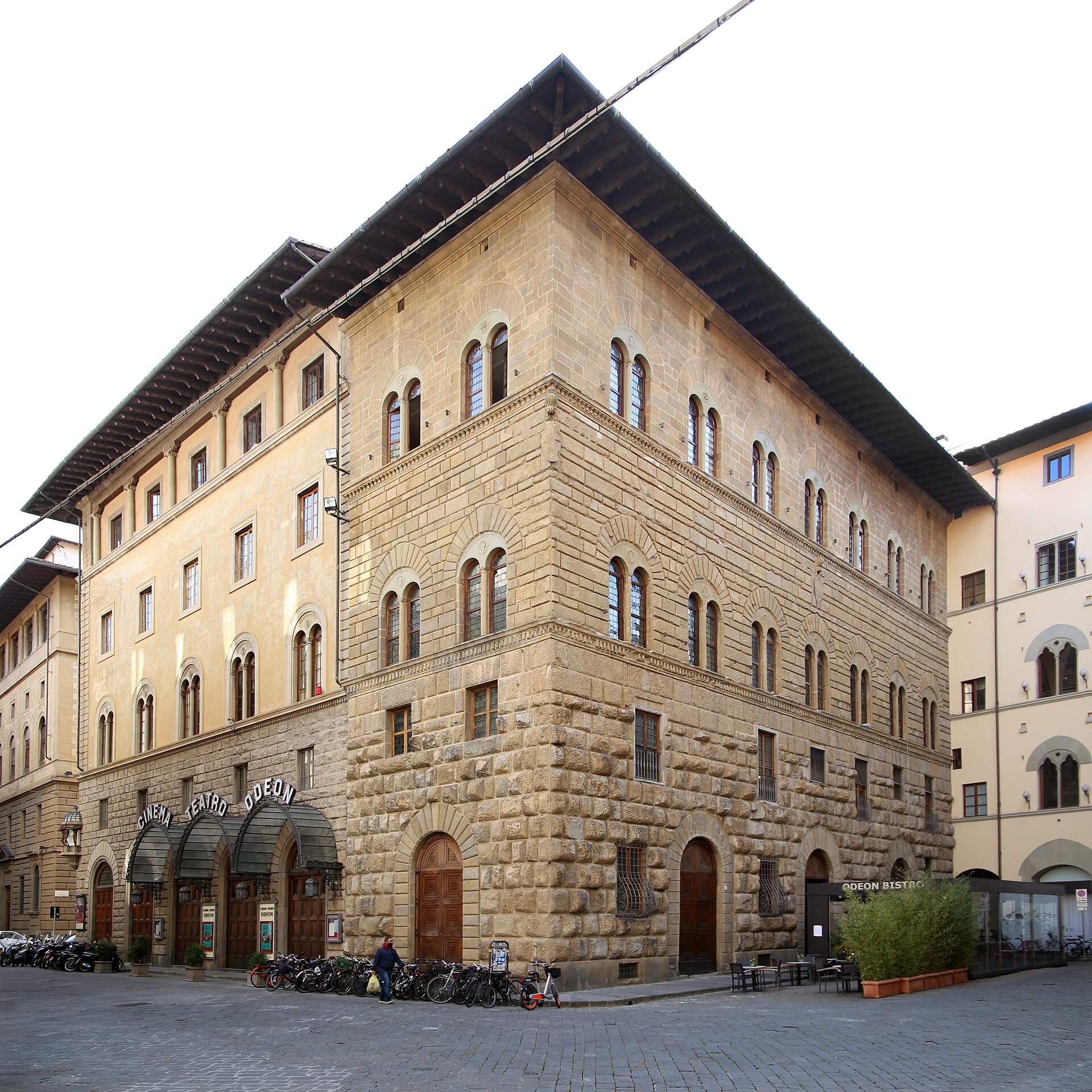
Palazzo dello Strozzino (Cinema Odeon, Giunti Odeon)
Всемирное наследие ЮНЕСКОAbout the Object
Michelozzo, Giuliano da Maiano, Adolfo Coppede, Marcello Piacentini
1457
Renaissance
Piazza degli Strozzi 2, Firenze
Public Building
Gallery (1)

The Palace That Had Its Courtyard Removed and a Cinema Inserted
On Piazza Strozzi stand two palaces, and almost everyone looks at the big one. The small one opposite is called Strozziino, meaning the "smaller Strozzi", and it has undergone a history unlike that of any other Renaissance palazzo in Florence. Construction began around 1457 for relatives of Palla Strozzi, who by that time had already been exiled from the city. The design is attributed to Brunelleschi, the lower facade with rough uneven rustication and the inner courtyard with columns were done by Michelozzo, and the second tier with paired windows and softer rustication by Giuliano da Maiano. The third floor was added only in the nineteenth century. This building should be read from bottom to top: the higher you go, the smoother the stone and the calmer the rhythm, and a single facade shows how taste changed over a few years. Next, the palazzo had some bad luck. When Florence briefly became the capital of Italy, it was partially demolished for the new city center layout. And in 1914, new owners decided to set up a cinema inside, reportedly on the advice of the actress Eleonora Duse. The project was begun by the Florentine Adolfo Coppede and finished by Marcello Piacentini together with Gino Venturi. Work lasted from 1920 to 1922: new facades "in the fifteenth-century style" were added, and the auditorium was placed in the spot of Michelozzo's old courtyard. The courtyard columns were not thrown away, however, but put back to work. The hall opened on December 14, 1922, with a gala evening and was then called Cinema-Teatro Savoia. The interiors were done in Art Deco style, featuring sculpture by Antonio Maraini and tapestries by Matilde Festa-Piacentini. Special mention should be made of Piacentini, because later his biography took a different turn. Ten years later, he would become the chief architect of Mussolini's regime, cut through Via della Conciliazione towards St. Peter's Basilica, and build the EUR. On our map he is present precisely in this capacity. But he started, among other things, like this: carefully inserting a cinema into a Renaissance palace in someone else's city.
AI translation · 🇬🇧 EN
Rate this review:
What is here now and why you should go
Since November 2023, there is a bookstore inside. Not instead of the cinema, but alongside it: the 198-seat auditorium has been preserved and is operating, showing movies in the evening, while during the day it serves as a retail and reading room. Fifteen hundred square meters, more than twenty-five thousand books, a cafe, and an area with tables where you can sit with a laptop. Open from ten in the morning until half past eight in the evening, free admission. Why it is worth your time, even if you were not planning to buy books. First, it is the only way to get inside Palazzo Strozziño and see what they have done with the courtyard. Second, it is a rare case in Florence where a historic building has not been mothballed or turned over to just another clothing store, but given a function that brings people together. Third, purely practically: in a city where it is hot in summer and there is nowhere to sit, here you have shade, quiet, a restroom, a cafe, and no one chases you away. With a child, this works better than it sounds. The middle of the day, when sightseeing is not working out anyway, is spent here without any loss.
AI translation · 🇬🇧 EN
Rate this review:
Nearby and related
Close by in Florence
About the Object
Michelozzo, Giuliano da Maiano, Adolfo Coppede, Marcello Piacentini
1457
Renaissance
Piazza degli Strozzi 2, Firenze
Public Building