
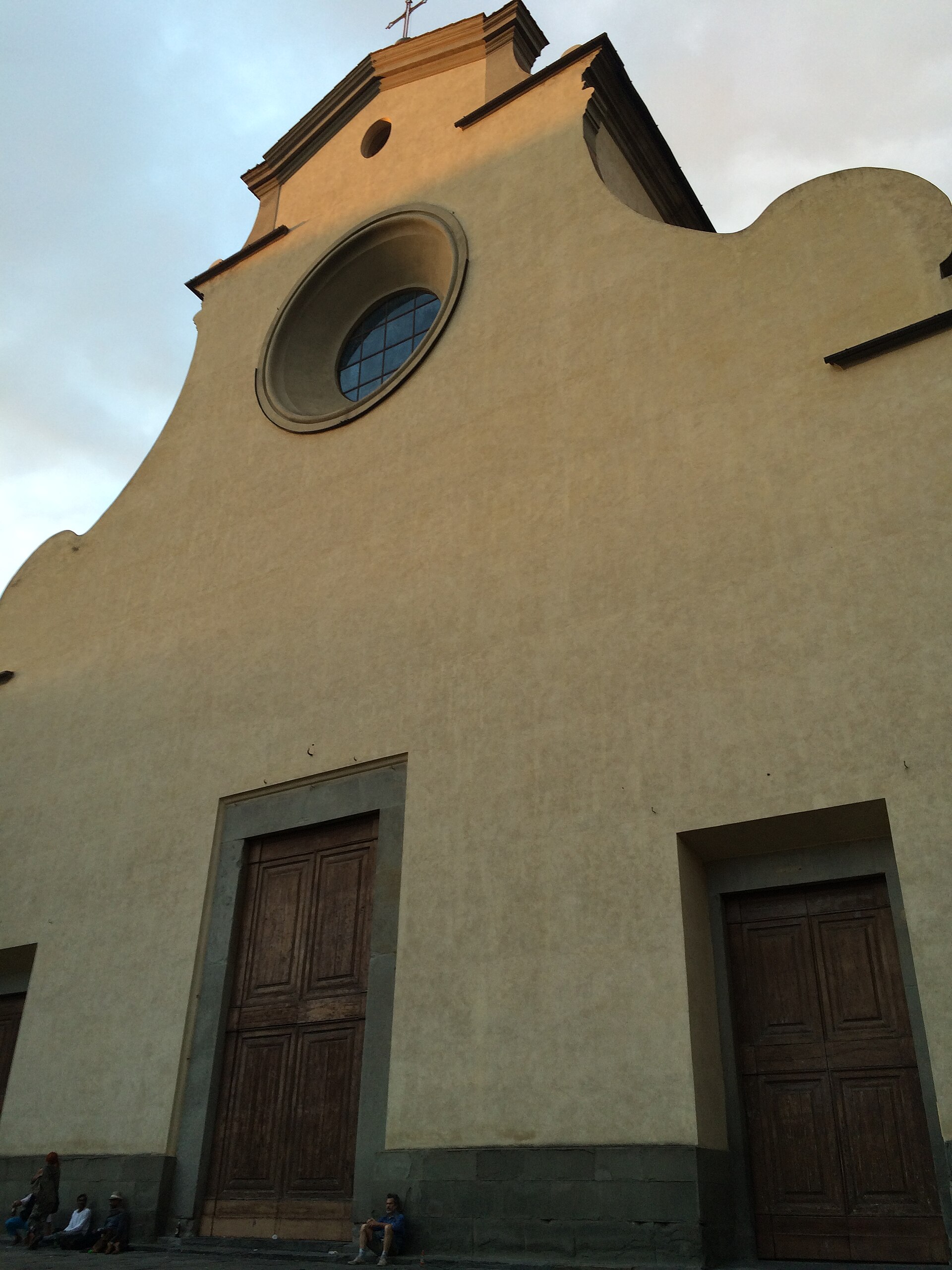
Basilica of Santo Spirito
Всемирное наследие ЮНЕСКОAbout the Object
Filippo Brunelleschi
c. 1487
Renaissance
Piazza di Santo Spirito, Firenze
Religious Structure
Gallery (1)

The church that the neighborhood ordered for itself - after a Lenten sermon
This church has a rare feature for Florence: we know its history not from documents, but from a witness account. Antonio Manetti, Brunelleschi's first biographer, lived in this neighborhood, and the construction directly affected his family - which is why he describes the organizational side in detail, like someone who was actually there. It all started, according to him, around 1428 with a sermon. Friar Francesco Zoppo, a doctor of theology, was reading Lenten sermons in Santo Spirito - and since he lived in accordance with what he preached, he gathered many listeners, especially from his neighborhood. He spoke about the monastery, its school and, finally, the church: this is the main church of one of the city's most important neighborhoods, where respected citizens live who contribute to the prosperity of Florence, which means it is time to think about renewing the building, "so that the church becomes worthy of the neighborhood." And since no one thought of it before, we must start now. Next comes the machinery that worked like clockwork in this city. Everyone decided that the endeavor would bring glory to the preacher, to themselves, and to the city. They understood that this had to be done with the consent of the Signoria, and that operai were needed - those responsible for construction. In 1428, five respected residents of the neighborhood were elected; at their very first meeting they decided that a proveditore was needed - an inspector, a notary, a specific location and a well thought-out plan for the entire building. The proveditore was chosen quickly: the main chapel of the old church belonged to the Frescobaldi, and Stoldo Frescobaldi was a man of business and loved the church - he was elected. And, as Manetti writes, before money was collected, Stoldo paid out of his own pocket. According to documents, a second date is added to this: an organizational committee of two responsible persons - Piero di Ghirigoro d'Andrea and Stoldo Frescobaldi - was created in 1434, a donation drive was announced, and it allowed the design and work to begin. Later, they managed to obtain an allocation of part of the tax from the Signoria for construction. And here is why all this needs to be known. San Lorenzo was built by the Medici, and therefore everything there was decided by the interests of a single family, right down to moving the altar for the sake of a tomb. Here the client was the neighborhood: five elected officials, an inspector, a subscription, a tax. The same architecture, two opposing models of commission, and both Florentine.
AI translation · 🇬🇧 EN
Rate this review:
What's actually Brunelleschi here: the arcades - yes, the facade - no
How Manetti describes Brunelleschi's work process: they sent for him, laid out their thoughts, gave him time to think, and instructed him to come back "with a good design," promising a handsome reward. He made a drawing with the foundations and explained verbally how the finished building should look. They liked it, and commissioned him to make a wooden model. He brought the model, and it was very beautiful. Manetti specifically notes that the architect never deviated from the model thereafter: "he said that the overall layout of the building corresponded to his vision, and indeed, he did not deviate from the model. He began construction and laid out several chapels, and built a part of it during his lifetime in accordance with his vision." And then comes an assessment worth quoting in full, because it belongs to a man who saw it with his own eyes: "It was a beautiful building, which, with its projecting chapels, had no equal in the Christian world, even with the errors and deviations introduced by other masters." Pay attention to the caveat at the end: errors and deviations of other masters. The church was completed over decades after Brunelleschi's death, right up to the end of the fifteenth century. What is worth seeing inside. The arcades with semicircular arches and a row of side chapels are entirely his. Thirty-eight side altars with 15th- and 16th-century Renaissance painting and sculpture, including works by Cosimo Rosselli, Domenico Ghirlandaio, and Filippino Lippi. And the vestibule behind the door beneath the organ in the left nave, featuring a rich coffered ceiling: designed by Simone del Pollaiuolo, universally known as Cronaca, in 1491. What gets in the way: the Baroque baldachin and high altar - seventeenth-century additions layered over the fifteenth. The DK guidebook puts it plainly: the harmony of proportions is "somewhat marred" by them. You don't have to agree, but it's good to know in advance so you understand precisely what elements of the interior are at odds with one another. And an honest detail about the facade: it remains unfinished. What you see from the piazza is an incomplete eighteenth-century work, a blank, blind plane. This church has no face, and in that it resembles San Lorenzo, whose facade was likewise never executed. Florence's two main Brunelleschi basilicas stand without facades - and perhaps that is the most precise metaphor for how this city built: the vision was always greater than the sum of the money they managed to raise.
AI translation · 🇬🇧 EN
Rate this review:
Nearby and related
By the same architect
Close by in Florence
About the Object
Filippo Brunelleschi
c. 1487
Renaissance
Piazza di Santo Spirito, Firenze
Religious Structure