
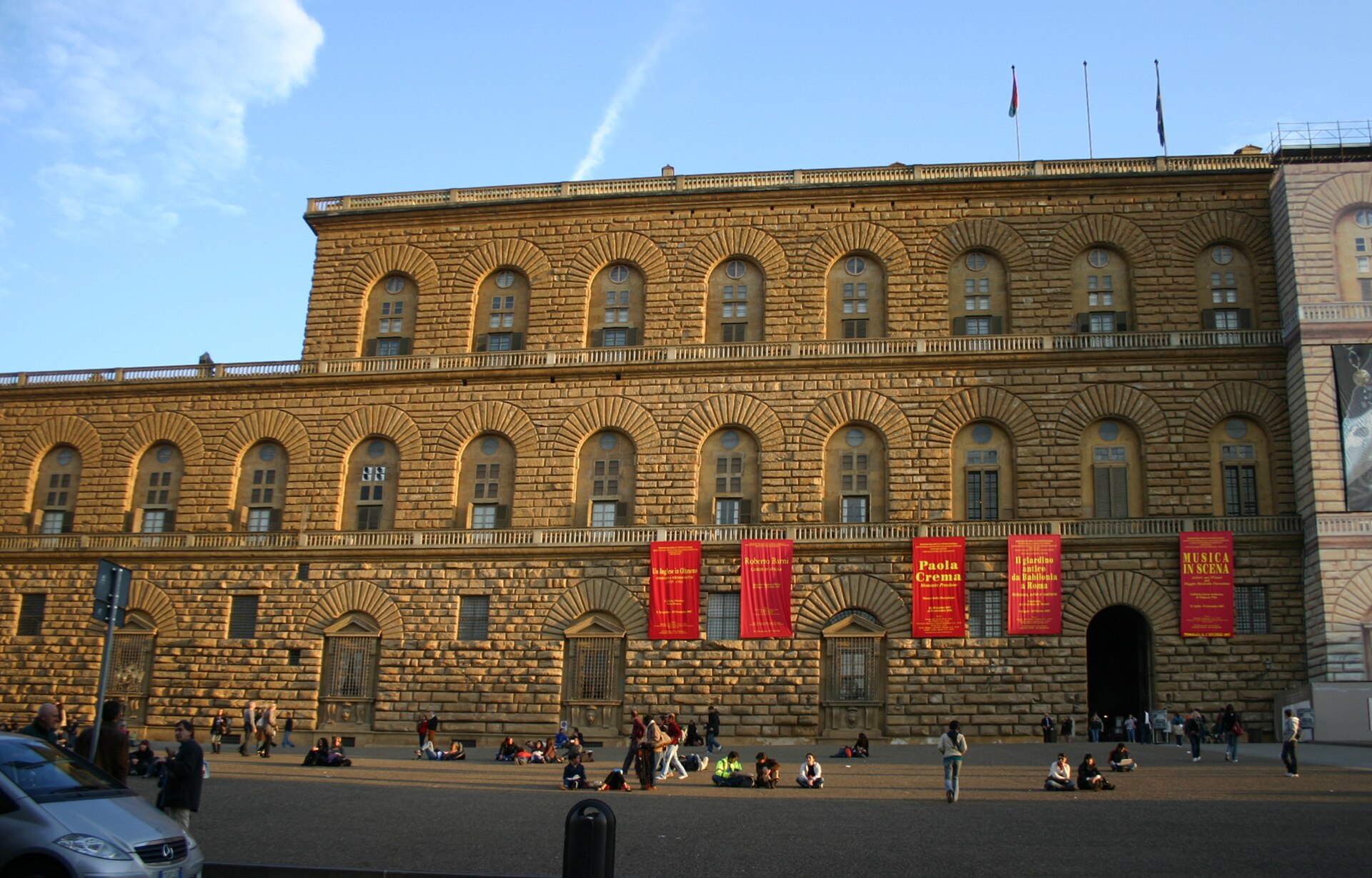
Palazzo Pitti
Всемирное наследие ЮНЕСКОAbout the Object
Bartolomeo Ammannati (courtyard, 1560–70)
c. 1457
Renaissance
Piazza de' Pitti, Firenze
Museum
Gallery (2)

The palace that ruined its commissioner and went to those he wanted to eclipse
Construction of the palace began in 1457 for the banker Luca Pitti, and it started with a clear goal: to eclipse the Medici Palace. This motif repeats for the third time in a row, and for the third time with a different ending. It ended like this. The construction costs ruined Pitti's heirs, and a century later the palace had to be sold. It was bought by Eleonora of Toledo, wife of Cosimo I de' Medici - according to DK [travel guide], because she believed that the relatively suburban location across the river would benefit her frail health. That is, the building, conceived as a weapon against the Medici, became their home, and not just a home: the family moved here, and thereafter all the rulers of Florence lived here. The Medici expanded the palace, and its current size is their doing, not Pitti's. Standing in the square and looking at the facade, it is worth keeping this in mind: before you is not the vision of the commissioner, but the vision of those who bought it out. Later, the building accumulated residents in escalating fashion. Napoleon lived here when he was in Florence. Collections settled here as well: today there are four separate museums inside. The main one is the Palatine Gallery, frescoed by Pietro da Cortona; its collection is the second largest in the city after the Uffizi, and it holds one of the world's best selections of Raphael and Titian. It was opened to the public in 1833. Besides the gallery, there are the Royal Apartments, the Medici Treasury, the Gallery of Modern Art, and the Costume Gallery spanning the 18th to 20th centuries. A strange thing turns out. The house, begun for the purpose of defeating the Medici in a contest of facades, ultimately became the place where everything the Medici collected is kept. Of all the stories of Florentine architectural commissioning, this one ends most mockingly.
AI translation · 🇬🇧 EN
Rate this review:
A courtyard intentionally made rough, and a gallery hung in 19th-century taste
It is worth going inside if only for the courtyard. Bartolomeo Ammannati built it between 1560 and 1570, by then for the Medici, and constructed it in a manner known as Mannerism: the same classical orders as everywhere else, but deliberately coarsened, exaggerated, with heavy rustication on the columns. This is not lack of skill. It is a conscious spoiling of the correct, done by a generation that grew up on the flawless proportions of Brunelleschi and Alberti and wanted something different. Further up, into the Palatine Gallery. It is frescoed by Pietro da Cortona, and its collection is the second-largest in the city after the Uffizi: one of the world's finest selections of Raphael and Titian. But the main thing here is not what hangs, but how. The paintings are hung as they were hung in the nineteenth century, and the logic was not museological, but decorative: does this Tintoretto suit the room's decor, do round canvases look good together. No chronology, no schools. Today this is a rarity: almost all major galleries in the world have long been rehung according to the textbook. Here you can see how paintings were displayed before art history decided that display had rules. If you walk through the remaining rooms, look at the Green Room in the state apartments: it has survived better than the others, featuring an ebony cabinet inlaid with stone and bronze, while the ceiling has trompe-l'œil stucco reliefs and a canvas by Luca Giordano - the very same one who painted the hall in the Palazzo Medici Riccardi on the other bank. One family, one artist, two houses, two hundred years difference from the beginning of this story.
AI translation · 🇬🇧 EN
📷 Wikimedia Commons · Dimitris Kamaras · CC BY 2.0 · https://commons.wikimedia.org/wiki/File:Ammannati_Courtyard%2C_Palazzo_Pitti%2C_Florence_(26586339732).jpg
Rate this review:
Nearby and related
Close by in Florence
About the Object
Bartolomeo Ammannati (courtyard, 1560–70)
c. 1457
Renaissance
Piazza de' Pitti, Firenze
Museum