
Boboli Gardens (Giardino di Boboli)
Всемирное наследие ЮНЕСКОAbout the Object
1550
Renaissance
Piazza de' Pitti, Firenze
Park
Gallery (2)

The garden started a year after the move, and why it was needed
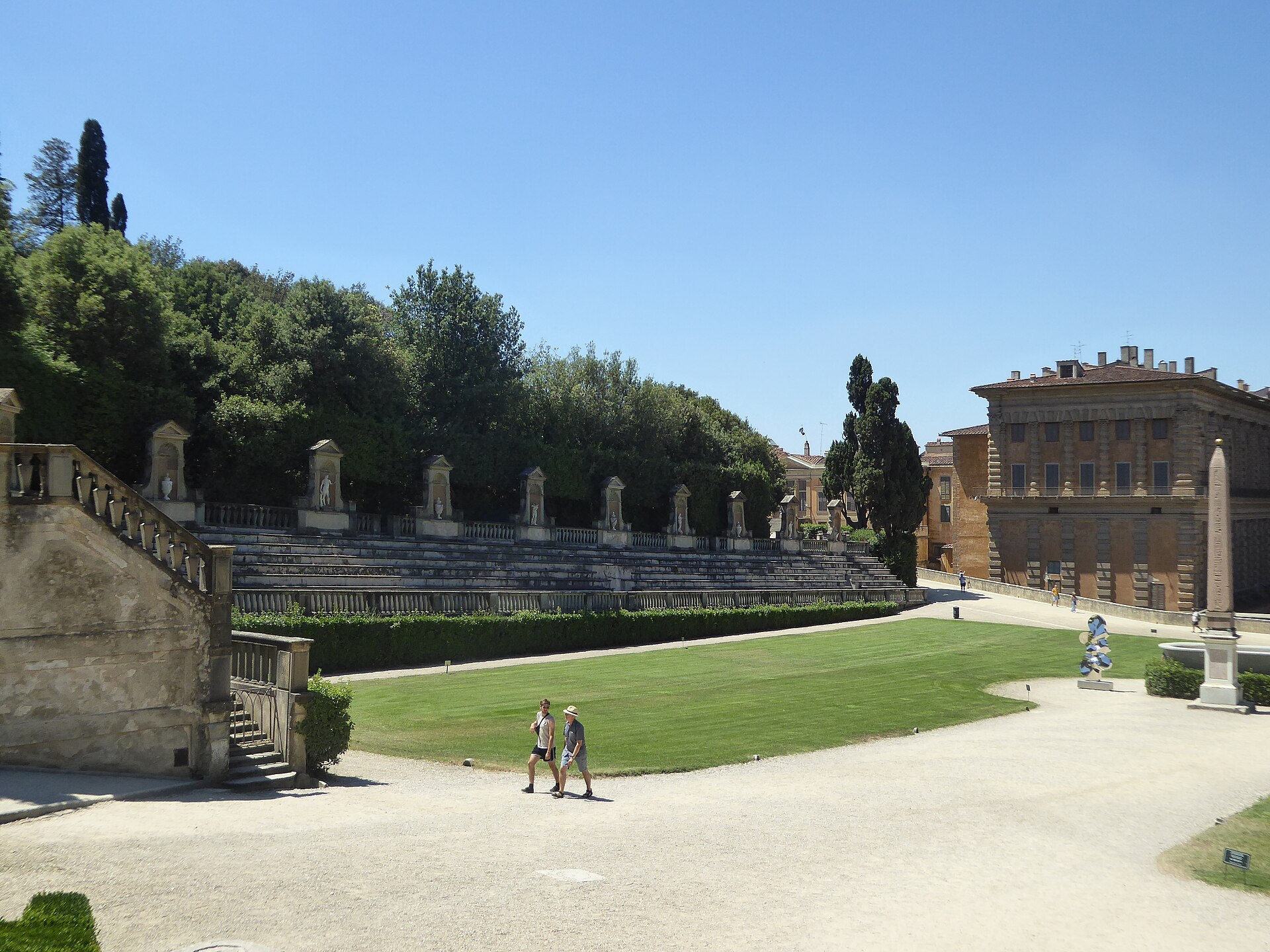
The Boboli Gardens unfold up the hill behind the Pitti Palace. They were laid out for the Medici in 1550, shortly after the family bought the palace and moved across the river, and this is crucial for understanding the entire place: the garden appeared not as a decoration, but as part of the relocation. It is not arranged as a park for strolls. It is an open-air extension of the palace: smooth lawns, staircases, paths that lead to unexpected places, and an amphitheater right behind the building. The amphitheater is worth lingering at. It is a theater without a theater, carved into the hillside, and it immediately makes clear why the dukes needed a garden of this size: performances were given and guests were received here. The palace was a place to live, the garden a place to show. The hill also provides a second thing: elevation. Oltrarno, meaning 'beyond the Arno', was incorporated into the city late, only when the final ring of walls was completed in 1333, and before the Medici move, it was the poorest part of Florence. Climbing up the garden, you realize what exactly the family bought for themselves along with the palace: not just a house, but a slope overlooking the entire city, left behind below and on the other bank. Practical info: allow a couple of hours and keep in mind that the entrance to the garden is separate from the palace. At the top of the garden stands the Porcelain Museum, and the same ticket grants admission to the nearby Bardini Garden.
AI translation · 🇬🇧 EN
Rate this review:
A Man-Made Cave and Michelangelo’s Captives That Spent Four Hundred Years Inside It
The main attraction of this garden is the Grotta Grande, the Great Grotto. From the outside it is a pavilion, on the inside a cave, and a cave handcrafted from the very first stone to the last. The walls are inlaid with mother-of-pearl and seashells, man-made stalactites hang from the ceiling, and all this stony dampness is deliberately implausible. Such things were loved by the sixteenth century and taken very seriously. This is Mannerism: the very same craftsmanship of the Renaissance, just turned inside out—nature crafted by hand and put on display so that the guest could simultaneously believe and disbelieve. Between Brunelleschi’s flawless courtyard at the Spedale degli Innocenti and this cave lies a hundred-plus years, and the difference between them is the entire history of taste over a century. Yet what is most interesting is what used to stand inside the grotto. Between 1521 and 1523, Michelangelo carved four "Captives"—figures that seem to be trying to break free from the raw stone. They were intended for the tomb of Pope Julius II, but the tomb was never finished. In 1585, the statues were transported here and placed in the cave. And so they stood in the garden for four centuries. Today the originals are in the Galleria dell'Accademia, next to the "David," while here stand their plaster casts. They are kept company by the works of Giambologna. It is worth pondering this as you stand inside. Michelangelo’s most unfinished sculptures, figures stuck halfway in the stone, spent four hundred years in an artificial cave made of seashells and fake stalactites. It is hard to imagine a setting that would suit them better.
AI translation · 🇬🇧 EN
📷 Wikimedia Commons · sailko · CC BY 2.5 · https://commons.wikimedia.org/wiki/File:Grotta_del_buontalenti%2C_prima_sala_01.JPG
Rate this review:
Nearby and related
Close by in Florence
About the Object
1550
Renaissance
Piazza de' Pitti, Firenze
Park