
Ponte Vecchio
Всемирное наследие ЮНЕСКОAbout the Object
Neri di Fioravanti – see note
1345
Gothic
Ponte Vecchio, Firenze
Bridge
Gallery (1)

The bridge where butchers worked, then jewelers - and why they were replaced
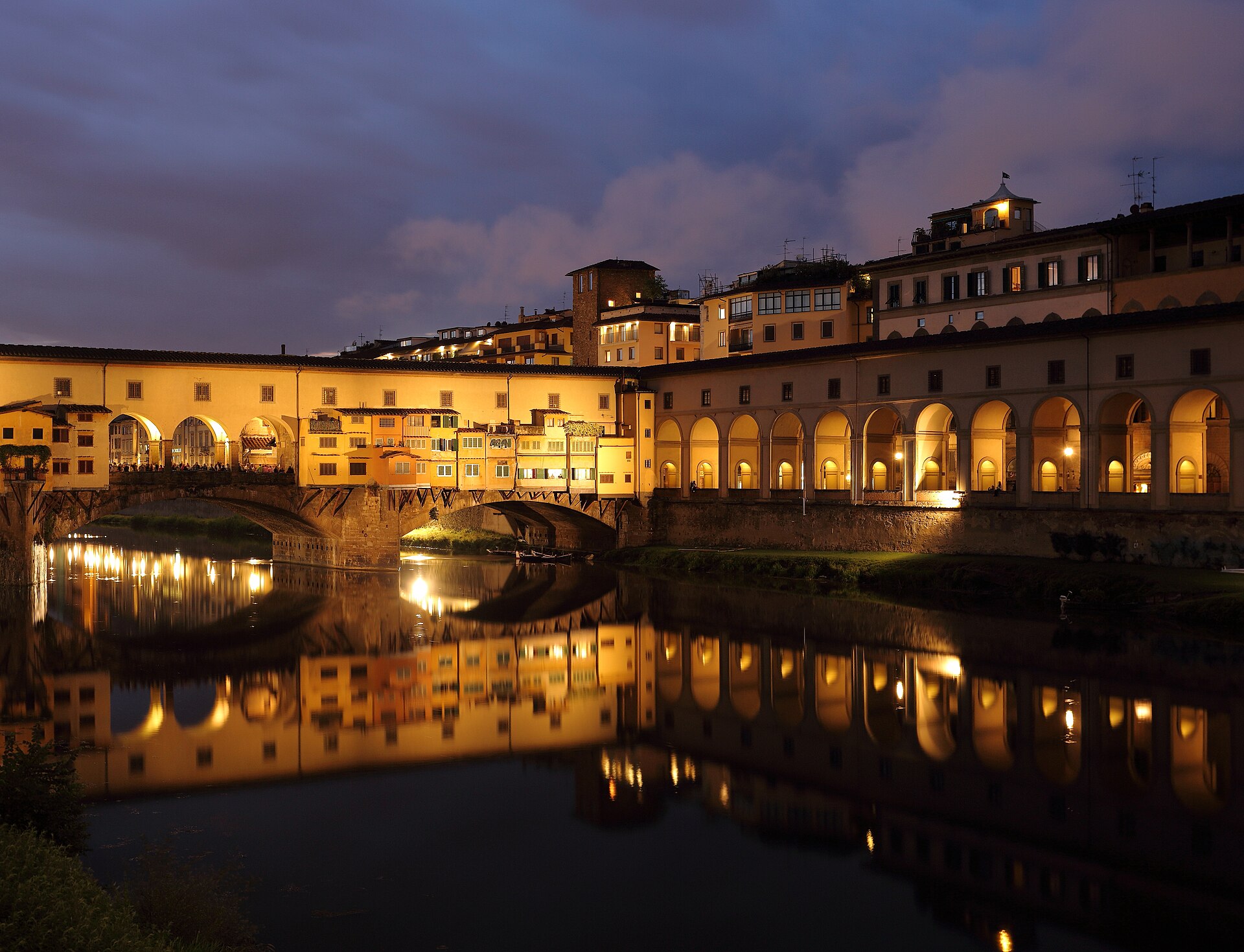
The Arno is narrowest here, which is why there has always been a crossing at this spot. Even the Etruscans set up a crossing here, and historical records show that a wooden bridge stood here in 972. The flood of 1333 swept it away, and in 1345 the bridge was rebuilt in the form you see today. Its creator is named differently: Neri di Fioravanti, while Vasari attributed the work to Taddeo Gaddi. Shops appeared on the bridge immediately, along with it. And here is what's important to understand: the bridge in Florence was not a walkway, but a workplace - meat was cut here, leather was tanned, metal was forged. The river was close at hand, which meant the sewer system was too: waste went straight into the Arno. At the end of the sixteenth century, this came to an end. Grand Duke Ferdinando I evicted the butchers, tanners, and blacksmiths because of the noise and stench, and installed jewelers in their place. The reason was also that by that time the Vasari Corridor, connecting the Palazzo Vecchio to the Palazzo Pitti, had been built over the eastern row of shops: the ducal family walked from their residence to the palace right above the shops, and walking above a slaughterhouse was not the kind of pleasure they had counted on. Since then, the bridge has traded in gold. In the middle, where the rows part and a view of the river opens up, stands a monument to Benvenuto Cellini - the jeweler and sculptor whose Perseus stands in the Loggia dei Lanzi. A logical choice for the bridge of jewelers. And one more thing to look out for. Having crossed the bridge, look at the facades of the houses: on some of them, marks of the 1966 flood are visible - the one that flooded the city and damaged thousands of works of art. The river that fed the bridge almost took it away twice in its history.
AI translation · 🇬🇧 EN
Rate this review:
August 4, 1944: the bridge survived, but everything around it didn't
On August 4, 1944, retreating before the British 8th Army, the Germans blew up all the bridges of Florence. All of them except this one. But here is what is more important than the mere fact itself, and what is almost never mentioned on tours: to block the approaches to the bridge, the buildings at both of its ends were demolished. That is, the bridge survived, but the medieval quarters that led up to it did not. Therefore, standing at the entrance to the bridge, you see buildings around you that are noticeably newer than the bridge itself: these are the traces of that very August. Why it was left untouched is not known for certain, and there are three versions. In Florence, they most often talk about Hitler's personal order. Lisi writes that they wanted to blow up the bridge, but the citizens didn't allow it. And the explanation that looks the least romantic and therefore the most plausible is military: the Germans mined all the bridges except the Ponte Vecchio, and instead of blowing this one up, they simply blocked it with rubble to cut off the crossing and buy time to retreat to the Gothic Line. I deliberately do not choose between the versions. This is precisely the kind of place where a beautiful reason usually turns out to have been invented later, and there is no way to verify it. Yet a hard fact remains a hard fact: Florence's only surviving bridge is the oldest of them all. And it is old not because it was cherished, but because on August 4, 1944, it proved more profitable to bury it in rubble than to blow it up.
AI translation · 🇬🇧 EN
Rate this review:
Nearby and related
By the same architect
Close by in Florence
Routes with this object
About the Object
Neri di Fioravanti – see note
1345
Gothic
Ponte Vecchio, Firenze
Bridge