
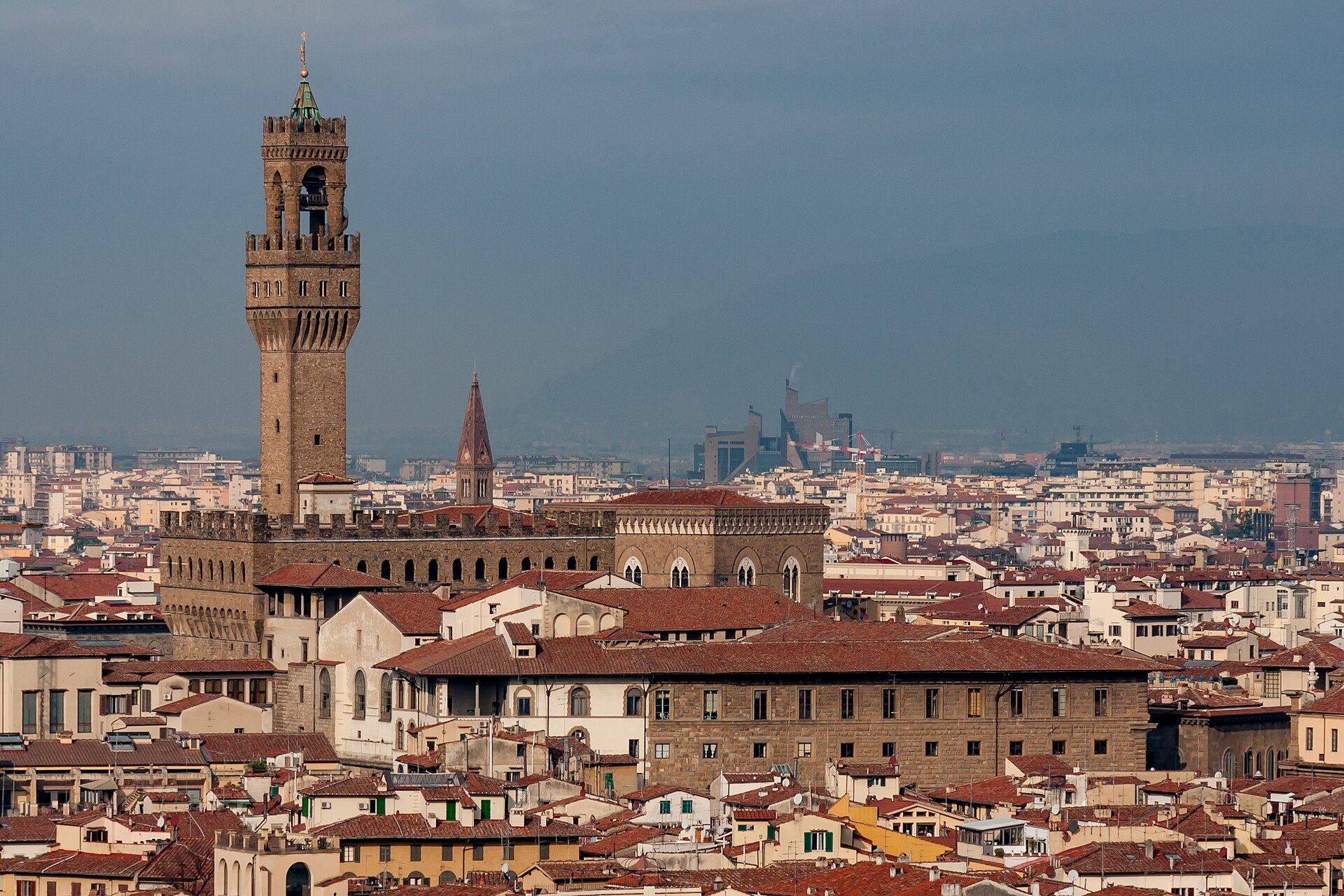
Palazzo Vecchio
Всемирное наследие ЮНЕСКОAbout the Object
Arnolfo di Cambio
1322
Gothic
Piazza della Signoria, Firenze
Public Building
Gallery (1)

Town Hall, Built as a Fortress - and the Bell That Called the City
The ancient core of this building was begun by Arnolfo di Cambio in 1299 - the same man who started the cathedral ten years later. They finished the palace in 1322, and finished it in a characteristic way: an enormous bell was hauled to the top of the ninety-five-meter tower. The bell is the very essence of the building. It was used to summon citizens to parliament, to warn of fire, of the Arno overflowing, of an approaching enemy. A town hall that knows how to call the whole city is a device, not a representation. Look at the palace from below: it looks like a fortress, and this is no stylization. Battlements, a blank lower section, narrow windows, a tower with a viewing platform - the city government building was constructed with the expectation that the government would need to be defended from its own citizens. Fourteenth-century Florence was a city where factions settled scores on the streets and power changed quickly: government members were chosen by lot every two months. And another detail of the same order: the palace still functions as a town hall today. Seven hundred years of the same function is a rarity even for Italy.
AI translation · 🇬🇧 EN
Rate this review:
What the Duke did to the Palace of the Republic
In 1540, Cosimo I de' Medici moved into this palace-and from that moment on, the building ceased to be the home of the commune, remaining so only in name. Outside, almost nothing changed. Inside, everything changed. Cosimo commissioned a remodeling of the interiors. Leonardo and Michelangelo were both invited to paint them-neither ever began the work-and Giorgio Vasari ended up doing it. His frescoes from 1563-1565 glorify Cosimo himself and his creation of the Grand Duchy of Tuscany. In other words, on the walls of a house where the elected Signoria had met for two hundred years, it is written how wonderful it is that there is now a duke. The name 'Vecchio', meaning 'Old', appeared at the same time and for the same reason: when the court moved to the Pitti Palace on the other bank, this palace became 'old'. Inside, there are two things worth finding. The first is Donatello’s 'Judith and Holofernes', a bronze that originally stood in the open air on the square; today, an outdoor copy stands in its place. For its political biography, see the square's description: the very same sculpture managed to serve as a monument to the Medici and a monument to their exile. The second is the Hall of the Five Hundred, and you need to know its history in advance, otherwise half of its meaning will pass you by. The hall was built in 1494, immediately after the expulsion of the Medici: it was commissioned by Savonarola, who had become the spiritual leader of the republic, and was built by Simone del Pollaiuolo, also known as Il Cronaca-the very same man who, three years later, would build the vestibule in Santo Spirito. The hall was intended for the Great Council of five hundred people, hence the name. Later, the hall was expanded by Vasari so that Grand Duke Cosimo I could hold his court there. And here is the cost of this remodeling: during the process, two unfinished works were lost, which we can now only read about-Michelangelo’s 'Battle of Cascina' and Leonardo da Vinci’s 'Battle of Anghiari'. Two of the greatest masters worked in this hall opposite each other, and nothing remains of either work. One hall, two opposing ideas of power-and the second is literally painted right over the first.
AI translation · 🇬🇧 EN
Rate this review:
Nearby and related
By the same architect
Close by in Florence
About the Object
Arnolfo di Cambio
1322
Gothic
Piazza della Signoria, Firenze
Public Building