
Basilica of Santa Croce (Basilica di Santa Croce)
Всемирное наследие ЮНЕСКОAbout the Object
Arnolfo di Cambio — see note
1443
Gothic
Piazza di Santa Croce, Firenze
Religious Structure
Gallery (1)

The largest Franciscan church in the world - built by the order of poverty
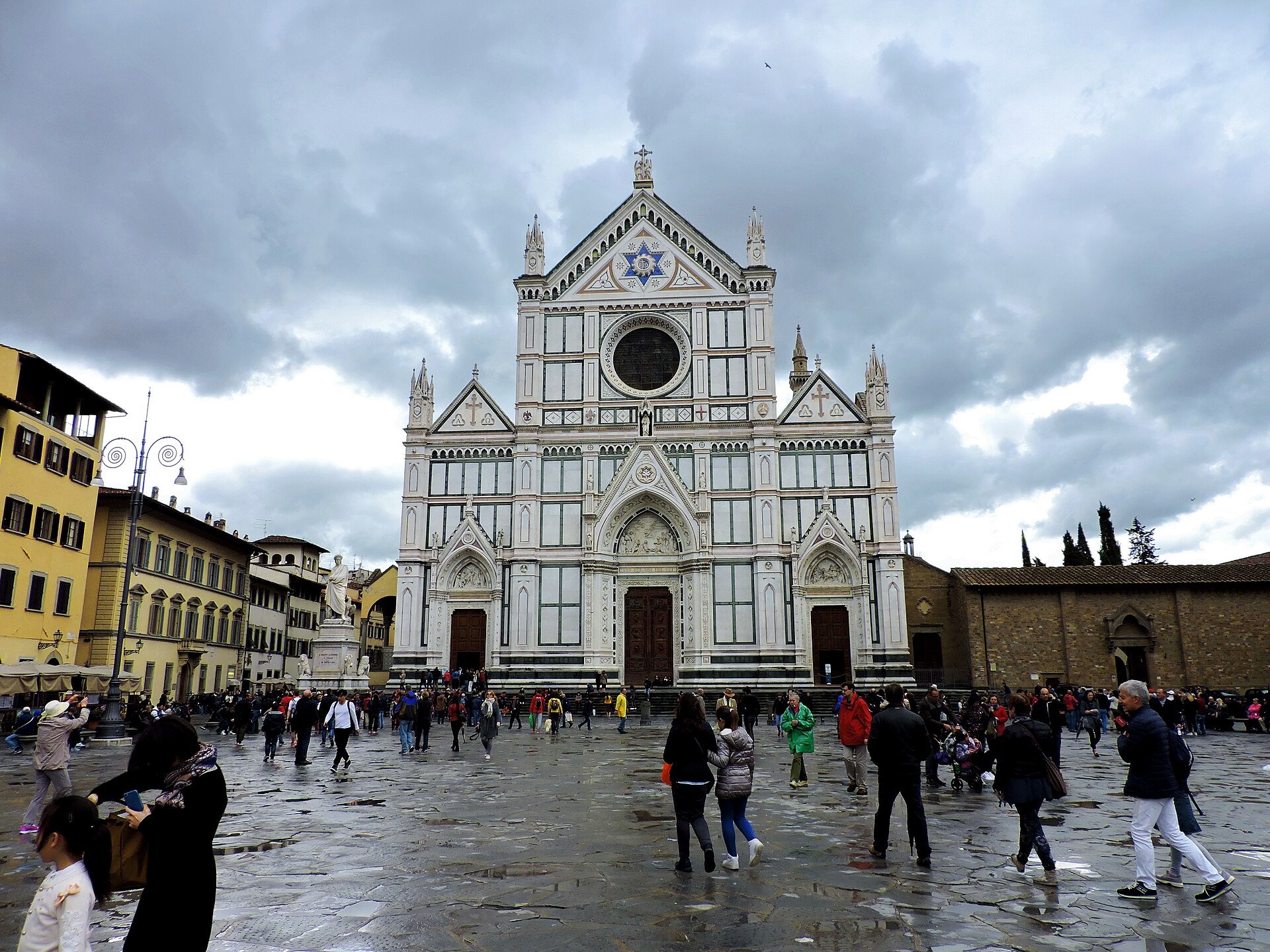
Start with the square. Before the Renaissance, people gathered here and celebrations took place, then tournaments were hosted, and today, once a year, they play historical football - calcio storico, a costumed ball game with fewer rules than it seems. In other words, the square is older than the basilica in its function: a place where the whole neighborhood comes. Construction of the basilica began in 1294 - funds were provided by wealthy families of the district - and it was consecrated only in 1443. A century and a half of building; the project is attributed to Arnolfo di Cambio, the same man who started the cathedral and the Palazzo Vecchio. Now about the main contradiction of this building, the very reason to come here. This is a Franciscan church, an order whose rule is based on poverty. And it is the largest Franciscan church in the world, with sixteen private family chapels inside. Wealthy Florentine families bought themselves a place in the temple of a mendicant order and decorated it with the best artists of their time. Inside are frescoes by Giotto and his student Taddeo Gaddi, fourteenth century; Giotto painted the famous cycle on the life of Saint Francis in the Bardi Chapel. At the same time, the plan is strictly Franciscan: a three-aisled church in the shape of the letter "tau" - a cross particularly revered by Saint Francis himself. The result is a building that with one hand observes the rule and with the other sells its walls for family tombs. The facade you approach is from the nineteenth century: the marble cladding was added in 1863, and it, like the neo-Gothic bell tower, noticeably clashes with the rest of the ensemble. Exactly the same story as the cathedral: the medieval church received a "medieval" facade six centuries later. Near the left entrance stands a monument to Dante by Enrico Pazzi, erected in 1865. The Florentines, true to themselves, nicknamed it "Dante jumping over a puddle".
AI translation · 🇬🇧 EN
Rate this review:
National Pantheon: Who Lies Here and Who Does Not
Santa Croce is called the national pantheon of Italy, and this is no exaggeration. Here lie Michelangelo, Galileo, Machiavelli, Lorenzo Ghiberti, Vasari, Rossini, Ugo Foscolo, Vittorio Alfieri, Canova, and Michal Ogiński - that very one whose polonaise everyone knows. A few stories worth knowing as you walk past the slabs. Michelangelo. He died in Rome, far from the Florence he loved, and his body was brought here because he wanted to be buried here. The Pieta that he prepared for his own tomb was never finished - it stands in the Museo dell'Opera del Duomo, by the cathedral. Machiavelli. Buried here in 1527, despite his reputation as a man who was, to put it mildly, religiously unsteady. And a monument to him was erected only in 1787, the work of Innocenzo Spinazzi - two hundred and sixty years after his death. Leonardo Bruni. Chancellor of Florence in 1410 and again in 1427, a convinced republican. His tomb was made by Rossellino in 1447, and it is a triumph of realistic portraiture: the humanist is depicted in peaceful old age, without rhetoric. Lorenzo Ghiberti (1378-1455). The very one who won the 1401 competition and spent half a century making the doors of the Baptistery. Buried here together with his sons and assistants Vittorio and Lorenzo. Pay attention to the connection: the man because of whose victory Brunelleschi left for Rome and invented the dome lies in a church in whose courtyard stands a chapel by Brunelleschi. And one thing that is usually kept silent about in this church. In the basilica's museum is Cimabue's Crucifix, severely damaged by the 1966 flood and later carefully restored. This is a symbol of that catastrophe: in the Santa Croce area, the water rose higher than six and a half meters - higher than the first floor - and around fourteen thousand movable works of art and from three to four million books and manuscripts suffered across the city. So the pantheon here is not just about people - it is also about how even with stone and paint, a city can lose to its own river.
AI translation · 🇬🇧 EN
Rate this review:
Nearby and related
By the same architect
Close by in Florence
About the Object
Arnolfo di Cambio — see note
1443
Gothic
Piazza di Santa Croce, Firenze
Religious Structure