
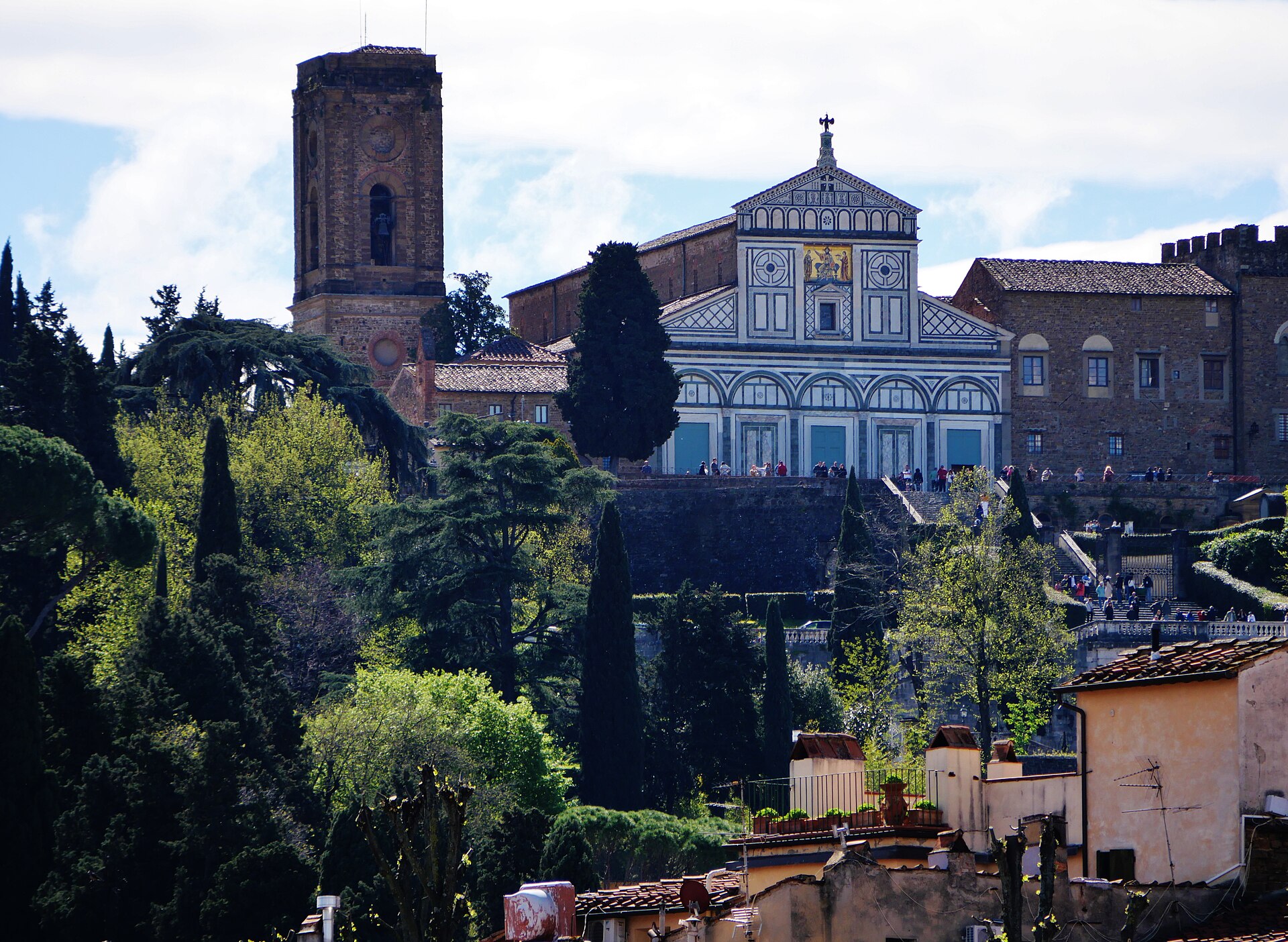
Basilica di San Miniato al Monte
Всемирное наследие ЮНЕСКОAbout the Object
1018
Romanesque
Via delle Porte Sante 34, Firenze
Religious Structure
Gallery (1)

The building that the Renaissance mistook for antiquity
San Miniato stands on a hill above the city, and you have to climb up to it past Piazzale Michelangelo, another three hundred meters or so upward. Almost the entire crowd stops at the square, takes photos of the city, and heads back down. Up top, where something far more important than the view is located, it is usually quiet. The church was begun in 1018, over the tomb of Saint Minias, a wealthy Armenian merchant who was beheaded for his faith in the third century. The facade was begun around 1090, and it is entirely built on geometry: green and white marble laid out on a flat plane into regular rectangles, circles, and arches, with no sculpture, no relief whatsoever. This is Tuscan Romanesque, sometimes called Pisan, and it is arranged like a blueprint applied to a wall. Then comes the most interesting part, and that is why this site belongs on the map. Four hundred years later, the Florentines of the Renaissance looked at this facade and were certain they were seeing an ancient Roman structure. They were off by a thousand years, but the mistake proved fruitful: it was from here that Leon Battista Alberti took the idea for the facade of Santa Maria Novella, and Brunelleschi gleaned that very clear geometry which he later laid at the foundation of his own architecture. In other words, the Renaissance in Florence began, among other things, with a misdated building. At the top of the pediment sits an eagle with a bale of cloth. This is the coat of arms of the Arte di Calimala, the guild of imported wool merchants that maintained the church in the Middle Ages: in Florence, even shrines were built with guild money, and the guild marked its authorship right on the facade. The 13th-century mosaic above the entrance shows Christ, the Virgin Mary, and Saint Minias, and they are repeated in the apse mosaic inside. Inside, there are three things worth seeing. The nave floor is laid with seven mosaic panels featuring animals and zodiac signs. The crypt is supported by columns salvaged from ancient Roman buildings, meaning genuine antiquity is actually here too, just not where it was looked for. And separately worth mentioning is the Chapel of the Crucifix by Michelozzo from 1448, standing freely in the middle of the church with doors painted by Agnolo Gaddi. Nearby is the Renaissance Chapel of the Cardinal of Portugal from 1480 with terracotta medallions by Luca della Robbia, and in the sacristy is a cycle of frescoes by Spinello Aretino on the life of Saint Benedict, completed in 1387. Admission is free. The church has its own hours, usually with a break for a few hours in the middle of the day, and the Olivetan monks sing vespers, which you can attend.
AI translation · 🇬🇧 EN
Rate this review:
How Michelangelo hung mattresses on the bell tower
Another reason to come up here, and it is not about marble. In 1529, Florence found itself under siege. The Republic was living out its final months, and in April, the Council of Ten appointed Michelangelo as chief commander and director of city fortification works for a term of one year. Not as a sculptor or an architect, but as a military engineer. He was a man of the republic himself, so the appointment was also political. San Miniato hill proved to be a key defense point: whoever holds it can shoot down upon the entire city from above. Michelangelo turned the church into a fortress, surrounded it with bastions, and placed two culverins on the bell tower. The bell tower had just been built by Baccio d'Agnolo, with work running from 1524 to 1529, and it immediately became the main target for enemy cannons standing on neighboring hills. And then Michelangelo did the thing that makes this story still told in Florence today. He ordered the bell tower to be hung with bales of wool, eighteen hundred of them, which the guild immediately provided. The bales were suspended from the top and piled up around the base. The calculation was simple: wool absorbs the impact of a cannonball, and the masonry remains intact. The bell tower survived. Standing by the wall today and looking down at the city, it is worth remembering that this view was not postcard-like, but calculated: Florence was within range of fire from here, and the man who made 'David' calculated angles and defended the tower with the soft against the hard.
AI translation · 🇬🇧 EN
Rate this review:
Nearby and related
Close by in Florence
About the Object
1018
Romanesque
Via delle Porte Sante 34, Firenze
Religious Structure