
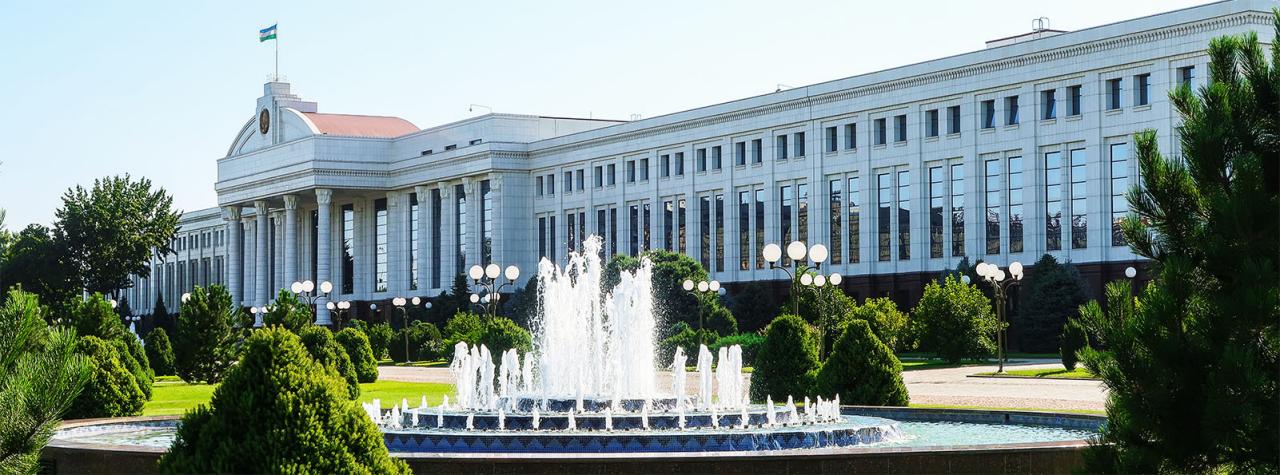
House of Government of the UzSSR / Office "Ak Saray" / Senate of the Oliy Majlis
Частично утраченоAbout the Object
S. Polupanov, A. Babakhanov, V. Volchek, Institute "Tashgiprogor"
1931
Modernism
Constitutional Court of Uzbekistan, Parade Alley, Yunusabad district, Tashkent, 100035, Uzbekistan
Other
Gallery (3)

From the Government House to the Senate
We are looking at the western part of Mustakillik Square. This place can be called a true architectural chameleon, where an astonishing urban planning drama unfolded. Over the years, several epoch-making government buildings replaced one another on this site. The history began with the pre-revolutionary single-storey White House, the former residence of the Governor-General. In 1931, architect Stepan Polupanov rebuilt it in the spirit of strict constructivism. The new Government House building received completely smooth facades and was painted in a radical proletarian black color. Eyewitnesses noted its incredible tranquility and grandeur. In 1936, a monument to Lenin was erected in front of the building, rigidly fixing the main ideological axis of the square. Architectural fashion changed rapidly in those years. Already in 1935, the same Polupanov radically redesigned the facades. Concise constructivism gave way to neoclassicism with columns and a monumental tribune. In 1940, the architect decorated the column capitals in the assembly hall with carvings in the form of leaves and open cotton bolls. This is how the famous Uzbek order was born, a unique synthesis of classics and oriental motifs. By the second half of the 1940s, side wings were attached to the building, which later housed the Bakhor concert hall and the halls of the Navoi Library. In the sixties and seventies, the square was built up with lightweight modernist glass volumes. Against their background, this classical palace looked like a heavy historical contrast. By the eighties, the monumental mass began to be perceived as a physical barrier, and urban planners seriously proposed demolishing it. During the years of independence, this government hub underwent its final transformation. The process of large-scale architectural replacement began in 1999, when the Ak Saray President Office, which translates as White Palace, was erected according to the project of the Tashgiprogor institute. The building stands out strongly with its central facade featuring a semicircular volume and columns, crowned with a tent roof. This tent acts as a direct symbol of Turkic architectural tradition. The motif with a semicircular colonnade turned out to be very successful and later migrated to other government residences. In 2005, the renewal process was completed with the construction of the four-storey building of the Senate of the Oliy Majlis. This structure is interesting for its dual character. From the square side, it greets visitors with a monumental columned portal, and from the opposite side, facing the Anhor canal, the facade is designed as a traditional Uzbek columned aywan. Inside, the Senate is decorated with an emphasis on national decor with light wood, fabric wallpaper, and picturesque panels in the central foyer. The most debatable question in the history of this place is related to exactly how the construction of the Senate was carried out. Among researchers, there is still no consensus. According to one version, two outer wings of the old Government House were preserved, namely the canteen and the Bakhor concert hall, and the new building rose right between them. There is also a more radical point of view, according to which the old fabric was completely destroyed, and the historical wings, which preserved fragments of pre-revolutionary buildings, were demolished to the ground. As a result, the modern ensemble of the western side of the square evokes mixed assessments from experts. Critics point out that the new buildings are made in different styles and materials. This created a certain stylistic gap and intensified the feeling that the single architectural fabric has disintegrated into separate, not always coordinated fragments.
AI translation · 🇬🇧 EN
📷 https://pastvu.com/_p/a/p/4/3/p433wclpb2s0fed2ul.jpg
📷 https://pastvu.com/p/2303813
Rate this review:
Nearby and related
By the same architect
Close by in Tashkent
About the Object
S. Polupanov, A. Babakhanov, V. Volchek, Institute "Tashgiprogor"
1931
Modernism
Constitutional Court of Uzbekistan, Parade Alley, Yunusabad district, Tashkent, 100035, Uzbekistan
Other
Visitor Information
Limited
Metro Mustaqillik maydoni