
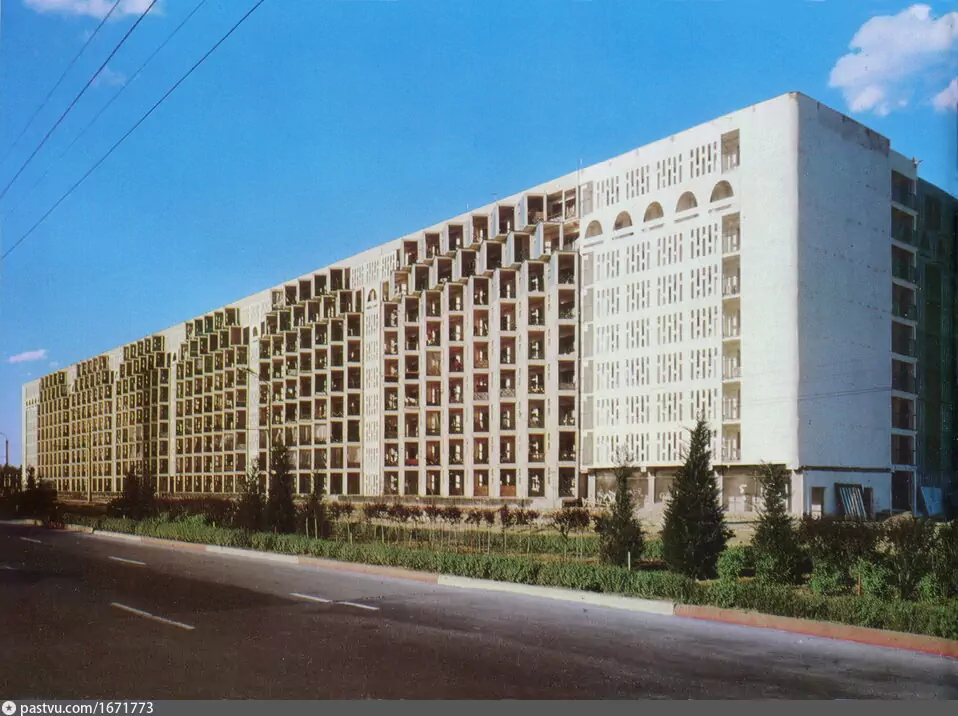
Bogdan Khmelnitsky Street (Babur Street)
Частично утраченоAbout the Object
A. Kosinsky (project architect), Yu. Miroshnichenko, I. Demchinskaya; chief engineer K. Shakhsuvaryan; with L. Mamaeva, V. Azimov, A. Dizik, E. Galustyan, T. Mametova, N. Ivanov; engineers L. Pergament, V. Povarich, B. Gorokhovsky, Z. Larionova, V. Mareeva, R. Madgazina. Institute Tashgiprogor
1980
Modernism
Улица Бабура (до 1954 года Театральная, затем улица Богдана Хмельницкого), Ташкент
Street
Gallery (1)

Viewer and Participant
In 1974, at the height of construction, Andrei Kosinsky published an article in a republican architectural magazine about what he was actually doing on this street. The article is titled "The Search for the Image of a Thoroughfare", and it begins with a simple fact: this thoroughfare meets the city from the airport and flows into Shota Rustaveli Street. That is, it is the entryway into Tashkent. Then comes the theory, which is unexpected for a departmental magazine. A typical street, he writes, is made up of buildings whose architecture is determined by the time of their construction, and is built on urban routine interrupted by pauses. But another kind of street is possible - an integral composition, a chain of spaces of varying emotional tension transitioning into one another, like in a musical piece, with its own culmination and end. Then powerful chords and a background are possible, but the background does not separate the chords; rather, it sounds alongside them. And right away he notes a difficulty that a musician does not face: a melody has one beginning and one end, but people move along a street in two directions. This means one must look for a solution where the melody sounds differently depending on which way you are traveling. The second half of the argument is even more curious. Kosinsky divides city residents into two categories based on their mode of perception. A person in transport is a "viewer". A person who lives, works, or rests in this place is a "participant". Today, he writes, the vast majority of architectural information units are received by a person from the window of a vehicle, that is, as a viewer. They become a participant where they need to be for some reason, or where something caught their attention earlier when they were a viewer. And from this he derives tempo. The perception of the city from a car is similar to the perception of cinema: time is accelerated tenfold or twentyfold, two or three close-ups change on the screen in a minute, and if the action slows down, the viewer loses interest. A pedestrian's tempo is also ten to twenty times slower than the speed of transport. From psychology, he adds, it is known that the best way to maintain attention is to change the tempo. The conclusion is formulated harshly: the development must necessarily have a sharp silhouette, be diverse, variously expressive, in contrastingly harmonic relationships, otherwise a viewer driving past simply will not notice it. And if it failed to arouse the viewer's curiosity, they will never want to become its participant. This is a rare case when a Soviet thoroughfare was designed as an attraction - and written about directly, in a magazine, in the year when half the houses were still standing in scaffolding.
AI translation · 🇬🇧 EN
Rate this review:
The lattice that covers the entire house
In the same 1974 article, Kosinsky lists the tools. Three of them are worth mentioning because they are what makes this street recognizable. First is sun protection. Here he does not mince words about his colleagues. The use of sun protection, he writes, has boiled down to simple recipes: horizontal lattices on the south, vertical fins on the east and west, a lattice above the roof. And most of the time it works poorly. Recently, he adds, sun-shading blades have begun to be hung on the northern sides of houses as well, now purely as decoration. The alternative he proposes is structured differently: the system should protect not the window opening, but the entire house, and be calculated so that complete shading occurs only in the hottest time of the year, while in winter it lets in the maximum amount of sun. From this follows something that determined the appearance of the street: a stamp-like approach is impossible here. The slightest turn of the building relative to the cardinal points changes the entire structure of the lattices. Hence that very kaleidoscope on the summer facades - this is not ornamentation, this is calculation. Second is color. Kosinsky believes that color today is reduced either to an enhancer of plastics or to decoration, whereas it is capable of overcoming distances at which the most sophisticated plastic form reads as a gray background. Color, according to him, can reveal and destroy volume, bring it closer or push it away, make it lighter or heavier. He formulates this almost aphoristically: color is one state of form, and its other state is plastics. Third is the most human element. He calls balconies and loggies an integral part of multi-story Asian housing and honestly describes what happens to them: residents glaze them themselves, repaint them, alter them, and soon after moving in, the house loses its original appearance, always for the worse. Fighting this, he admits, no one has managed to do. And he suggests not fighting it: if human striving for amateur modification is built into the project program from the very beginning, you get houses whose facades will not be harmed by any amateurish tinkering of the inhabitants. What had been accomplished by that moment, he lists matter-of-factly: by the anniversary day, a group of nine-story ninety-four-apartment buildings was built, the five-hundred-apartment building is nearing completion, construction of the main complex of high-rise buildings and the Gipropromselsktroy institute is beginning, and the reconstruction of existing buildings is underway. He expected the completion of all construction approximately by 1977. The canon dates the work to 1968-1980, meaning the street was built for another three years after his deadline. The street itself is older than these houses. Until 1954 it was called Teatralnaya, then it was named after Bogdan Khmelnitsky, and for the fiftieth anniversary of October a overpass was built here, unburdening several traffic nodes at once. The development project was drafted by Tashgiprogor in 1970-1971, along with the center of Chilanzar, and the institute considered both works an example of a comprehensive, ensemble approach. Kosinsky ends the article with a phrase that today reads almost like a stake: to what extent these reflections managed to be embodied in the project and to what degree they are justified in reality, the completion of the street's construction will show.
AI translation · 🇬🇧 EN
Rate this review:
Nearby and related
By the same architect
Close by in Tashkent
About the Object
A. Kosinsky (project architect), Yu. Miroshnichenko, I. Demchinskaya; chief engineer K. Shakhsuvaryan; with L. Mamaeva, V. Azimov, A. Dizik, E. Galustyan, T. Mametova, N. Ivanov; engineers L. Pergament, V. Povarich, B. Gorokhovsky, Z. Larionova, V. Mareeva, R. Madgazina. Institute Tashgiprogor
1980
Modernism
Улица Бабура (до 1954 года Театральная, затем улица Богдана Хмельницкого), Ташкент
Street