
Tashkent Airport Terminal
About the Object
V. Ermolaev, L. Ivanov, Yu. Gomon, I. Khusnutdinov (1976); I. Merport, M. Kondakova (1956)
1976
Modernism
Airport
Gallery (2)

Tashkent Airport Terminal
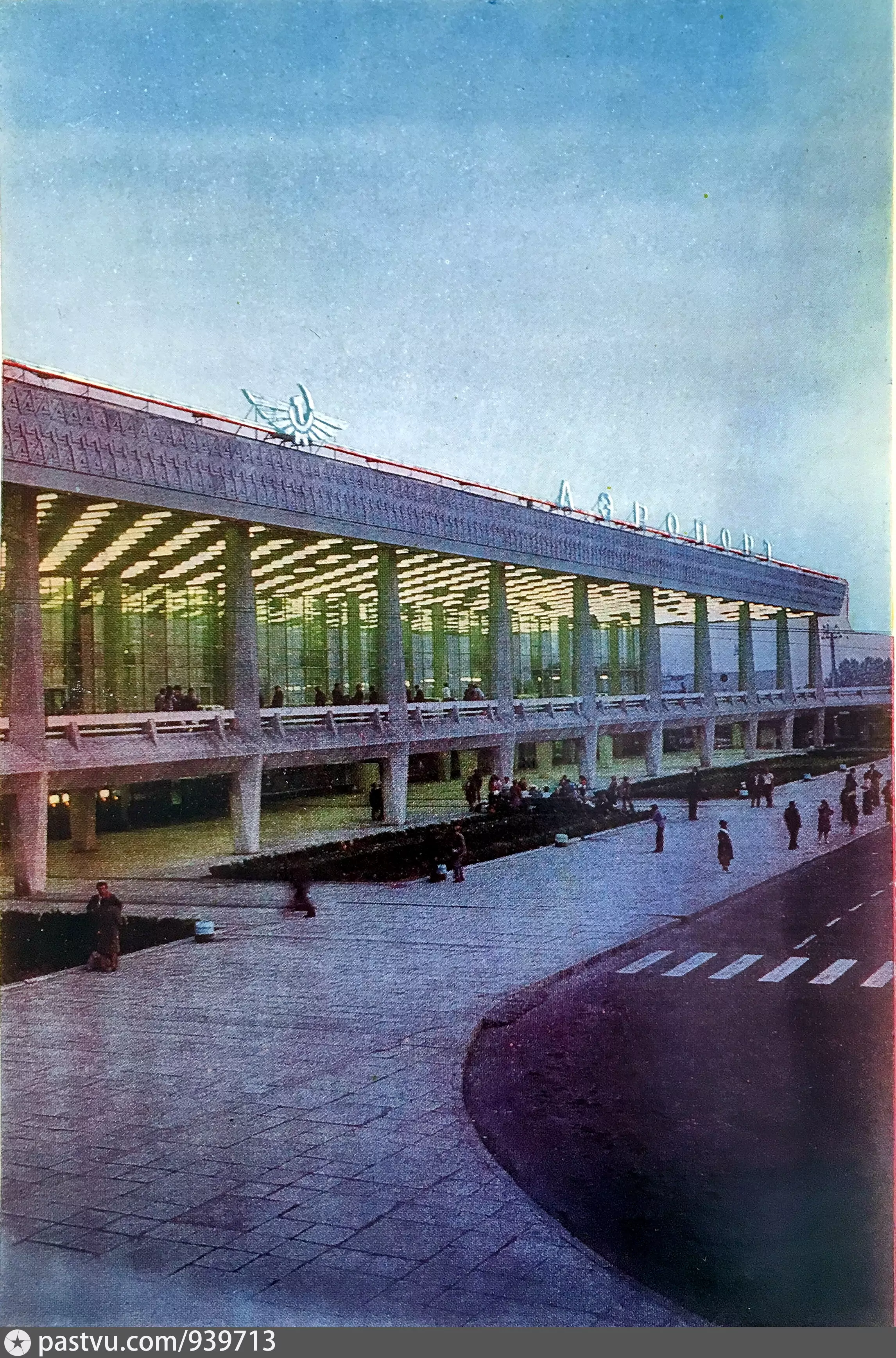
Tashkent Airport, bearing the name of Islam Karimov today, is the gateway to the city, and its passenger terminal has changed several times over the past hundred years. The current building is far from the first in this location, and the easiest way to read the entire history of local aviation is precisely through the succession of terminals. The first terminal appeared in the early 1930s, shortly after the formation of the Uzbek SSR. It was small and stood west of the current international terminal; no "oriental" motifs were sought in it-just the usual functional architecture of the International Style of those years. The second building was erected in 1956 based on a design by architects Ilya Merport and Maria Kondakova. It was noticeably larger and more ceremonial, featuring an interior courtyard, and already responded to the increased passenger traffic. The terminal became truly large in the 1970s. By this time, jet and even supersonic aircraft were flying, passenger traffic was growing, and the city needed a modern terminal. Construction of the fourth building in succession began in 1972 and it was commissioned in 1976. This was a major modernist structure with an area of about eighteen thousand square meters: a dynamically curved overpass led to it, lifting cars directly to the second level under a deep canopy, and inside, passengers were greeted by a spacious double-height concourse. The wall was decorated with the "Boguston" relief by sculptor Damir Ruzybaev, themed around the mythical Simurgh bird. According to the registration card of the Corpus of Monuments, the authors of this terminal were architects V. Ermolaev, L. Ivanov, Yu. Gomon, and I. Khusnutdinov. Unfortunately, the modernist appearance of 1976 has hardly been preserved. In 2001, the terminal was thoroughly reconstructed: the building's volume was distorted, and most of the monumental art was lost. In 2024, the airport was expanded again-a new departure hall was opened, and the area of the international terminal grew from approximately forty-five to sixty-five thousand square meters. Thus, the terminal you see today is merely another in a long line of Tashkent's "gates to the sky," and the 1976 modernist terminal can hardly be discerned within it anymore. The easiest way to "visit" the terminal is for its intended purpose-flying into or out of Tashkent; there is no separate observation deck or museum here. The airport operates around the clock, and the most convenient way to get there is by taxi: the metro has not been extended here yet.
AI translation · 🇬🇧 EN
Rate this review:
The Spire That Was Never Built
In the autumn of 1955, people started talking about the Tashkent airport, and not at all in the way its author would have liked. On November eleventh, the Decree of the Central Committee of the CPSU and the USSR Council of Ministers "On Eliminating Extravagance in Design and Construction" was issued. It closed an entire era: the columns, porticos, and spires with which the country had adorned itself for twenty years were declared a ruinous mistake. Soviet architecture, the document stated, should be characterized by simplicity, strictness of forms, and economy of solutions, and the attractive appearance of buildings should be created not by far-fetched, expensive decorations, but by proportions, the correct use of materials, and high-quality work. The next day, "Pravda Vostoka" named local examples. First on the list was the airport: "The building of the Tashkent airport is one of the clear examples of extravagance in design, violations of spatial planning and structural forms. Strictly speaking, the project came under criticism even earlier. In May of that year, the 4th Congress of the Union of Soviet Architects of Uzbekistan was held in Tashkent, and there delegates, among them architects Zotov and Babakhanov, said that designers were not delving into the economics of construction and were allowing extravagances in finishing. The project of the new airport was named directly as an example. And a week later, a cartoon appeared. A drawing by artist M. Vorobeychikov was published in the "Satire and Humor" section and signed simply: this is how architect Merport would have liked to see the Tashkent airport. A squat building with a two-tier colonnade, a balustrade, and vases along the cornice is drawn, and above it a multi-tiered spire tower with rings, around which airplanes circle, barely touching it. From the text nearby, it turns out what it was all for. The author of the project, architect Merport, intended to erect a spire above the building that would have cost the state several hundred thousand rubles. It was decided not to build the spire, contrary to the architect's will, and pilots joked about this that flying over the airfield would be dangerous. But the matter did not end with the spire. Large extravagances remained in the project: luxurious, two-story colonnades from the airfield side and galleries on the northern side, unnecessary porticos, superstructures. And the main inner room where passengers wait for the airplane was also decorated by the architect with luxurious columns, without caring about their convenience. It matters at what moment this was said. A year ago, those same colonnades would have been a virtue of the project, and they would have been praised for them. The campaign changed the sign of the words without changing the buildings themselves: what yesterday was called a worthy decoration became an "extravagance," and the architect from the author of a ceremonial structure turned into the hero of a satirical strip. The building was built after all. In January 1958, the Presidium of the Supreme Soviet of the Uzbek SSR awarded Certificates of Honor to twenty-three people who worked on this construction site: locksmith Annasov, plasterer Averin, welder Shuvalov, and Maria Fyodorovna Kondakova, chief architect of Tashgortransproekt. Merport is not in the printed part of the list, but the enumeration breaks off with the words "and others," so one cannot judge for sure. How it turned out in the end is evident from a review from 1959, short and kind: the halls of the Tashkent airport are spacious, beautiful, and comfortable. True, passengers still preferred to wait on the open platform, although the sun baked mercilessly there: they were attracted by the non-stop life of the airfield. That building is no more: in the seventies, it was replaced by a new terminal. But the Tashkent airport is one of the few places where the turn of 1955 is recorded not in general words, but by name: with the author, with a price of several hundred thousand rubles, and with a pilot's joke.
AI translation · 🇬🇧 EN
📷 «Правда Востока», 20 ноября 1955, № 275 (9723), с. 3 · рис. М. Воробейчикова
Rate this review:
Nearby and related
By the same architect
Close by in Tashkent
About the Object
V. Ermolaev, L. Ivanov, Yu. Gomon, I. Khusnutdinov (1976); I. Merport, M. Kondakova (1956)
1976
Modernism
Airport
Visitor Information
Anytime