
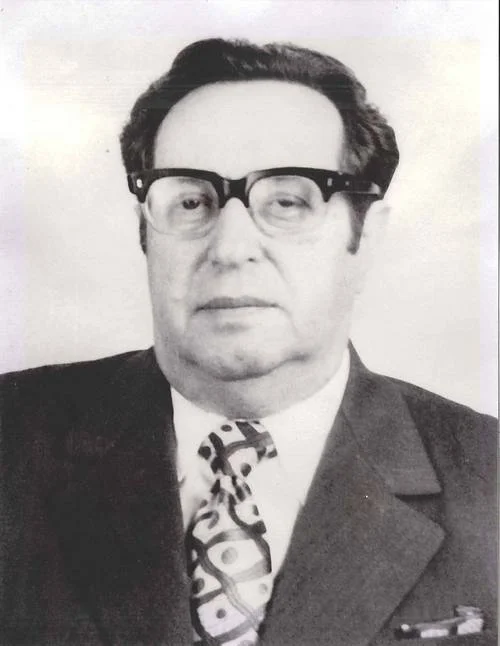
Ilya Aronovich Merport
About the Object
Ilya Aronovich Merport
1917
Other
Historic Personality
Gallery (1)

Ilya Merport
Cast your eyes up at the curved, light stone-clad facade of the Uzbekistan Hotel. Its chief architect was Ilya Aronovich Merport - a man without whom it is hard to imagine the appearance of modern Tashkent. He was a local through and through, a Tashkent native to his core. Born in 1917 into the family of a watchmaker and a seamstress, in 1940 he graduated from the architectural department of the Central Asian Polytechnic Institute - the very same one that Ophelia Aydinova would graduate from twenty years later. Having barely started working, he went to the front, to a sapper battalion. And upon returning, he found himself right in the thick of major construction. Back in the 1950s, Merport became one of the founding fathers of the Chilanzar large-block apartment building: he devised economical standard sections from which entire neighborhoods were later assembled. When the city needed housing after the 1966 earthquake - quickly and in huge quantities - it was precisely such houses that saved the day. But another thought truly occupied him. Heading the scientific department of the TashZNIIEP institute, he argued against the habit of seeing only backwardness in the old city. Merport wrote that the solidarity, cooperation, and mutual aid developed in the mahalla were by no means a relic, but rather the foundation upon which a modern neighborhood should be built. His teams designed "mahalla-type complex houses": various apartments connected by shared green courtyards, with rooms for joint cooking, leisure, and childcare. Almost all these projects remained on paper. But the idea was not lost - just a few years later, Ophelia Aydinova lifted it into the sky in her "Zhemchug". So, looking at the "vertical mahalla", you are seeing Merport's thought among others. He lived a long life and witnessed independent Uzbekistan - he passed away in 2004. And the Uzbekistan Hotel, the old air terminal, and the Chilanzar neighborhoods still stand - like his signature on the body of the city.
AI translation · 🇬🇧 EN
Rate this review:
From "False Beauty" to an Award
On May 26, 1955, Pravda Vostoka published a report from the congress of architects of Uzbekistan, which included the following line: "Architects Comrades Merport and Kondakova, in pursuit of false beauty, envisioned the construction of a thirty-meter tower, a two-tier gallery, and other complex and expensive structures." Twenty-two years later, the same newspaper would publish a decree awarding him the State Prize of the republic. He was scrutinized even earlier. In October 1950, architect Merport was reproached for making a technical design for a thirty-six-apartment building on Poligraficheskaya Street with many errors, "guided by an outdated design assignment." By March 1952, he was already a co-author of a project for the reconstruction of an entire square. And in April, spent funds were being tallied: of the budget allocated for 1951, 39 percent was spent, and "the project authors, Comrades Merport and Mukhamedshin, are little concerned about this." In the autumn of 1955, a campaign against excesses began, and his name made it onto the lists. November 12: some architects, "to please ostentatious decoration," use columns, porticos, and complex cornices, "giving the houses an archaic look," followed by names starting with the city's chief architect Bulatov, among others Merport. Eight days later, a caricature came out about the spire of the Tashkent airport terminal with the caption: "This is how architect Merport would like to see the Tashkent airport." In September 1957, he caught flak again, now for the opposite: leading architects, and he among them, "talking a lot about the significance of the architectural heritage of the Uzbek people, did little in their practical work." A different person emerges from the late fifties. Merport says precisely what he was once taken to task for not following: in December 1958, "I. A. Merport, chief project architect of Uzgosproekt," speaks about standard designs, while precast reinforced concrete is discussed alongside. He spends the sixties in industrial construction. In June 1961, he presents a model of a house-building plant: "Meet... this is a house-building walking combine." His group made the plant project in a year and without remuneration. In 1962, he shows a split-level apartment: downstairs is the kitchen and dining room, upstairs are the bedroom and nursery, and in front of the apartment is a fifty-square-meter green corner. His high-speed construction method, described in 1963, is arranged such that a molding machine makes monolithic elements for two rooms at once, finishing is done at a testing site, and the house is assembled twice as fast as a panel building. The hotel appears around the same time. In September 1964, a group led by chief architect Merport develops a design for the Intourist Hotel: a fifteen-story monolith near Revolution Square, between Karl Marx and Pushkin streets. In February 1965, the numbers grew: twenty floors, 750 rooms, a height of 54 meters. Built in 1974, the Uzbekistan Hotel stands in the same place and was made under his same leadership, but it has seventeen floors and 487 rooms, and it is called differently. Whether this is the same design, changed over ten years, is not directly stated anywhere. The coincidence of the location and the leader is recorded, and the conclusion is left open. His official career goes upward during this time: in 1966, he signs a material alongside the director of the new institute for standard and experimental design; by 1968, he is already the deputy director of TashZNIIEP and a candidate of architecture. Upward does not mean smooth. In May 1972, a decree on poor-quality roofing work was issued, and acting institute director I. A. Merport was reprimanded. He answered for it by virtue of his position, not as the project author, but his surname stood next to the penalty once again. And finally, 1977. In July, a list of nominees for the Hamza State Prize of the Uzbek SSR was published, and in twentieth place is the Uzbekistan Hotel complex: Merport as creative director, architect Yershova, structural engineer Gorlitsky, civil engineers Artykov, Kavtarov, and Sannikov. In November, the decree itself is published, featuring the same team plus engineer Minakov. The prize was awarded for the Uzbekistan and Bukhara hotels and the Uzbekistan sanatorium complex in Sochi. Now the building was described the way its excesses were described twenty years ago: "a large-scale 17-story structure made in the form of an open book, where hundreds of openwork windows take the place of lines," with the main facade "in the form of a grandiose panjara." In April 1980, he received the title of Honored Architect, along with Vladimir Berezin, Tamara Kadyrova, and Zakhidov. This sequence of publications tells more about him than any anniversary biography. The same newspaper first prints a caricature of his spire, then admires his panjara, and between these two publications lie twenty-two years during which the architect managed to restructure himself along with the country, receive a reprimand, build the most prominent building in the center, and become a laureate.
AI translation · 🇬🇧 EN
Rate this review:
Nearby and related
By the same architect
Close by in Tashkent
About the Object
Ilya Aronovich Merport
1917
Other
Historic Personality