
Toshkent Metro Station
About the Object
Architects S. Adylov (head), A. Tabibov, Ya. Mansurov, F. Muzaffarova, R. Fayzullaev; artists S. Sultanmuradov (ceramics), A. Khabibulin (smalt emblems)
1984
Modernism
Привокзальная площадь (АиСУз № 5, 1982)
Railway Station
Gallery (1)

A Subway Brought Right to the Train
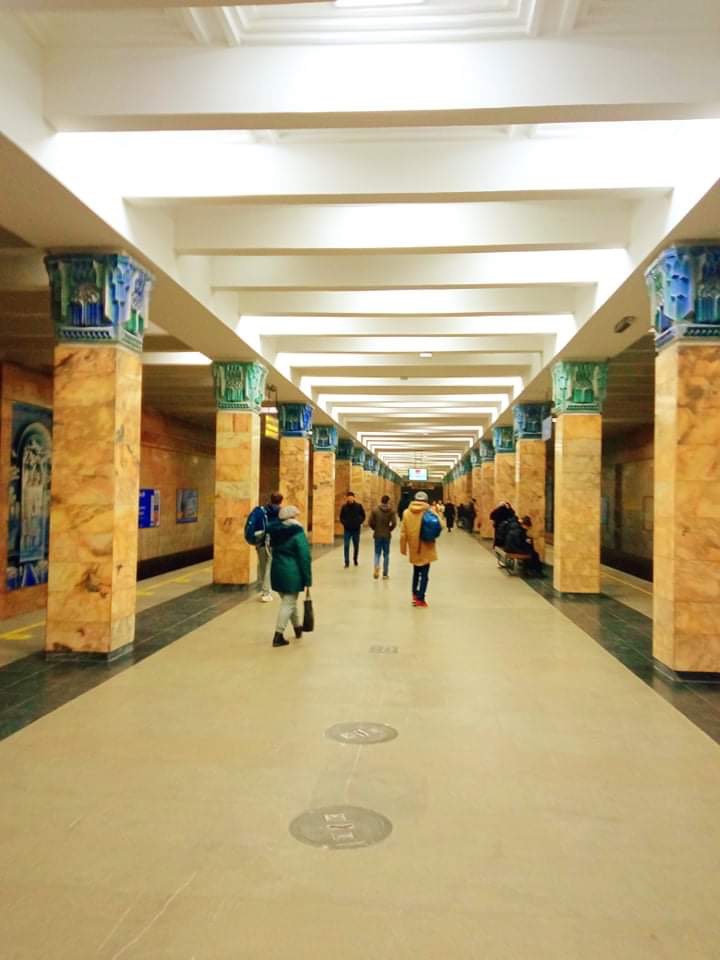
This station was conceived not as a stop near the station, but as part of the station itself. Location: Station Square. The station complex, as a magazine wrote in 1982, was designed with commercial, administrative, economic, and cultural enterprises and structures; the square itself was planned to be developed with alleys and boulevards leading toward the city center. The station is of the column type, with two underground lobbies combined with pedestrian underpasses. And most importantly, through one of the lobbies via underground passages, one could get directly to the railway boarding platforms. For the Soviet metro, this was an uncommon solution. Usually, the metro and the station are connected by a square that you have to cross on the surface with a suitcase; here, passengers were to be led underground from train to train. At the same time, the lobbies combined with underpasses eliminated pedestrian conflicts right on the square, the same technique used at "Uzbekistanskaya" and "Tashselmash". The track section to it was built using the cut-and-cover method. In December 1981, "Pravda Vostoka" reported: the fifth section, from "Oybek" station to the station "Tashkent" at the square, is being constructed by the cut-and-cover method, three-quarters of the work is completed, and the section is ready for track laying. The cut-and-cover method is a trench along the street where cranes place ready-made tunnel boxes, and slabs are laid on top and traffic is restored; in Tashkent, more than half of the first line was done this way, and this was considered a local invention of a scale never applied anywhere before. The station became the terminus for the first section of the second line. Five stations of this section, "Navoi", "Uzbekistanskaya", "Cosmonauts Avenue", "Oybek", and "Tashkent", connected the first line in the city center, at "Pakhtakor", with the railway gates of the city. This is how the magazine itself formulated the task, and the formulation is precise: the line was pulled from the stadium to the railway station.
AI translation · 🇬🇧 EN
Rate this review:
Station for the two-thousandth anniversary
In 1983, Tashkent celebrated its two thousandth anniversary. The date was set, preparations had been underway for several years, and the metro station at the railway station was supposed to be one of the gifts - a gateway through which a guest of the city enters its history. The magazine describes the design theme directly: the image of the station is expressed by elements of glazed ceramics, which make up the capitals of the platform hall columns and artistic panels on the track walls, and this theme reveals the stages of the history of the city of Tashkent, the two-thousandth anniversary of which will be celebrated in 1983. The star-shaped ceramic inserts by artist S. Sultanmuradov, combined with the light fixtures on the openwork ceiling, as stated in the same place, continue the national traditions of interior architecture. The most distinct detail is above the platform entrances. The brows of the entrances are crowned with coats of arms assembled from smalt, depicting the coat of arms of the city of Tashkent and the emblem of its two-thousandth anniversary; the artist is A. Khabibulin, the same one who made the panel in the form of an open book at the neighboring Aybek station. The two-thousandth anniversary jubilee had its own graphic sign, it was everywhere in those years - on badges, posters, souvenirs - and here it was assembled from smalt and hung above the entrance to the metro. Glazed ceramics in this series are no accident. The magazine in the same issue reminds us: ceramics are a traditional material of the architects of Uzbekistan, as evidenced by the historical monuments of Samarkand, Bukhara and other cities, and in recent years it has received a second birth in the decoration of stations. At Prospekt Kosmonavtov, walls were assembled from bluish-turquoise shades of ceramics, at Aybek - purple with gold plates of columns, here - capitals and star-shaped inserts. One technique, three different tasks. The station was designed by the same team from Tashmetroproekt as the neighboring ones: S. Adylov as the head, A. Tabibov, Ya. Mansurov, F. Muzaffarova, R. Fayzullaev. How much all this was built as intended, we cannot say: the description was made two years before the launch, and the opening year - 1984 - turned out to be a black hole in both the newspaper files and the magazine. The station was opened, and the press remained silent about what exactly was opened.
AI translation · 🇬🇧 EN
Rate this review:
Nearby and related
By the same architect
Close by in Tashkent
About the Object
Architects S. Adylov (head), A. Tabibov, Ya. Mansurov, F. Muzaffarova, R. Fayzullaev; artists S. Sultanmuradov (ceramics), A. Khabibulin (smalt emblems)
1984
Modernism
Привокзальная площадь (АиСУз № 5, 1982)
Railway Station