
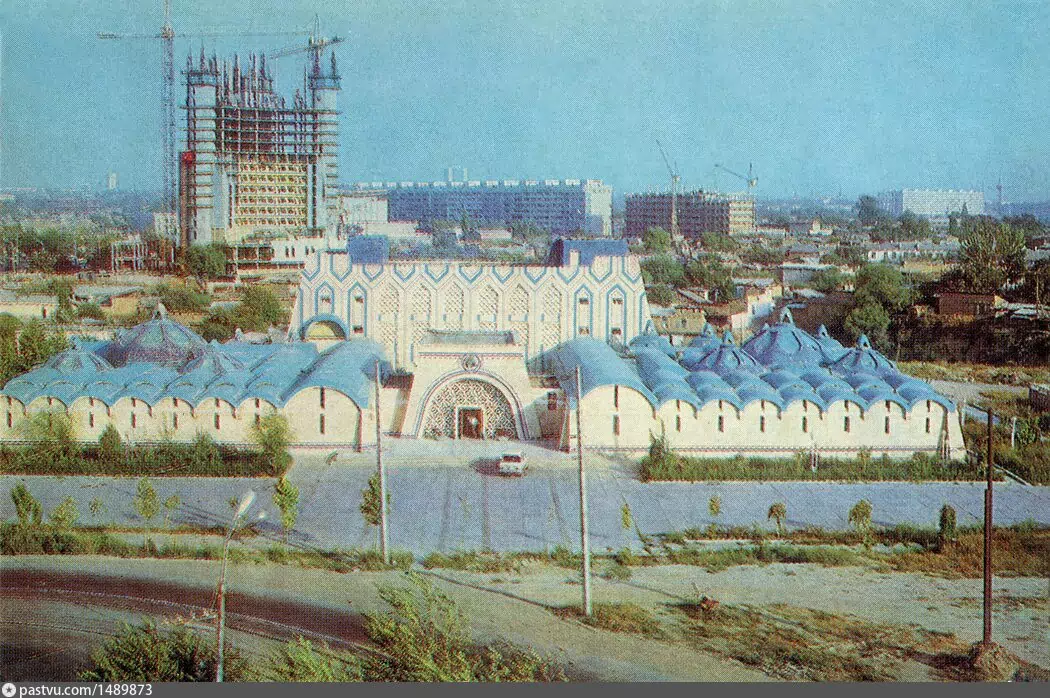
National Bathhouse "Hammom" (Chorsu)
УтраченоAbout the Object
A. Kosinsky, G. Grigoryants, R. Akhmedov; engineers V. Pershin, V. Pevchin, V. Vaisman
1977
Modernism
Перекрёсток улиц Беруни и Лайлитугон, у площади Чорсу, Ташкент
Public Building
Gallery (1)

The bathhouse that the city had no room for
You are standing by Chorsu, at the intersection of Beruni and Lailitugon, and there is nothing to look at here: a parking lot. And just over twenty years ago, a building under blue glazed domes stood on this spot - the National Bathhouse Hammam. It was built in 1977 according to the design of Andrei Kosinsky, a Moscow architect who was sent to Tashkent after the earthquake and stayed here for fourteen years. Kosinsky conceived a bathhouse that cools itself. He left the ceramic vaults without waterproofing so that moisture would escape through them and evaporate - the exact same way an unglazed clay pitcher stays cool. He called it just that: the sweating house. Inside, visitors split into two streams, male and female, and could go either to the oriental bathhouse or to the section with private rooms. The main hall stood under a large dome, surrounded by smaller halls; the hottest rooms were right by the lobby, and the further away from them, the cooler it got. A hair salon, a teahouse restaurant, and a summer courtyard garden operated in the same complex. The interior walls were carved in ganch. And then the most interesting part begins. The Tashkent architectural community hated this bathhouse. Architectural historians Iosif Notkin and Shukur Askarov surveyed colleagues across all the city's main design institutes, and the Hammam took last place in all final ratings. Tashgiprogor, TashZNIIEP, Tashgenplan, and UzNIIPgradostroitelstva all turned against it at once. A history of architecture teacher confessed that he was ashamed to show students this lack of taste. Meanwhile, in Moscow the bathhouse was admired, and the Japanese magazine Process Architecture published it in a review of contemporary Soviet architecture - in both English and Japanese at once. Kosinsky himself never disowned his work and argued with critics until the end of his life; he would challenge them about the bathhouse by asking: What is not postmodern about it? It stood for about a quarter of a century. In the early 2000s, the Hammam was demolished to build a multilevel parking lot. The building that Moscow, Tashkent, and Tokyo argued about ended up as a space for cars.
AI translation · 🇬🇧 EN
Rate this review:
Nearby and related
By the same architect
Close by in Tashkent
About the Object
A. Kosinsky, G. Grigoryants, R. Akhmedov; engineers V. Pershin, V. Pevchin, V. Vaisman
1977
Modernism
Перекрёсток улиц Беруни и Лайлитугон, у площади Чорсу, Ташкент
Public Building