
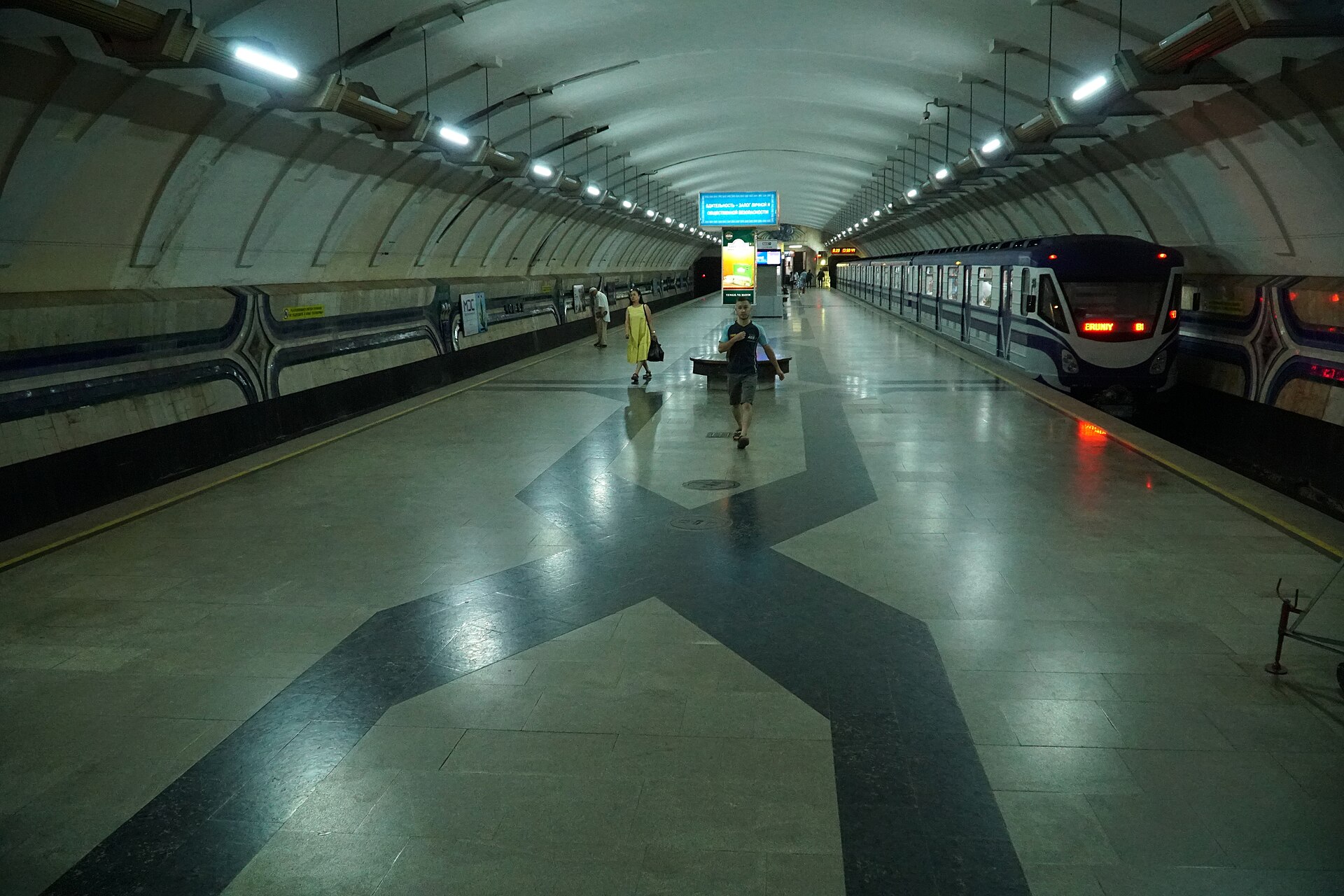
Chorsu Metro Station
About the Object
Tashgiprogor (institute); individual architects not established
1989
Modernism
Старогородская часть Ташкента, у Октябрьского рынка (ПВ 22.01.1989, 07.11.1989)
Railway Station
Gallery (1)
Three years to the bazaar
The Tashkent Metro was built quickly and they loved commissioning it ahead of schedule. The section to Chorsu was an exception: it took three years to build, and the newspaper managed to promise its launch twice during that time. In February 1987, Pravda Vostoka reported on the affairs of the Tashmetrostroy trust: from January 1, the trust completely switched to full cost accounting, which, according to the secretary of the party committee, eliminated supply snags and raised responsibility. Work on the section between Navoi and Chorsu was already underway by then. In July of the same year, the tunneling crews relocated their main forces here; the newspaper wrote that trains would run here in 1989, and a year later traffic would open from Chorsu to Beruni. In November, on the metro's tenth anniversary, the deadline was named publicly: November 1989. In December, the scale was clarified - the new section from Navoi to Chorsu is four kilometers - and a phrase was added explaining the slowness: there had never been a more complex section of the line. Neglected underground utilities, numerous adobe buildings to be demolished. For the first time, the metro was going under the old city. In January 1989, the tunneling of the connecting tunnel was completed. Trust manager G. Shtern explained to the correspondent where the time went: before tunneling began, underground utilities were studied and relaid for a long time. In May, the tunnels were ready, track laying and finishing of three stations were underway, and the opening was scheduled for November 7. In August, it turned out they would finish two months ahead of schedule. Regular traffic opened on November 6, 1989. 2.4 kilometers and two stations were commissioned - Gafur Gulyam and Chorsu; over thirty-seven million rubles were mastered at the construction site and hundreds of thousands of cubic meters of soil were moved. The rally on the occasion of the launch was held right here, at Chorsu. The builders, the metro team, and all residents of Tashkent were congratulated by the Chairman of the Council of Ministers of the Uzbek SSR M. M. Mirkasymov; he said that the early launch and loyalty to the given word became a kind of calling card of Tashmetrostroy. The first train was driven by driver Kudrat Mansurov. After this, Chorsu became the terminal station of the line - and remained so for a year and a half, until April 1991, when Tinchlik and Beruni opened. After the launch, there were twenty-one stations and twenty-eight kilometers of lines in the Tashkent metro, and more than five hundred thousand people used it every day.
AI translation · 🇬🇧 EN
Rate this review:
The station you can see from the street
Most Tashkent metro stations are invisible from the surface: a staircase, a lobby with ticket offices, turnstiles - and all this underground, while the lobby also serves as an underground pedestrian crossing. Chorsu is arranged differently. It has surface pavilions from which you step right onto the platform. According to the inventory Baudenkmale in Taschkent, there are only three such stations in the entire Tashkent metro: Pakhtakor, Halklar Dostligi, and this one. The location explains this solution. The station stands in the center of the Oktyabrsky market - the very Chorsu bazaar that gave it its name and which was being rebuilt under blue domes in those same years. The bus station also comes out here, and in 1989, when discussing the transport and pedestrian scheme of this hub, the design proposal explicitly stipulated that the scheme must be built taking into account the pavilions of the Chorsu metro station, and the issue of the Keles bus station should be resolved by a multi-level complex with parking lots. That is, the pavilions were not an architectural whim, but a nodal point around which pedestrian flows of the city's largest market were calculated. Who designed the station is only half known. In September 1989, two months before the launch, Pravda Vostoka published an anniversary essay about the Tashgiprogor institute - the very one that designed the circus, Moscow hotel, Zarafshan restaurant, Trudovye Rezervy sports complex, and the Chilanzar and Sebzar residential areas. The list of the institute's works also names the metro stations: Khamza and Chorsu. The essay does not give the names of the authors, but the institute is already something: for the other stations of this section, there is not even that. About the decoration, the newspaper said briefly: ceramics and marble, and passengers will appreciate the high quality of the architectural execution themselves. They did not have to evaluate for long. In the autumn of 1991, in an article about the misfortunes of the Tashkent metro, a correspondent listed the troubles and mentioned: the launch of each successive station was carried out without the acceptance of the corrosion control system, and leaks under the action of aggressive groundwater at Chorsu and other stations are far from the worst of the troubles. The station, opened less than two years ago, was already being undermined by water. Today, a passenger coming up here has three things in one place: a 1989 station, a bazaar under blue domes, and a hotel that has been operating as the high-rise dominant of this piece of the city since the mid-1980s. The metro was the last thing to arrive here.
AI translation · 🇬🇧 EN
Rate this review:
Nearby and related
By the same architect
Close by in Tashkent
About the Object
Tashgiprogor (institute); individual architects not established
1989
Modernism
Старогородская часть Ташкента, у Октябрьского рынка (ПВ 22.01.1989, 07.11.1989)
Railway Station