
Villa Borghese
About the Object
Flaminio Ponzio, Giovanni Vasanzio, and Antonio and Mario Asprucci
1606
Baroque
Piazzale Napoleone I / Porta Pinciana / Piazzale Flaminio, Roma
Park
Gallery (1)

A park built for the sake of a single collection
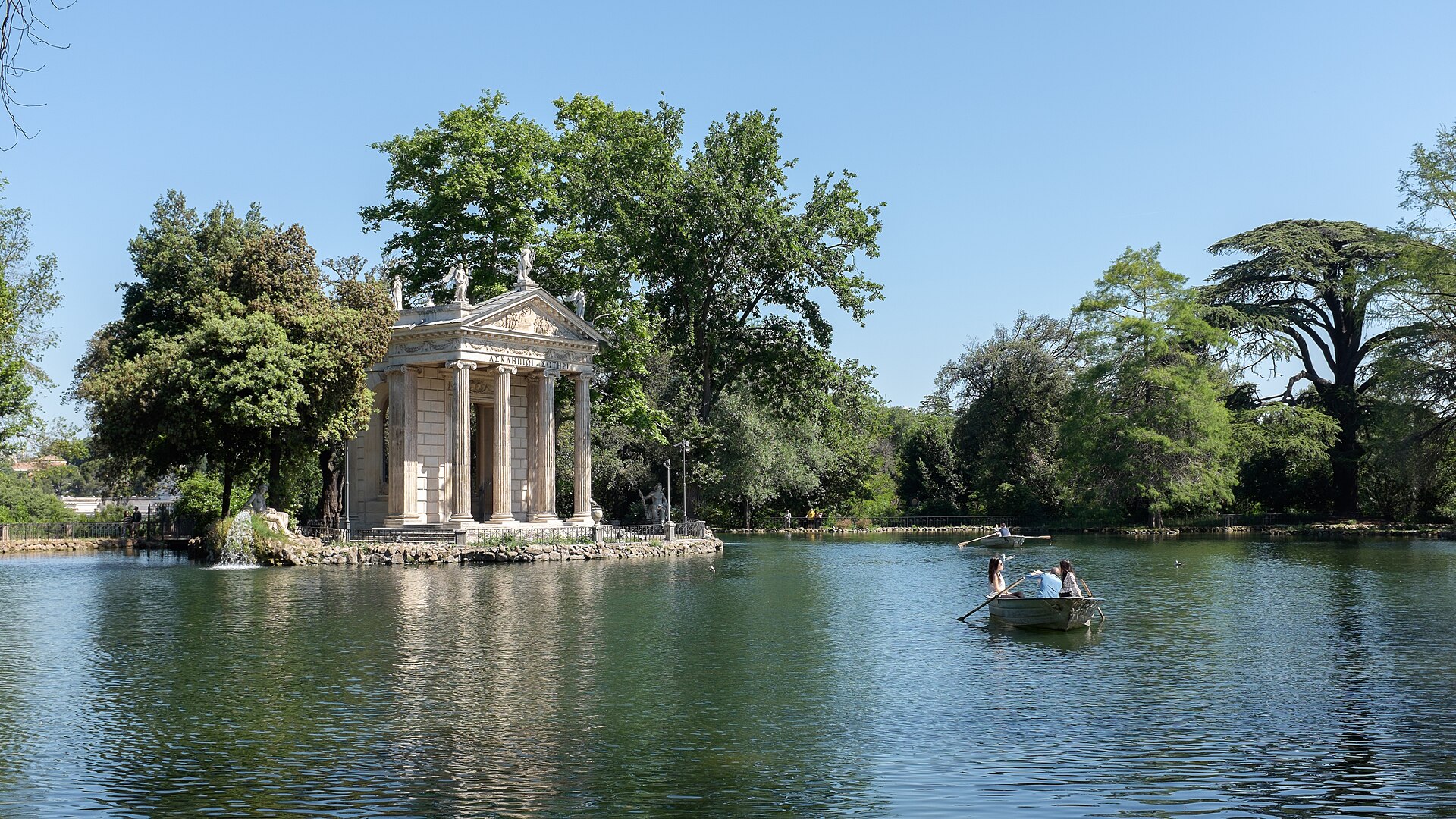
Eighty hectares of greenery in the middle of Rome exist for a reason that nothing in the park reminds you of. They were laid out neither for the city nor for walks. They were laid out as a setting for a collection. In 1606, Cardinal Scipione Borghese, nephew of Pope Paul V, began buying up vineyards on the Pincian Hill. He entrusted the construction to Flaminio Ponzio, and when he died in 1613, Giovanni Vasanzio took over. What resulted was called a villa of pleasures, and that must be taken literally. The garden functioned as a Baroque amusement park: surprise fountains that soaked an unwary guest, a grotto with artificial rain, a mechanical speaking satyr, bird aviaries. Scipione first opened all this to the public, but one visitor was outraged by the erotic paintings in the garden house, and Paul V decided it was safer to keep the garden closed. Lily-white collection, or rather the collection for the sake of which it all started, still stands inside. Scipione was a patron of the young Bernini, and "Apollo and Daphne", where the nymph turns into a laurel before your eyes, and "David" with his bitten lip and stretched sling were made for these halls. He also bought Caravaggio, and the "Madonna and Child with Serpent", which was removed from Saint Peter's Basilica as improper, hangs here. In the 1760s, Prince Marcantonio IV commissioned Antonio and Mario Asprucci to completely redesign it. That was when the English lawns, the artificial lake with the Temple of Aesculapius in the middle of the water, and the neoclassical pavilions scattered across the park appeared. It is precisely this layer that you see today, walking among the pine trees. Later, history did what Paul V tried so hard to prevent. After the unification of Italy, the state sued the Borghese family, bought the whole thing in 1901, and in 1903 handed the park over to the city of Rome and opened it to everyone. Three hundred years later, the garden of pleasures became public, and ever since it has been exactly what Scipione originally intended, before he got scared.
AI translation · 🇬🇧 EN
Rate this review:
What to do here with a child
The practical side. Villa Borghese is the only park in Rome that can keep a small child occupied for a whole day, and do so without any effort on your part. It is more convenient to enter not from Via Veneto, but from Piazzale Flaminio or via the Pincio from Piazza del Popolo. From the Pincio you immediately get a terrace with a view of the whole city and a gentle slope instead of stairs, which is important if you have a stroller. Inside the park, there are several separate spots. Casina di Raffaello is a house called Raphael's former property, which is now a children's center for those aged three to ten, featuring playrooms and workshops. Bioparco is a zoo where people go with older children. The Carlo Bilotti Museum in the Orangery building is small and free, featuring twenty-two works by de Chirico, a portrait by Warhol, and almost never anyone around. There are a lakeside cafe, boat rentals, bicycles, scooters, and rickshaws. There is a copy of Shakespeare's Globe, built in three months in 2003, where open-air plays are performed in summer. Three things worth knowing in advance. The park is large, eighty hectares, and crossing it on foot from end to end takes half an hour, so choose one part rather than the whole thing. The paths are mostly gravel and well packed, the stroller rolls, but you cannot call it quiet. And most importantly, there is little shade in Rome, but here it is everywhere, so on a hot day it makes sense to go here not after sightseeing, but instead of the middle of the day. Admission to the park is free, from seven in the morning until sunset. The Borghese Gallery inside the park is a separate story and a separate ticket, admission is strictly by time slots and with a reservation, and with an infant in arms it is better to go there in turns rather than all at once.
AI translation · 🇬🇧 EN
Rate this review:
Nearby and related
Close by in Rome
About the Object
Flaminio Ponzio, Giovanni Vasanzio, and Antonio and Mario Asprucci
1606
Baroque
Piazzale Napoleone I / Porta Pinciana / Piazzale Flaminio, Roma
Park