
Ara Pacis Augustae and its Museum
Всемирное наследие ЮНЕСКОAbout the Object
Richard Meier (pavilion); Vittorio Ballio Morpurgo (1938 pavilion)
2006
Contemporary Architecture
Lungotevere in Augusta, Roma
Museum
Gallery (2)

An altar where the world is depicted as a family procession
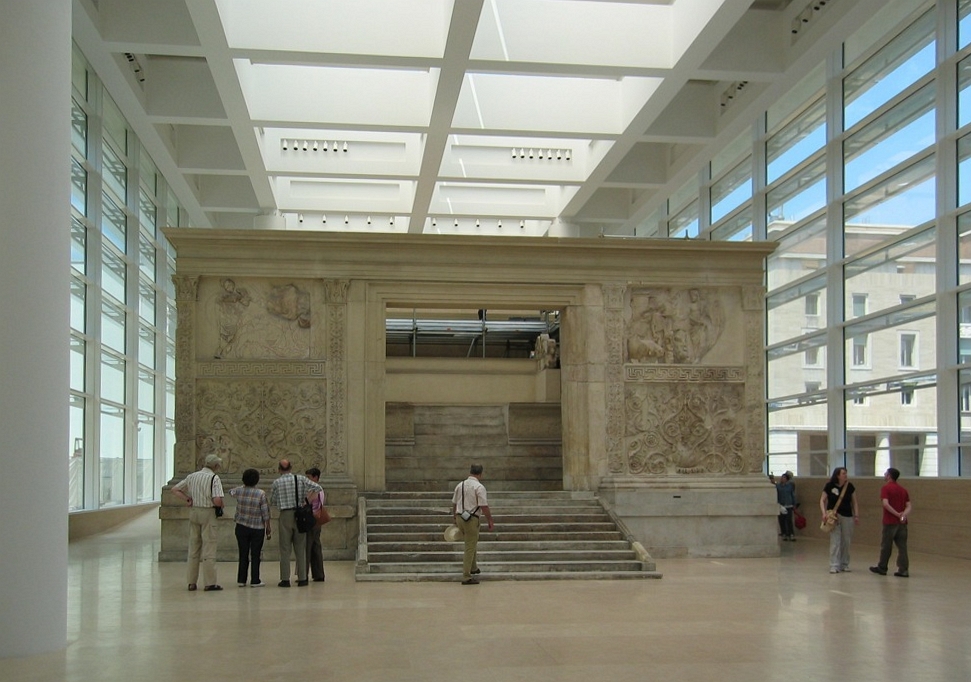
Before you is a square marble enclosure on a low platform, and inside it is the sacrificial altar. This is the Altar of Peace, the Ara Pacis. The Senate decreed its construction in 13 BC, and it was completed four years later. The occasion: Emperor Augustus returned from campaigns in Gaul and Spain, and peace was established throughout the Mediterranean. On the long walls, north and south, a procession is depicted. This depicts a very specific procession that took place on the fourth of July, 13 BC, and members of the imperial family are recognized in it. Moreover, they are arranged in order of succession: the heir at the time was Marcus Agrippa, husband of Julia, daughter of Augustus. That means before you is not just a religious monument, but a political hierarchy carved in Carrara marble. Look closely at the faces. The carving is so realistic that even a toddler clinging to his mother's skirt can be individually recognized - a detail worth walking around the altar twice for. And one more thing you should know while standing here. The altar was originally positioned so that the shadow of the huge sundial obelisk in the Campus Martius would fall on it on Augustus's birthday. Peace, family, calendar, and power were linked into a single system, and the altar was part of it.
AI translation · 🇬🇧 EN
📷 Wikimedia Commons · author unknown · Public domain · https://commons.wikimedia.org/wiki/File:RomaAraPacis_ProcessioneSudParticolare.jpg
Rate this review:
Fragments, Mussolini, and a glass box the Romans never forgave
The history of this altar is the history of its gathering. The first slabs were found as early as the 16th century nearby on Via in Lucina. The pieces scattered around the world: one ended up in Paris, another in Florence. Only in the late 19th century did archaeologists realize what they actually had in their hands. What you see today has been assembled starting from 1938, with some slabs being originals and others copies. The year 1938 was not chosen by accident. Mussolini was waging a campaign to reclaim Roman-ness: the Ara Pacis was lifted, assembled, and placed near the Mausoleum of Augustus, and a pavilion was built over it designed by Vittorio Ballio Morpurgo. The neighborhood around the mausoleum was cleared at that same time through demolitions - by the very same hand that punched Via della Conciliazione through to St. Peter's Basilica. Then a seventy-year pause and a new scandal. Morpurgo's pavilion was demolished, and in its place American architect Richard Meier built a new museum: glass, white panels, straight lines. It opened on April 21, 2006, after seven years of work, and became the first major intervention in Rome's historic center since the fascist era. Reaction was fierce. Critic Vittorio Sgarbi called the structure "a Texas gas station in the middle of one of the most important urban centers in the world." The New York Times wrote that it is "a modern expression of what happens when an architect turns his own style into a fetish." Archaeologist Adriano La Regina reproached the building specifically: it lacks the necessary protection from direct sunlight, and the altar itself is turned into an excuse for the building instead of the reverse. Everyone is free to judge for themselves. The argument against is obvious: a white box next to the Baroque facades of the embankment. The argument for is also clear: the altar finally stands in a controlled climate and proper light rather than in the open air, and it can be seen completely from all four sides. And keep the main thing in mind. Before you is a monument that was twice used as a political statement: first by Augustus to announce peace and heirs, then by Mussolini to announce himself as the heir of Augustus. The dispute over the glass pavilion looks almost domestic against this background.
AI translation · 🇬🇧 EN
Rate this review:
Nearby and related
Close by in Rome
About the Object
Richard Meier (pavilion); Vittorio Ballio Morpurgo (1938 pavilion)
2006
Contemporary Architecture
Lungotevere in Augusta, Roma
Museum