
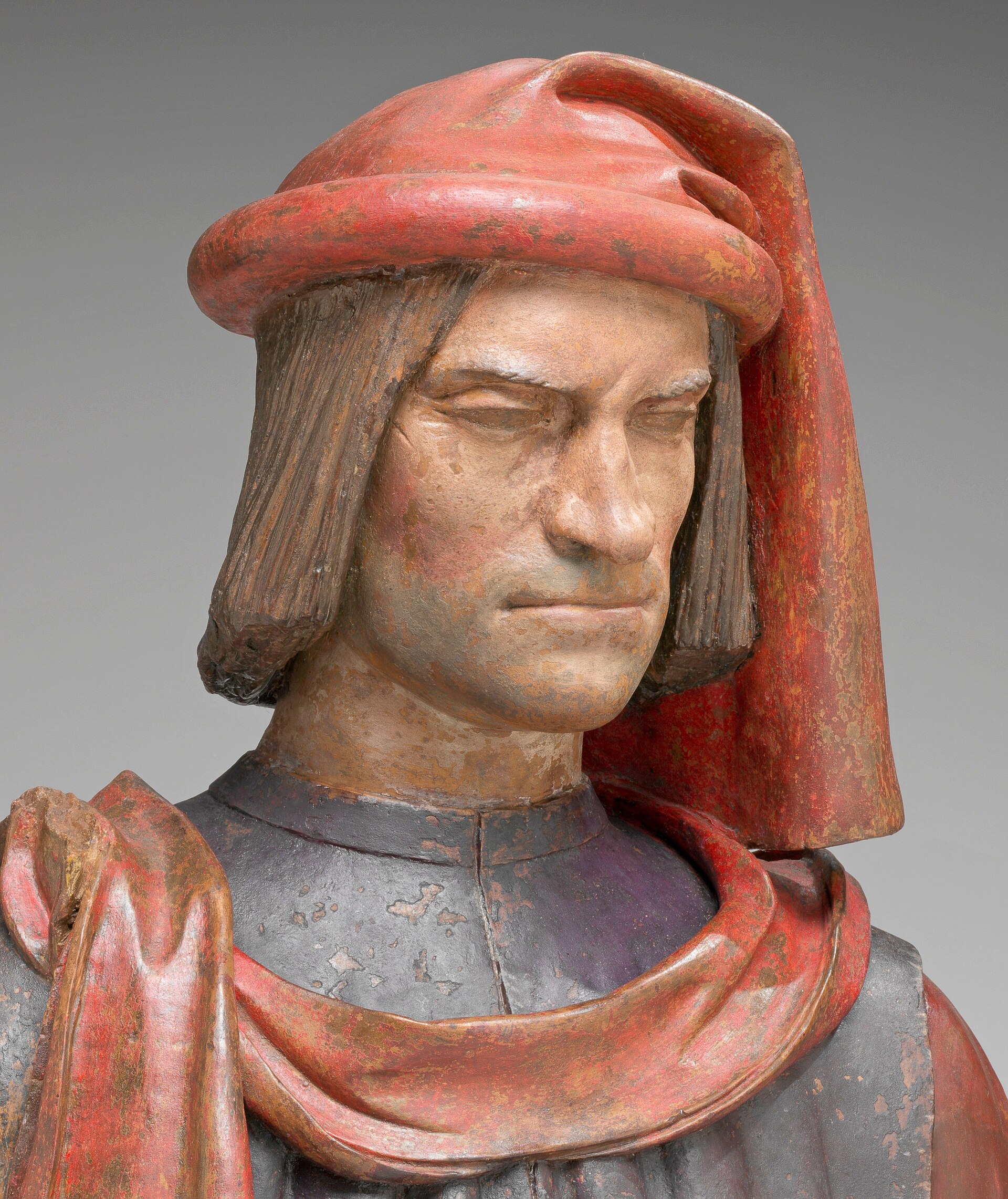
Lorenzo de' Medici the Magnificent
About the Object
Lorenzo de' Medici the Magnificent
1449
Other
Via Camillo Cavour 3, Firenze
Historic Personality
Gallery (1)

The Magnificent: under him Florence was the capital of Europe, yet he built just one house
Lorenzo de' Medici, grandson of Cosimo, ruled Florence from 1469 until his death in 1492, while maintaining all republican forms: offices, councils, elections. The nickname 'the Magnificent' stuck to him during his lifetime and remains to this day. Let's figure out what lies behind it. To begin with, these years were not a golden age of tranquility. The Medici banking empire was tottering under Lorenzo, and he himself fended off conspiracies and constant threats-both internal and external. The most serious conspiracy occurred in April 1478 and is known as the Pazzi conspiracy. The Pazzi bankers, a nephew of Pope Sixtus IV, several condottieri, and a couple of amateur assassins united against the Medici, with the Pope participating in silence. They intended to kill both brothers. They killed Giuliano, who was politically insignificant; Lorenzo narrowly escaped. The Pazzi attempt to rouse the townspeople against the Medici failed, and the revenge was swift and merciless: the conspirators, including the Archbishop of Pisa, were hanged and hacked to pieces. Next came politics. The Pope, infuriated by the failure and using the execution of the archbishop as a pretext, excommunicated Lorenzo, placed Florence under an interdict-no sacraments could be performed in the city-and declared war. The war went poorly, and in 1479 Lorenzo secretly traveled to Naples to negotiate personally with the Pope's main ally, King Ferrante, a man of monstrous reputation: it was said of him that he murdered his guests and kept their mummies on display. Four months of negotiations, and Ferrante broke his alliance with the Pope. Lorenzo returned a hero, and the war ended with the peace of 1480. What kind of man he was is best described by Machiavelli: 'There were two different men in him, united in an almost impossible way.' Unattractive-and irresistible to both men and women; arrogant and hot-tempered-and capable of charming anyone; despite immense wealth, he lived simply, ate ordinary food, dressed modestly, and was accessible to the townspeople; he wrote philosophical treatises and serious poetry-and carnival songs famous for their obscenity. He died at forty-three, worn out by gout and, judging by the descriptions of his symptoms, several other diseases at once. And now the awkward part, without which this card would be an advertising brochure. Some modern researchers believe that Lorenzo's fame as a patron of the arts is largely a later legend invented by the Medici themselves. The arguments are as follows: he was hardly interested in banking, and under him several branches of the family bank collapsed; he abused power by taking public money for his own needs and trying to fleece his cousins out of their inheritance; as a collector, he preferred expensive trinkets; and in his entire life he built exactly one building-the Poggia a Caiano country villa-without commissioning a single significant painting or sculpture. Judith Testa, from whom we take these accusations, answers them as follows, and her answer seems honest to me. Lorenzo gave art something that cannot be measured by a list of commissions-the air in which it grew. While he was alive, Florence was the cultural capital of Italy and all of Europe. It is also worth remembering what happened afterwards. As soon as Lorenzo died, disasters began-both for Florence and for Italy; contemporaries directly connected one with the other. His death was not the cause of everything that followed, but from that moment on, there was no longer a firm and clever hand on the peninsula.
AI translation · 🇬🇧 EN
Rate this review:
Nearby and related
Close by in Florence
About the Object
Lorenzo de' Medici the Magnificent
1449
Other
Via Camillo Cavour 3, Firenze
Historic Personality