
Donato Bramante
About the Object
Donato Bramante
1444
Other
Piazza San Pietro in Montorio 2, Roma
Historic Personality
Gallery (1)

Rome's smallest building, where it all began
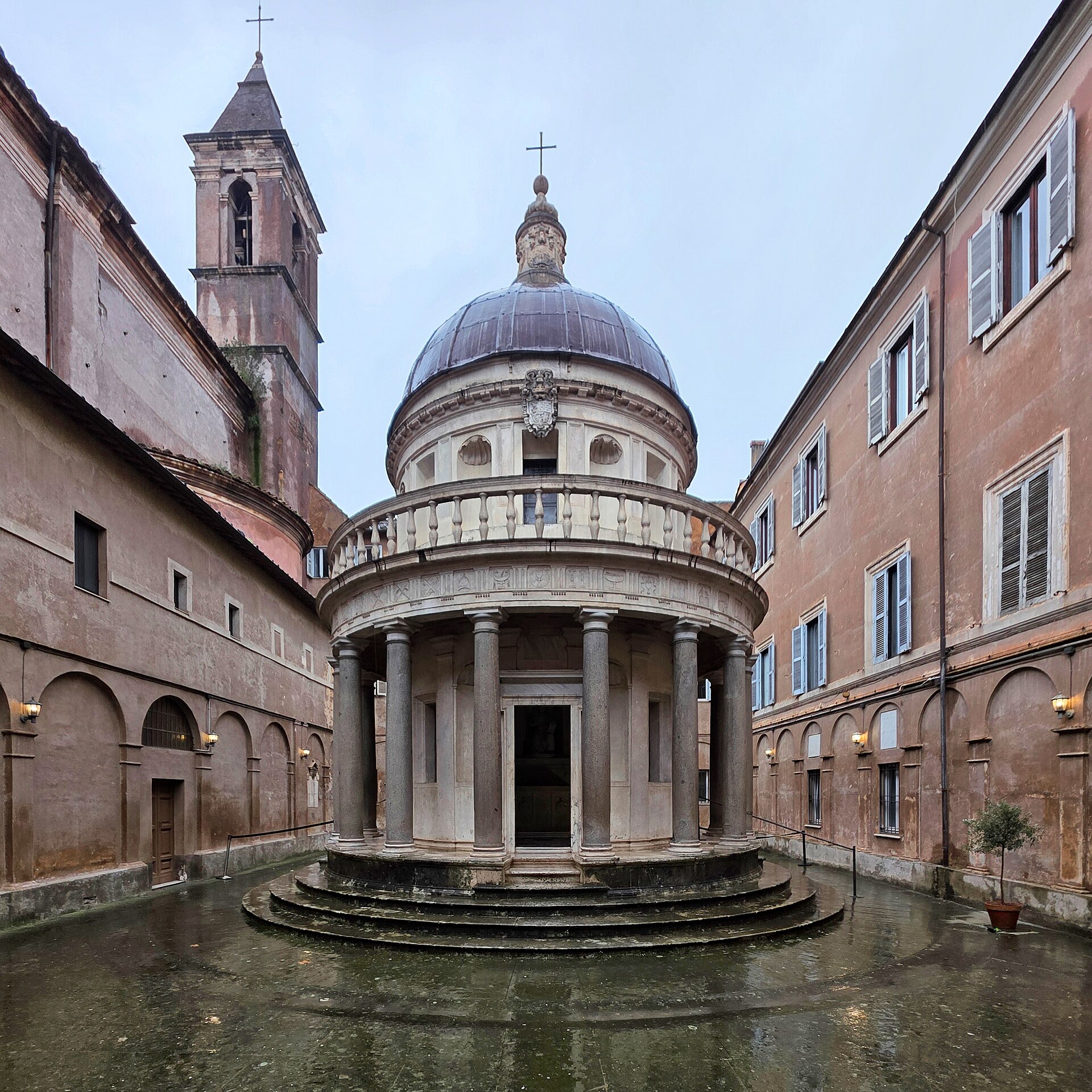
We are talking about the courtyard of the monastery at the church of San Pietro in Montorio. There, squeezed between the walls, stands a round building with a colonnade and a dome: slender Tuscan columns, a Doric entablature, you can walk all the way around it in a minute. This is the Tempietto, the "little temple", and it is perhaps the most influential building in European architecture. It was built around 1502 by Donato Bramante, commissioned by the Spanish monarchs Ferdinand and Isabella. The site was not chosen by chance: according to legend, this is precisely where the Apostle Peter was crucified, and the building was conceived as a martyrium - a monument on the site of execution. Now, why this is important. Bramante lived from 1444 to 1514 and in Rome he represents the High Renaissance - a time when ancient models were not copied, but confidently reinterpreted. The Tempietto broadly repeats the ancient Temple of Vesta, but speaks a different language. Architectural historian Jonathan Glancey describes the effect like this: a colonnade where the sun plays and where you can walk, and this small building speaks of reason and dignity, rather than religious fear and oppression. Next begins the chain of events for which it is worth coming here. Glancey directly calls the Tempietto the source for three domes: Michelangelo's dome on St. Peter's Basilica, Christopher Wren's dome of St. Paul's Cathedral in London, and the dome of the Capitol in Washington. That is, a line leads from a pavilion in a courtyard on the Janiculum to the building of the US Congress. And one more thing, the most Roman part of this whole story. In 1506, Pope Julius II commissioned Bramante to demolish the old St. Peter's Basilica, which had stood for over a thousand years, and build a new one. Bramante conceived a Greek cross with a dome inspired by the Pantheon, standing not on solid walls, but on four pillars. The first stone was laid on April 18, 1506. He died in 1514, having seen nothing but the started pillars; the cathedral was built for over another hundred years, and Michelangelo returned to his centralized design thirty-three years after his death. So this man has two main buildings in Rome: the smallest, which he finished, and the largest, which he began.
AI translation · 🇬🇧 EN
Rate this review:
Nearby and related
By the same architect
Close by in Rome
About the Object
Donato Bramante
1444
Other
Piazza San Pietro in Montorio 2, Roma
Historic Personality