
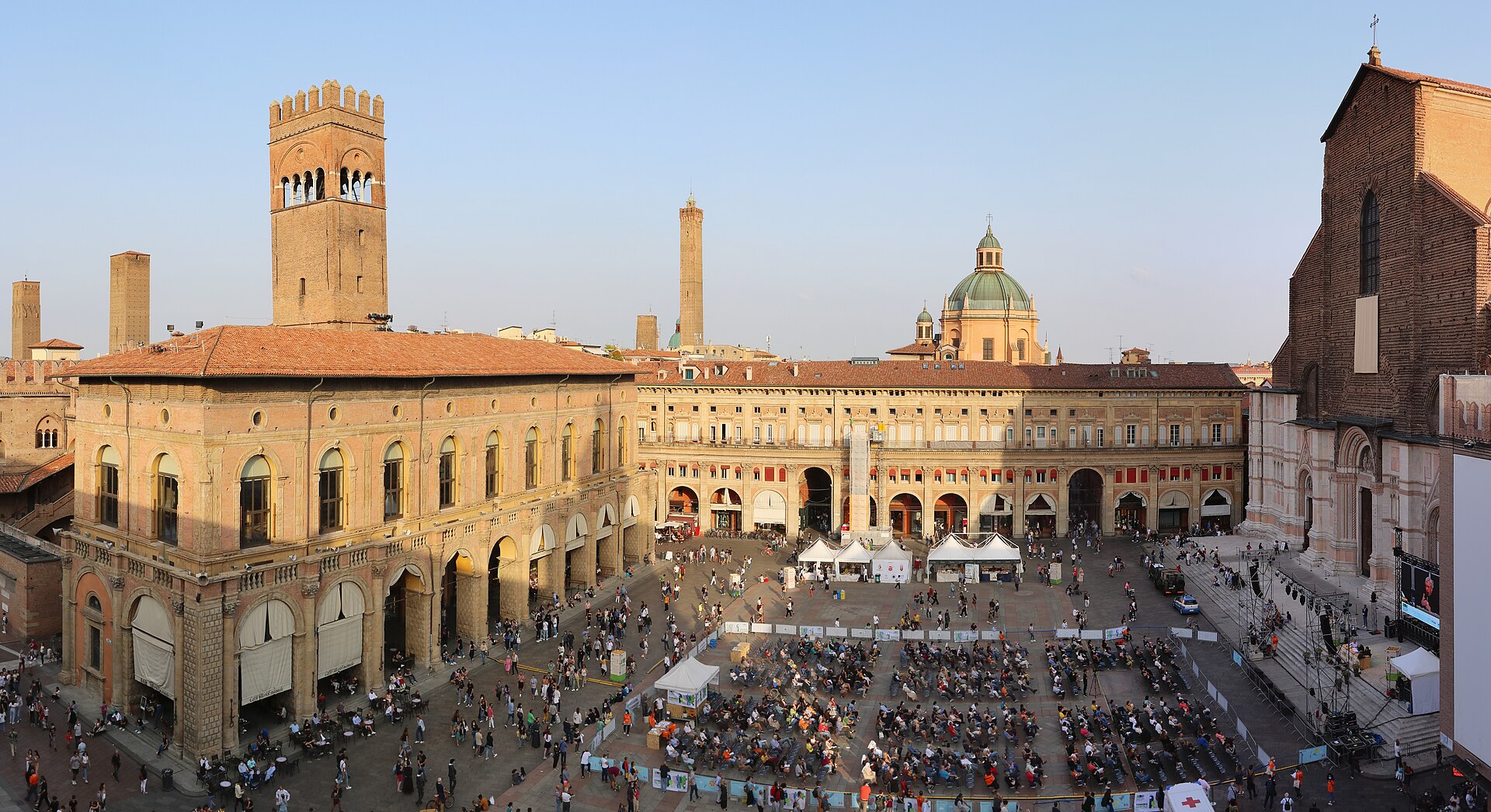
Piazza Maggiore and Fontana del Nettuno
Всемирное наследие ЮНЕСКОAbout the Object
Tommaso Laureti, Giambologna
1200
Other
Piazza Maggiore, Bologna
Square
Gallery (1)

A square that took three hundred years to assemble and was signed off in three
Piazza Maggiore is 115 meters long and 60 wide, almost seven thousand square meters, and it is still the main square of Bologna. They began assembling it around 1200, and the reason was prosaic: the city needed a marketplace. Then it was built up in a circle, century after century, and every wall on it is someone's commission. Palazzo del Podesta, the northern side, was erected in 1201 and thoroughly remodeled between 1472 and 1484 under the Bentivoglio, the family that practically ruled the city. Above it rises the Arengo tower, whose bell summoned the citizens. Palazzo d'Accursio, the western side, is the city hall. Built in 1290, after the fire of 1425 it was rebuilt by Fioravante Fioravanti. Palazzo dei Notai, the southwest, the guildhouse of notaries, was built between 1384 and 1422 from the designs of Antonio di Vincenzo. The name is worth remembering: the same man in 1390 started San Petronio on this very square. That means the square has an architect who worked on two of its corners at once. Palazzo dei Banchi, the eastern side, originally dates to 1412, and got its current appearance in 1565-1568 from Vignola. And this is where one should pause, because this is a very Bolognese thing. Behind this porticoed facade stand not chambers, but mismatched merchant houses. Vignola did not build a building, he built a screen: a unified facade that brings a motley row down to a common denominator. A trick that entire urban heritage protection departments deal with today was applied here in the 16th century and still works. In the middle of the square lies a slightly raised rectangular platform of white and pink granite, only fifteen centimeters high. They call it Crescione, named after the local crescente flatbread it resembles. It was not made in the Middle Ages, but in 1934, and this is useful to know: what seems to be the ancient floor of the square is younger than the automobile.
AI translation · 🇬🇧 EN
Rate this review:
Neptune, placed by Rome, and the vault where you can whisper across twenty meters
The Neptune Fountain has a postcard reputation, but its history is political, and that explains why it stands here. In 1563, the papal vice-legate in Bologna was Pier Donato Cesi. Exactly a year later, he would demolish a block of medieval houses to open the new Piazza del Neptune, and a year after that, he would commission the University to build the Archiginnasio building twelve meters away from San Petronio. In other words, Rome was redrawing the center of Bologna quickly and visibly, and the fountain was part of this work rather than a decoration. The contract was signed on August 2, 1563. The concept was created by the Sicilian painter Tommaso Laureti, the bronze was cast by the Bolognese master Zanobio Portigiani, and it was sculpted by the Fleming Jean Boulogne, whom Italy called Giambologna. By 1566, everything was standing. You need to look at the composition of the plot. Neptune raised his hand not to pose, but to calm the waves. Below are four putti with dolphins and four sirens. For a city that had just passed under the firm hand of Pope Pius IV, the metaphor was read without explanation - here is someone who calms the raging elements. The fountain underwent a radical restoration between 1988 and 1990. Now for the trick that all Bolognese and almost no visitors know. Between the Palazzo del Podesta and the Palazzo Re Enzo there is a passage covered by a groin vault on four pillars, the Voltone del Podesta. If you stand in one corner, put your companion in the opposite one, and speak in a half-whisper while turning towards the corner, the trick works. They will hear you as if you are right next to them. This is not a gimmick, but a consequence of geometry - above the vault is the emptiness of the Arengo tower, and it acts as a transmitter. Such places exist in the world, for example, the whispering gallery at Grand Central Terminal in New York, but the Bolognese vault is several centuries older. The history of this passageway is gloomier than the attraction. A market and notary offices used to be here, and later executions by hanging took place here precisely because the spot is visible from Piazza Maggiore, where people always gathered. The beams to which the ropes were attached are still visible. On the pillars of the vault stand terracotta figures of the four patron saints of the city, Petronius, Dominic, Proculus, and Francis, made by Alfonso Lombardi in 1525. Practical info. The square is flat, entirely pedestrianized, easy to navigate with a stroller, and along the edge run the Pavaglione porticoes, where you can take shelter from the sun. This is the best meeting point for any day in Bologna.
AI translation · 🇬🇧 EN
Rate this review:
Nearby and related
Close by in Bologna
About the Object
Tommaso Laureti, Giambologna
1200
Other
Piazza Maggiore, Bologna
Square