
Basilica di San Domenico
About the Object
Carlo Francesco Dotti
1221
Gothic
Piazza San Domenico 13, Bologna
Religious Structure
Gallery (1)

The tomb that took two hundred years to make, and the boy who finished it
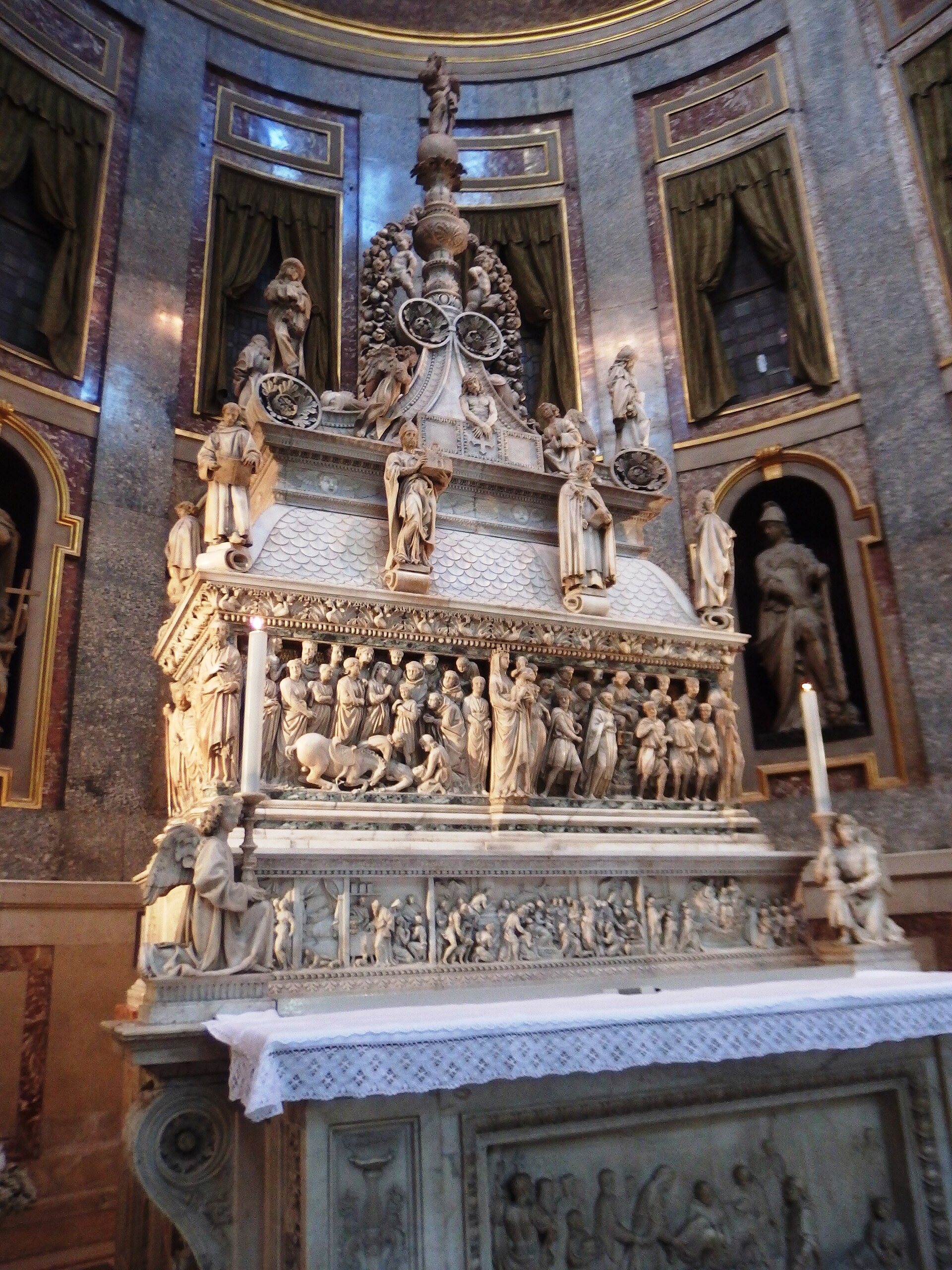
There are three sculptures by Michelangelo in Bologna, and almost no visitors know about it. They stand not in a museum, but in a church, a half-hour walk from the main square, and you can see them for free. The story begins more than two centuries before Michelangelo. Dominic de Guzman, founder of the Order of Preachers, arrived in Bologna in January 1218 and died here on August 6, 1221. The church was started immediately after his death to provide a place to keep the body. At first, it lay in a simple sarcophagus behind the altar. In 1264, a proper tomb was commissioned, and Nicola Pisano undertook to make it with his workshop, where the young Arnolfo di Cambio, among others, worked. In 1267, the remains were transferred to the new structure. The reliefs of the saint's life on this tier belong to Pisano and his assistants, and this is already grand sculpture, not church utensils. After that, the tomb stood unfinished at the top for two hundred years. In 1469, the crowning part was commissioned from the sculptor Niccolo da Bari, and he made it in such a way that the nickname from this work stuck to his name forever: Niccolo dell'Arca, Niccolo of the Ark. The lid was installed in 1473. And in March 1494, Niccolo died without finishing several figures. And this is where Michelangelo appears. In the autumn of 1494, at nineteen years old, he flees Florence: the Medici are expelled, Savonarola is rising in the city, and it is dangerous to stay. Via Venice, he ends up in Bologna and lives until early 1495 in the house of Gianfrancesco Aldrovandi, an educated man who liked to listen to his guest read Dante and other Tuscans aloud. In exchange for shelter, the young sculptor finishes the Ark: the angel with a candlestick on the right, Saint Petronius holding the city of Bologna on his palm, and Saint Proculus. You need to look at them right next to Niccolo's figures, because that is when the difference becomes visible. Niccolo's angel is slender and graceful. Michelangelo's angel is dense, heavy, antique in build. And Saint Proculus has a turn of the head and a gaze such that in a few years this will turn into the "David". This is that rare case when the artist's future can be seen in advance and in person.
AI translation · 🇬🇧 EN
Rate this review:
Baroque over Gothic, one hundred and two chairs and an organ that remembers Mozart
The church you will enter is medieval on the outside and in its plan, but eighteenth century on the inside, and you need to know this in advance, otherwise your first impression will be one of bewilderment. In 1728-1732, the interior was completely remodeled by the Bolognese architect Carlo Francesco Dotti. The commission came from Pope Benedict XIII, a Dominican, meaning the order was reclothing its own main church in the modern language of that time. Dotti is not a minor figure in our story: he also built the San Luca Sanctuary on the hill and the Meloncello Arch on the way there. It turns out that two of the most dissimilar Bolognese landmarks were made by the same hand. There is something in the church that makes it worth stepping into the choir behind the altar. One hundred and two wooden seats were made by the monk Damiano da Bergamo in 1528-1530, and the intarsia work on them was assembled from 1541 to 1549. This is intarsia, pictures laid out with pieces of different wood, and on some of the backrests you will see quite distinct perspective with architecture. For an architect, this is a special pleasure: a Renaissance drawing executed in veneer. Behind the marble sarcophagus of the Arca stands the 1383 reliquary that houses the head of Saint Dominic. The phrasing sounds wild, but this was a common practice in the Middle Ages: the relic was divided so that it could work in several places at once. And an urban history story that you will be told on site. In the chapel, they say, the young Mozart played the organ when he came to Bologna to study with Padre Giovanni Battista Martini. He was in Bologna in 1770, in March, and then from July to mid-October, and on October 10, 1770, he was admitted to the Philharmonic Academy. He was fourteen. Practical note. The church is active, admission is free, but the Arca has its own hours, and the chapel may be closed during the lunch break. It is worth planning so as to arrive before noon.
AI translation · 🇬🇧 EN
Rate this review:
Nearby and related
By the same architect
Close by in Bologna
About the Object
Carlo Francesco Dotti
1221
Gothic
Piazza San Domenico 13, Bologna
Religious Structure