
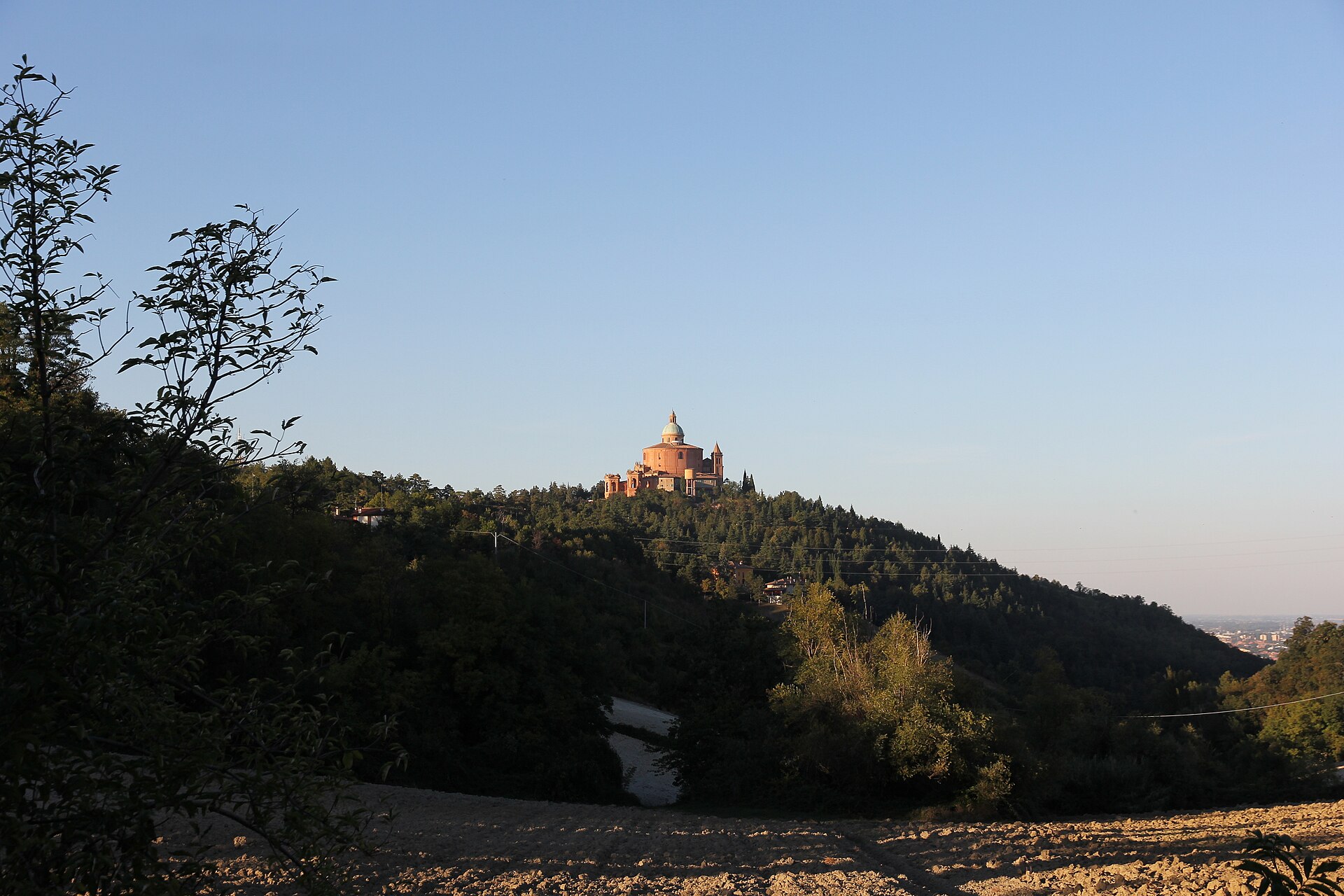
Santuario della Madonna di San Luca
Всемирное наследие ЮНЕСКОAbout the Object
Carlo Francesco Dotti, Gian Giacomo Monti
1674
Baroque
Via di San Luca 36, Bologna
Religious Structure
Gallery (1)

Four kilometers of roof, bought together
The longest continuous portico in the world goes uphill in Bologna, and the townspeople built it with their own money. This is not a figure of speech, this is a method of financing. Construction began in late June 1674. The idea belonged to the architect Gian Giacomo Monti: a continuous covered gallery from the Saragozza city gate to the top of the Guardia hill, where the sanctuary stood. The length is about four kilometers, rising some three hundred meters above the plain. According to the design, there were supposed to be 666 arches. The city had no money for this, and the money was raised differently. The arches were sold. A family, a craft guild, or a brotherhood bought an arch or a section of several and got the right to carve their name and coat of arms on the stone. Everyone chipped in, nobility and commoners, clergy and laymen, personally and through associations. Moreover, the townspeople formed a chain along the slope and passed building materials up from hand to hand, such a transfer was called passamano. Pause on this, because the thought here is exactly the same as in the city porticos below, only taken to the limit. Below, a private person is required by law to build a piece of shared roof in front of their house. Here, a private person voluntarily buys a piece of shared roof in an open field, on a hill where they own nothing. Bologna knows how to assemble a public space from private contributions, and has been doing so for seven centuries in a row. Why a roof on the road at all. Because they carry an icon along it. Every year the image of the Madonna is brought down from the hill into the city, and the portico was built so that the procession could walk in any weather. The tradition dates back to 1433, and the current procedure is that in May the icon is brought to the city cathedral of San Pietro for a week. They will tell you a round number of arches, 666, and a devilish meaning is willingly read into it: they say the road to the Madonna tramples the number of the beast. With an exact count, the figure turns out slightly different, it all depends on what is considered an arch at turns and near the gates. This does not cancel the beautiful version, but it is useful to know that it is beautiful, not exact.
AI translation · 🇬🇧 EN
Rate this review:
Dotti's Church on the summit and the question of visiting with a child
The church on the Guardia hill, to which all of this leads, is younger than the portico. Construction of the current building began in 1723 based on a design by Carlo Francesco Dotti, and work dragged on until the middle of the eighteenth century. Dotti accomplished something that is rarely achieved on a mountain: a structure that looks equally good up close and from a distance, as a silhouette on the ridge. An elliptically based volume, a serene facade, a dome visible from the plain for many kilometers. He is also responsible for the Meloncello arch on the way up, the spot where the flat urban portico transitions into the mountain one. The road had to jump over it, and Dotti threw an arch across it, turning an engineering necessity into the main highlight of the entire route. The same architect had remodeled the interior of San Domenico in the city center five years prior. If you go through our Bologna selection in sequence, Dotti will appear twice, and this is an instance where it is useful to see how one person works in the cramped space of an old church and on an open mountain. Inside is kept an icon of the Virgin and Child in the Byzantine style. Legend has it that in the twelfth century a pilgrim brought it from Hagia Sophia in Constantinople, and in 1160 Bishop Gerardo Grassi assigned it to the hermitage on the hill. That is how it all started: first the image, then the church, then the four-kilometer-long road leading to it. The terraces offer a view of the hills and the city. If Asinelli is closed and you need a view from above, this is now the only decent option in Bologna. A practical note, and an important one. Walking up is a four-kilometer uphill climb, which means a separate half-day, and in the September heat with a stroller it is a bad idea. Tourist transport runs up from the center, but I did not check its schedule and am not including it in the plan. The church is open from 7:00 to 18:30, in summer until 19:00. If you only have one day in Bologna, the honest choice is this: explore the center under the porticoes on foot, view San Luca from the plain, and come back here next time.
AI translation · 🇬🇧 EN
Rate this review:
Nearby and related
By the same architect
Close by in Bologna
About the Object
Carlo Francesco Dotti, Gian Giacomo Monti
1674
Baroque
Via di San Luca 36, Bologna
Religious Structure