
Palazzo dell'Archiginnasio
About the Object
Antonio Morandi (Terribilia)
1562
Renaissance
Piazza Galvani 1, Bologna
Public Building
Gallery (1)

A building constructed to ensure the neighboring one remained unfinished
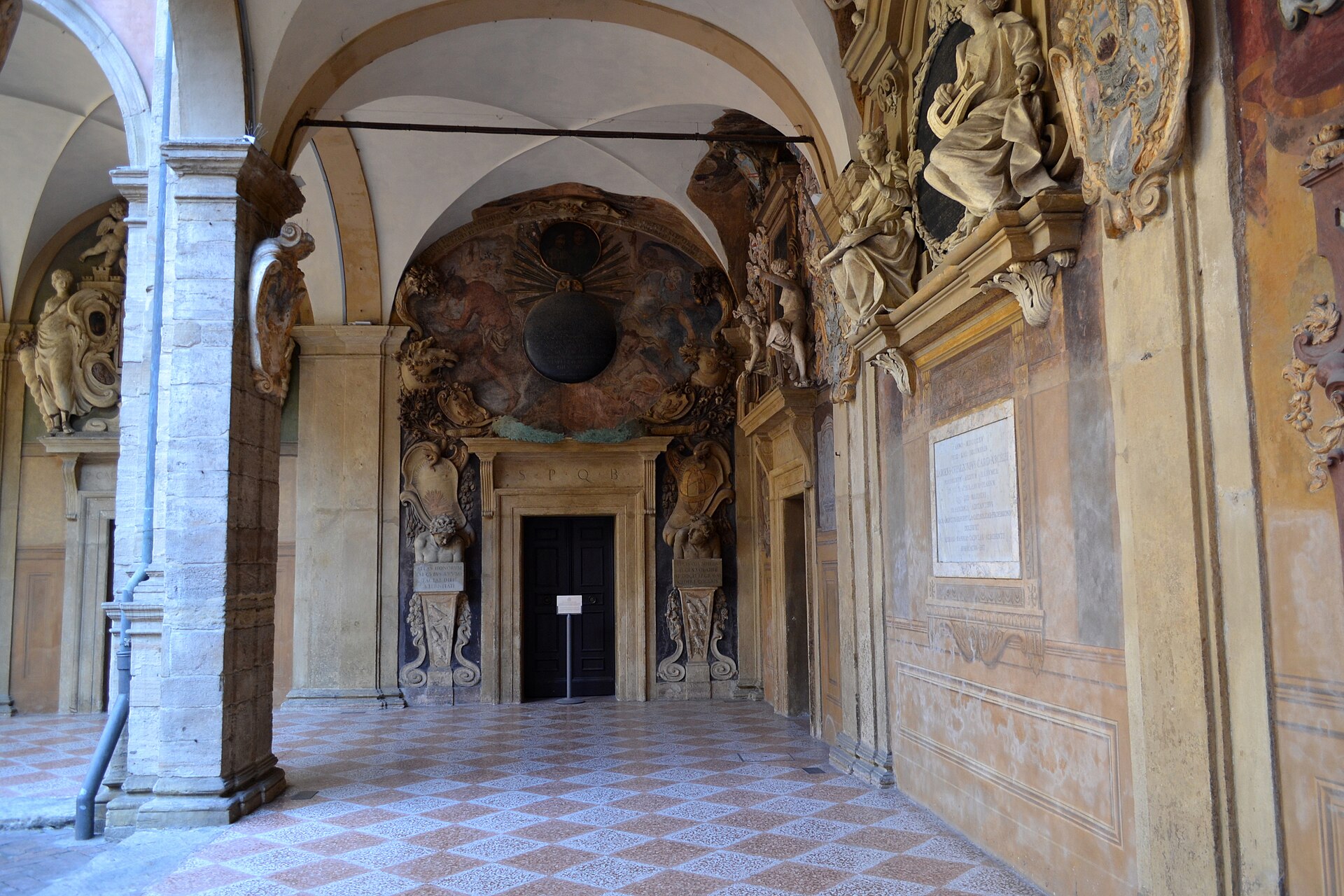
The University of Bologna, the oldest in Europe, had no home of its own for its first four hundred years. Classes were held all over the city - in churches, rented rooms, and professors' homes. In 1562, this came to an end, and for a reason that had little to do with education. Pope Pius IV, through Cardinal Carlo Borromeo and Vice-Legate Pier Donato Cesi, ordered a single shared building to be constructed for the university. The project was designed by Antonio Morandi, nicknamed Terribilia, and the building was placed twelve meters away from the Basilica of San Petronio - right where its left transept was supposed to rise according to the design. It was erected quickly, using papal funds. After this, San Petronio could never become the church it was intended to be, and to this day it stands without a cruciform ground plan and with an unfinished facade. In Bologna, this is called the "black legend": the story that Rome did not allow the province to outgrow St. Peter's Basilica. Historians debate this, pointing out that the basilica's construction was stalling even without the pope due to lack of money. But the building stands where it stands, and from the street this is clearly visible. What you must see is the courtyard. It has two tiers with open galleries, and its walls are entirely covered in coats of arms - over six thousand heraldic signs of students and professors, and there used to be over seven thousand. This is the largest collection of mural heraldry in the world. Each coat of arms represents a specific person who studied here and left a mark of themselves on the wall, and the sum of it all is a portrait of the educated European class over several centuries, laid out in paint and stone. The university lived here until 1803, then moved to Palazzo Poggi. Since 1838, the building has housed the Archiginnasio Municipal Library, and it is still here today - around eight hundred and fifty thousand volumes, two and a half thousand incunabula, and fifteen thousand 16th-century editions. The courtyard and galleries are open free of charge, Monday through Saturday.
AI translation · 🇬🇧 EN
Rate this review:
The wooden hall where people were dissected beneath constellations
On the second floor is the Anatomical Theatre, and it is the main reason people come here. It was built in 1637, entirely out of wood, in the shape of an amphitheatre: rows of benches rise around a marble table in the middle. Bodies were dissected here before the eyes of students, and the room was arranged so that everyone could see, just like in a theatre, hence the name. Along the walls stand wooden statues of physicians: Hippocrates, Galen, among them the Bolognese Gaspare Tagliacozzi, who in the sixteenth century worked on nose reconstruction and is considered a forerunner of plastic surgery. The ceiling is coffered, and fourteen constellations and Apollo are carved into the coffers. This is not decoration for its own sake: at that time medicine was seriously connected with astrology, and the alignment of the luminaries was believed to influence the course of a disease. In other words, the sky hung above the anatomical table, and this was part of the same science. In 1944 the building was bombed, and the theatre was destroyed. It was reassembled from scratch, preserving the surviving sculptures and restoring the hall according to the original drawings. It is worth knowing this: what you see is half postwar work, and it is done honestly. A ticket to the Anatomical Theatre and the Stabat Mater hall costs three euros. For what you get, this is perhaps the most underrated price in Italy.
AI translation · 🇬🇧 EN
Rate this review:
Nearby and related
Close by in Bologna
About the Object
Antonio Morandi (Terribilia)
1562
Renaissance
Piazza Galvani 1, Bologna
Public Building