
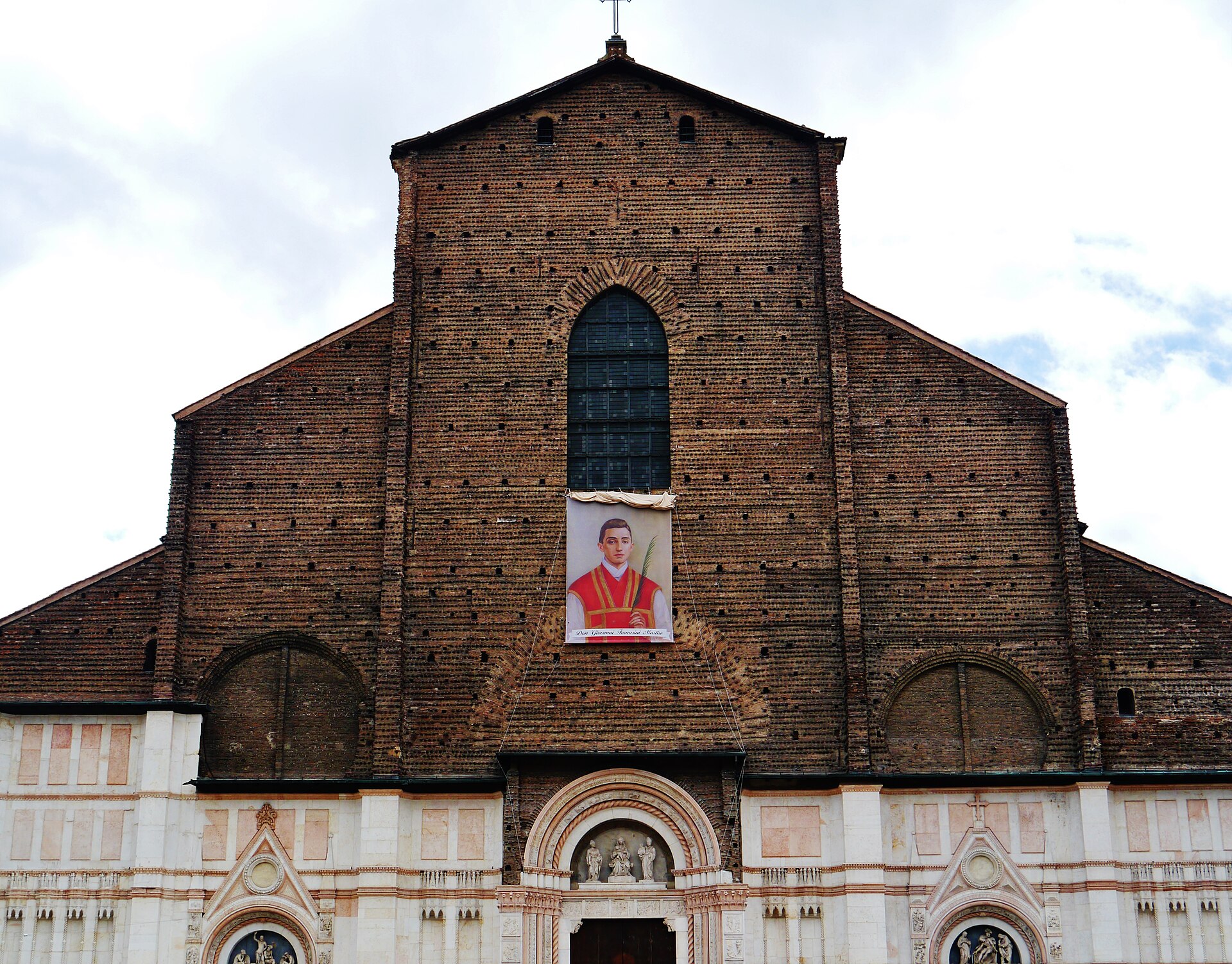
Basilica di San Petronio
About the Object
Antonio di Vincenzo, Jacopo della Quercia
1390
Gothic
Piazza Maggiore / Piazza Galvani 5, Bologna
Religious Structure
Gallery (1)

The Church That Was Never Allowed to Become the Largest in the World
On Piazza Maggiore stands a building whose face is split in half. At the bottom, for about four meters, there is marble. Above that is bare brick, all the way to the top. It looks as though construction was abandoned yesterday, yet it was abandoned nearly five hundred years ago. Work began in 1390, directed by Antonio di Vincenzo. The church was not built by a bishop, but by the city: San Petronio was conceived as a civic temple of Bologna, dedicated to its 5th-century bishop, and was maintained by the municipal commune, not Rome. From this came everything that followed. The plan was this: to make the church larger than St. Peter's Basilica in Rome. For a medieval city, this was a statement not about faith, but about itself. And for a time, things were heading that way. Further on, the versions diverge, and this is the case when both are worth telling. The generally known one states that in 1562 Pope Pius IV ordered the construction of the Archiginnasio nearby, a new university building, and placed it right where the left transept of the basilica was supposed to rise, twelve meters from the wall. By means of this single building, erected in record time with papal money, the expansion of the church became permanently impossible, and Bologna did not get a Latin cross ground plan. In the city, this story is told as a black legend: the pope did not allow the province to outgrow Rome. Historians dispute this and show that money was lacking anyway, and construction had been stalling long before Pius IV. The truth is most likely in the middle, but the fact remains: the Archiginnasio stands on the site of the unrealized transept, and it can be seen from there. The trace of this story can be read on the building itself. On the eastern side runs a row of columns that was supposed to support another nave, and they just stand there, propping up the air. What to see inside. The central portal was created by Jacopo della Quercia between 1425 and 1438, and this is one of the major sculpture works of the early Renaissance created outside of Florence. Marble cladding of the lower part of the facade began in 1538. In 1547, the Council of Trent temporarily moved here because there was plague in Trento, meaning that for several months the fate of the Catholic Church was decided within these walls. Admission to the basilica is free.
AI translation · 🇬🇧 EN
Rate this review:
The most accurate sundial of its century lies right beneath your feet
If you walk down the left nave and look down at your feet, you will see a brass strip embedded in the floor running diagonally across the entire church. This is a meridian line, and at 67.7 meters long, it is the longest in the world. It was laid out in 1655 by Gian Domenico Cassini, then a Bologna professor of astronomy, and later the man whose name was given to the division in Saturn's rings. The mechanism is simple and visual. An aperture was made in the vault at a height of twenty-seven meters, through which a sunbeam passes, falling as a bright spot on the floor. At noon, the spot falls precisely on the line, and the exact spot it hits depends on the day of the year - between the two solstices, the spot travels fifty-six meters across the floor. Why was this necessary? The huge dimensions of the church made it possible to measure the position of the Sun with an accuracy unattainable by the instruments of that time, and accuracy was needed for the calendar and for verifying how the Solar System is structured. In other words, in the middle of the 17th century, a Catholic church functioned as a scientific instrument, and it was built this way quite consciously. Another thing is important for us here. We are used to a building containing science like a box. Here it is the other way around: the building itself is the instrument, and its size is not vanity, but resolving power. It is best to come around noon on a sunny day, otherwise there will be nothing to see.
AI translation · 🇬🇧 EN
Rate this review:
Nearby and related
Close by in Bologna
About the Object
Antonio di Vincenzo, Jacopo della Quercia
1390
Gothic
Piazza Maggiore / Piazza Galvani 5, Bologna
Religious Structure