
Basilica di Santo Stefano (Sette Chiese)
About the Object
Romanesque
Via Santo Stefano 24, Bologna
Religious Structure
Gallery (1)

A building that was not built, but grown
In Bologna, there is a place where an architect spends more time than a tourist, and it is not the main square. Santo Stefano stands on the most beautiful square of the city and from the outside looks like a single church with several facades. Inside, it turns out to be not a church, but a concretion: several temples of different centuries, fused under one roof and connected by passageways. People call this place the complex of the Seven Churches, although today there are four of them, or even more than a dozen if you count all the rooms with an independent history. Seven here is not an accounting figure, but a symbolic one. You have to walk through it slowly, because what is interesting is not each part individually, but the joints. You enter through the Church of the Crucifix, Lombard in origin, with an 11th-century crypt. Essentially, it functions as a corridor. The corridor leads to the main thing: the octagonal Church of the Holy Sepulchre, also from the 11th century, in the middle of which stands the tomb of Saint Petronius, the patron saint of Bologna. The tomb is made in the image of the Holy Sepulchre in Jerusalem, and this is not a tour guide's metaphor, but the original design. Tradition attributes the first building on this site to Bishop Petronius, who lived in the 5th century: he went to Jerusalem, brought back relics from there, and wanted to replicate at home what he had seen there. The church tradition of Bologna reads this building as a cipher: the octagon is the number of the resurrection, the twelve pillars around the tomb are the twelve gates of the Heavenly Jerusalem, and at the same time the twelve gates of Bologna. Everyone has their own attitude to such a reading, but it is worth knowing, because then it becomes clear why everything is arranged just this way. Further on, there are parts that are older than everything else. The Church of Saints Vitale and Agricola dates back perhaps to the 5th century, was renovated in the 8th, and acquired its current appearance in the 11th. The Church of the Trinity is mentioned from the 4th to 6th centuries, but its original layout can no longer be deciphered: it has been rebuilt too many times. The general feeling of the place is this: before you is not a design, but a sedimentary rock. A thousand years of construction, where each successive one did not demolish the previous, but leaned against it.
AI translation · 🇬🇧 EN
Rate this review:
Pilate's Courtyard, an eighth-century basin, and an honest conversation about restoration
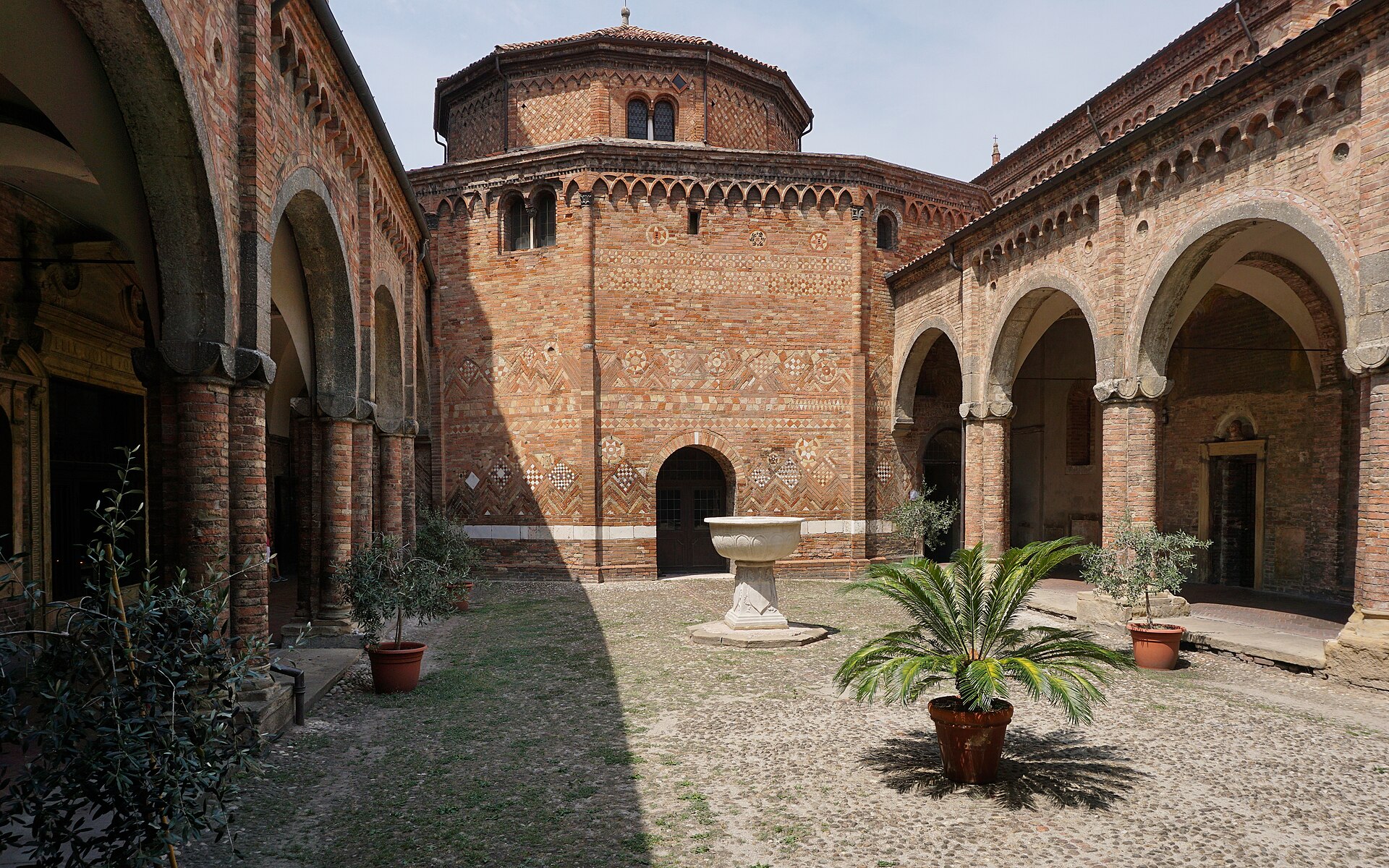
Deep inside the complex lies a courtyard. It is called Pilate's Courtyard, and it is the quietest spot in central Bologna. In the middle stands a basin on a Renaissance pedestal. The basin is dated to 737-744, that is, the Lombard period, and an inscription along the edge tells what it was used for: offerings were collected in it on Maundy Thursday. The popular name of the basin is connected with the evangelical washing of hands, but it has nothing to do with Pilate and is seven centuries younger than him. Around the courtyard is a Romanesque double loggia and cloister: the lower tier dates to the eleventh century, the upper to the mid-twelfth, and the bell tower to the thirteenth. If you have come to Italy to see Romanesque architecture, there is more of it here and it is purer than in any other place in the city. Now for what guidebooks usually keep silent about. The complex was heavily remodeled at the turn of the twentieth century. The restorers of that time tried to give the building a medieval appearance, and this is especially noticeable in the Church of the Crucifix. That is, part of what you take for the early Middle Ages is actually the late-nineteenth-century idea of the early Middle Ages. In itself, this is not a flaw, as it was done all over Europe, but it is more honest to look at the building with this caveat in mind. And one thing that is older than Christianity. Beneath the complex were the remains of a pagan temple associated with the cult of Isis, evidenced by seven columns of Greek cipollino marble and inscriptions. In other words, the site has functioned as a holy place for roughly two thousand years in a row, the gods in it simply changed. Practical info. Admission is free, the complex is open daily, opening hours in 2026 were from 9:30 to 12:30 and from 14:30 to 18:00, and until 19:30 in the summer. There are thresholds and floor level changes inside, so you will have to move slowly with a stroller.
AI translation · 🇬🇧 EN
Rate this review:
Nearby and related
Close by in Bologna
About the Object
Romanesque
Via Santo Stefano 24, Bologna
Religious Structure