
Due Torri: Asinelli e Garisenda
About the Object
1109
Romanesque
Piazza di Porta Ravegnana, Bologna
Tower
Gallery (1)
One tower and one construction site, and why this is more interesting than a postcard
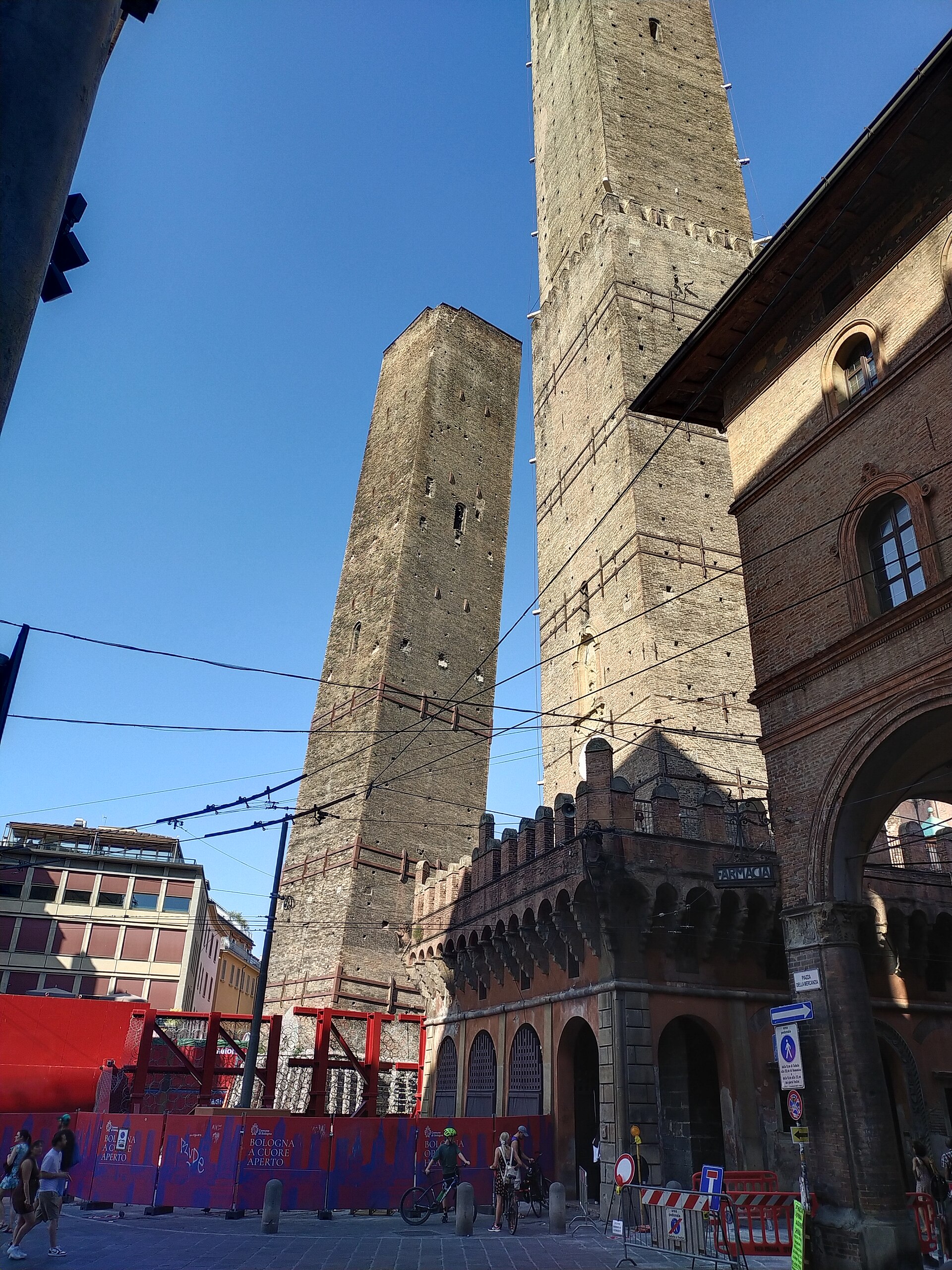
Let us start with what ruins plans, because otherwise you will find out on the spot. You cannot go up Asinelli right now. The tower has been closed since October 2023, and it is closed not because of itself. Sensors showed that its neighbor, Garisenda, is experiencing a worsening condition of its foundation, it was declared at risk of collapse, a construction camp was set up around it, and Asinelli was closed along with it, out of caution. The rescue work for Garisenda is following the same scheme that was once used to straighten the Leaning Tower of Pisa: steel pylons and cables that pull the tower in the right direction, plus foundation reinforcement by grout injection. This costs about nineteen million euros, and the work is scheduled until 2028. Talks about opening Asinelli earlier are underway, but as of late August 2026, there is no decision. That means you will arrive and see one tower and one fence. No postcard view. Instead, you will get a story much better than a postcard. You are looking at a city that has been deciding what to do with its falling symbol for twenty years, and deciding it publicly, with disputes in newspapers, with two factions, and with a figure of nineteen million in plain sight. This is a rare opportunity to see heritage conservation not in a finished state, but in process, with all the scaffolding and awkwardness. As for the towers themselves. Asinelli is 97 meters high, the fourth tallest tower in Italy, and 498 steps lead to the top. Its deviation from the vertical is about two meters. Garisenda is shorter and more crooked: the inclination is about three meters, and because of it, back in the mid-14th century the tower was shortened from about sixty meters to forty-eight so it would not collapse. That means the problem that all of Bologna is busy with today is exactly seven centuries old. Garisenda entered literature before it entered the news. Dante mentioned it in the Inferno: the giant leaning over the poet is compared to this tower, as it appears from below when a cloud passes over it. Anyone who has stood under a leaning tower on a windy day knows that the comparison is accurate to the point of being unpleasant.
AI translation · 🇬🇧 EN
Rate this review:
One hundred and eighty towers, of which twenty remain
To understand what these structures were like, you have to imagine 12th-century Bologna as a forest. There were very many towers. DK mentions about a hundred, while Jonathan Glancey writes that there were supposedly one hundred and eighty. Nobody has an exact figure because counting started only when most had already fallen or been dismantled. Today, about twenty are standing. Formally, these were watchtowers. Essentially, as Glancey notes, they were a statement of power by the family that built them. Square, made of brick, with almost no windows, architecturally unremarkable. Their significance lies not in their beauty, but in the fact that they managed to be built at all: in an era when load calculation was a matter of experience and intuition, a family of local rich folk would raise a brick chimney to one hundred meters and it would stand. Some, of course, did not stand. They were not built by architects. They were built by the patrons, the Asinelli and the Garisenda, two Bolognese families whose names the towers still bear. The point of the enterprise was roughly the same as that of a Moscow skyscraper or a tower in Dubai, only more blatant: mine is taller, so I am more important. It is worth mentioning here that climbing the Asinelli, when it reopens, is no easy task. The stairs are wooden, it is narrow inside, there are nearly five hundred steps, and with a child in your arms this is no walk. If you need a view of Bologna from above and the tower is closed, there is the terrace of the San Luca sanctuary on the hill. The view from there is broader, and you do not have to climb if you take transport.
AI translation · 🇬🇧 EN
Rate this review:
Nearby and related
Close by in Bologna
About the Object
1109
Romanesque
Piazza di Porta Ravegnana, Bologna
Tower