
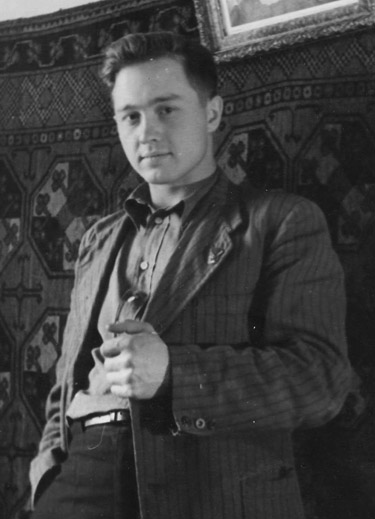
Vladimir Vladimirovich Berezin
About the Object
Vladimir Vladimirovich Berezin
Other
Проспект Алишера Навои, у Панорамного кинотеатра, Ташкент
Historic Personality
Gallery (1)

Vladimir Berezin: The One Who Assembled the Team
You are standing by the Panoramic Cinema. A horizontal glass block of the foyer, against which is set the blind cylinder of the auditorium, its walls treated with vertical fluting like the cut of a Doric column. In reality, the auditorium is not round but oval, but you can only see that from above. This was what Option B looked like at the 1961 competition, and it was developed by Vladimir Berezin's group, along with Yuri Khaldeev, Sergo Sutyagin, Dmitry Shuvaev, and Olga Legostaeva. Experts at the time doubted the cable-stayed roof of the auditorium. The authors met them halfway and replaced the cables with radial steel half-trusses with a central drum. It turned out stronger and, as the experts themselves later admitted, more beautiful. The jury accepted Option B for construction. Next begins what makes Berezin's biography strange, reconstructed from archival documents by architectural historian Boris Chukhovich. Berezin had been working on the working drawings for the Panoramic since 1961, and in mid-1963 he was transferred to another project - the building of the Central Committee of the Communist Party of Uzbekistan. Sutyagin, who turned twenty-six that year, was appointed chief architect of the Panoramic. And at the Central Committee building, Berezin once again ended up not where he started: two proposals were up for selection, his own and Yuri Khaldeev's, and the decision was made in Moscow in favor of Khaldeev. After that, Berezin's team asked the institute's management themselves for permission to continue working on Khaldeev's idea. Permission was granted, while Khaldeev himself was not allowed to participate in further development. The Central Committee building was completed in 1964, and in 1966 the author collective received the republican Hamza Prize for it. In the consolidated list of laureates, this award is listed for two objects at once: the Central Committee administrative building and the Palace of Arts with two thousand three hundred seats. So for both buildings that Berezin worked on in the early sixties, he was ultimately awarded a single prize. He had another piece of work that is usually not remembered. In 1968, he served as the chief reviewer for the project of the indoor ice rink, the future Yubileyny Sports Palace, and wrote that the building was oriented incorrectly: the main facade is facing the wrong way, and it should look north toward the student campus under construction, where a square should have been laid out between the rink and the campus. This is also a profession - telling colleagues that their building is facing the wrong way. And a year earlier, at the 1967 closed competition for three theatres for the future Square of Arts, the jury preferred Uzgostroyproject's project out of three institutional proposals: a puppet theatre of three cylinders of different diameters, where the stage was housed in the large one, and separate foyers and two auditoriums with different seating capacities in the two smaller ones. It was created by Berezin, Yulia Zakirova, A. Kozlova, and engineer Vitaly Shterenshis. Several years later, colleagues persuaded Berezin to become the chief architect of the Uzgosproekt institute. Sergo Sutyagin, who wrote about him, explained it this way: the step was personally sacrificial for Berezin, but any outside architect could have introduced dissonance into the already established Uzgos school. He agreed and assembled at the institute what Yuri Miroshnichenko called the golden link: a group capable of taking on an object of any level. He knew how to argue unlike what was customary in the trade. When Andrei Kosinsky arrived in Tashkent and quarreled with seemingly everyone, Berezin never once took the side of those who insulted him, even though he and Kosinsky were direct antipodes and the students of one did not recognize the students of the other. Instead of arguing, he put friendly humor into play, and according to colleagues' recollections, with this he won over the most deadlocked situations. He was so well-read that the Divine Comedy from his library circulated around the institute from hand to hand, but he trotted this out only when all other arguments had run out. When he was once asked what to do with the central park in Dzhizak, he replied instantly: make a Jurassic Park. To mark his fiftieth birthday in 1981, colleagues drew a friendly caricature and titled it Vladimir Berezin on the Managerial Golgotha. Miroshnichenko concludes the chapter about him with two words worth repeating: Work, brothers!
AI translation · 🇬🇧 EN
Rate this review:
Nearby and related
By the same architect
Close by in Tashkent
About the Object
Vladimir Vladimirovich Berezin
Other
Проспект Алишера Навои, у Панорамного кинотеатра, Ташкент
Historic Personality