
Giorgio Vasari
About the Object
Giorgio Vasari
1512
Other
Piazzale degli Uffizi, Firenze
Historic Personality
Gallery (1)

The Man Who Invented Art History - and Remade a City for a Single Patron
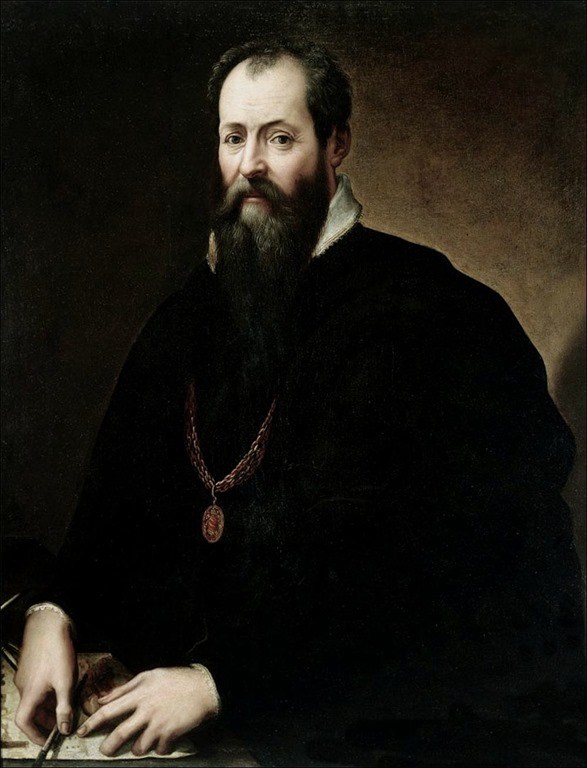
You are standing in the courtyard of the Uffizi. Everything around you was made by one man, who also wrote the book without which we would not know who built everything else in Florence. Giorgio Vasari was born in Arezzo in 1512. He was a painter, architect, and, as we would say today, a manager: he ran a large workshop with assistants and handled dozens of commissions. In 1541, he built a house for himself in Arezzo and decorated it with portraits of fellow craftsmen, friends, and teachers. He also had a house in Florence-the one where he lived from 1557 until his death in 1574-and its walls are painted by his own hand. His main achievement is his book: "Lives of the Most Excellent Painters, Sculptors, and Architects," first published in 1550. From it, we know the biographies of Renaissance artists; almost everything tour guides tell us comes from there, including Michelangelo's famous phrase about the "Gates of Paradise." For this, Vasari is called the first art historian. With one significant caveat, also noted by the DK guidebook: he treated the truth, to put it mildly, quite freely. His accounts have to be checked against documents, and wherever they have been checked, it often turns out that a beautiful story was just made up. His second major undertaking was his service. Cosimo I de' Medici, the first grand duke, appointed Vasari as overseer of all artistic works, and starting in the 1540s, he began remaking the city for the new master. In the Palazzo Vecchio, there are frescoes around Michelozzo's courtyard and the Hall of the Five Hundred, overflowing with the apotheosis of the Medici dynasty. Then the Uffizi: administrative offices for the ducal apparatus. Then the corridor across the river so the ducal family could walk from palace to palace without mingling with the townspeople. The list goes on, revealing not so much architecture as a political program: the city of the republic is being re-dressed as the city of a sovereign. Now for the honest part, without which this review would just be an ad. Judith Testa, whose guidebook we consider one of the best, puts it bluntly: Vasari was a talented researcher and writer-it is hard to imagine what historians of Italian art would do without his "Lives"-but as a painter he was of mediocre talent, and most of what his workshop produced in Florence is pedestrian. She also attributes the "garish" tomb of Michelangelo in Santa Croce to him. It is a harsh judgment, and we quote it as someone else's, not our own. Yet it explains a strange anomaly everyone notices: Vasari's name is everywhere in Florence, but no one lingers in front of his paintings. There is a sad symmetry to this. Florence lost its greatest artist in 1534 when Michelangelo left and never returned to his native city. A few years later, the grand duke hired Vasari-and got a man who knew better than anyone how to talk about the greats, but was not great himself.
AI translation · 🇬🇧 EN
Rate this review:
Nearby and related
Close by in Florence
About the Object
Giorgio Vasari
1512
Other
Piazzale degli Uffizi, Firenze
Historic Personality