
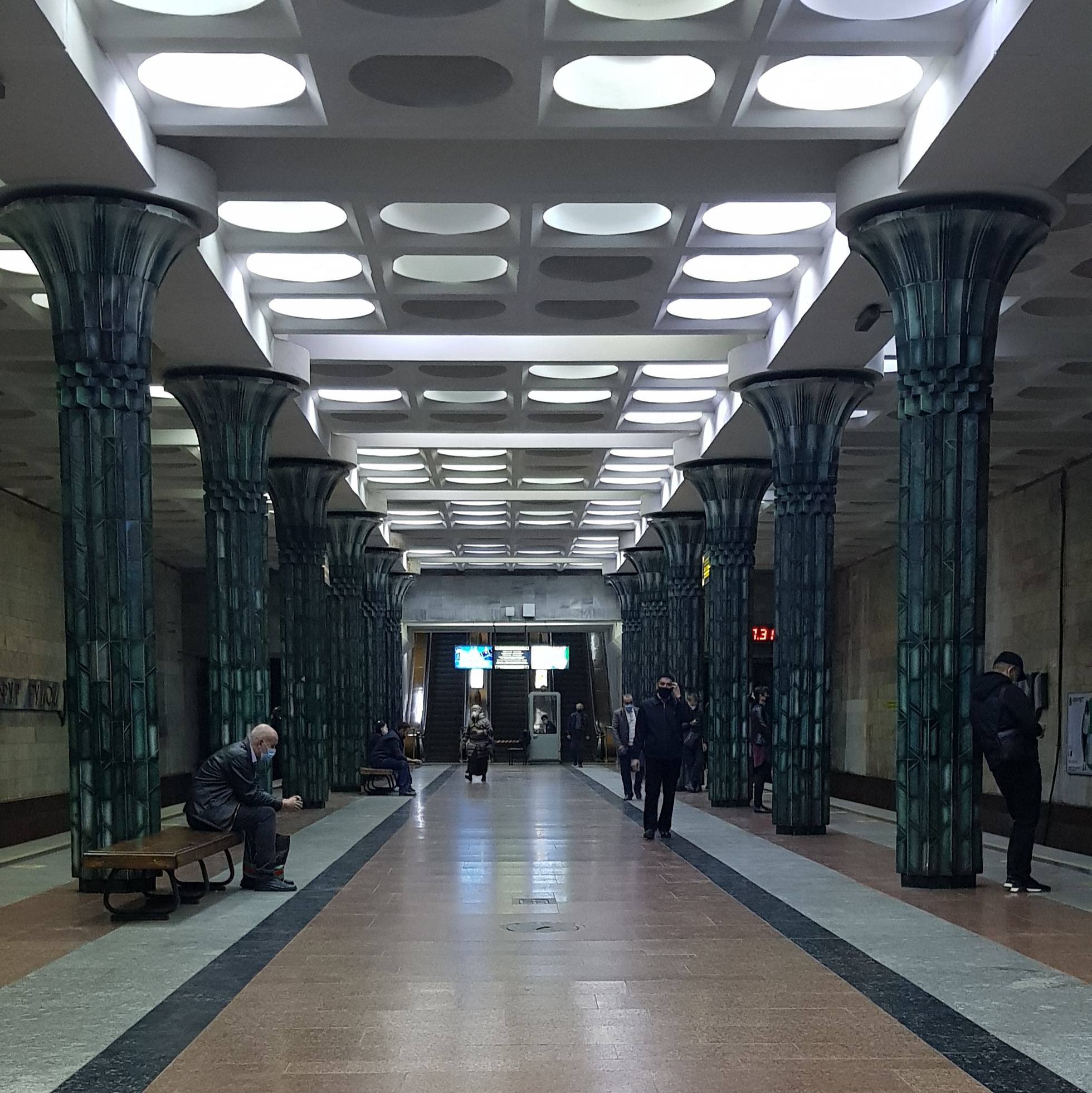
Gafur Gulom Metro Station
About the Object
Not established - period sources name the builders, not the designers
1989
Modernism
Старогородская часть Ташкента, у магазина «Ганга», близ жилого массива Сибзор (ПВ 22.01.1989, 20.08.1989, 07.11.1989)
Railway Station
Gallery (1)

The hardest section of the line
Almost everything is known about this station, except who built it as a piece of architecture. But it is known how it was built. In November 1987, at the celebrations marking the tenth anniversary of the Tashkent metro, it was announced: the next goal is to commission two more stations, Gafur Gulam and Chorsu, in November 1989. Trains would run from the center to the most densely populated, old-city part of the city, and by the end of the five-year plan, the total length of the lines would reach thirty-two kilometers. One and a half months later, in the last days of December 1987, the teams of the second management of the Tashmetrostroy trust ahead of schedule completed the tunneling from Navoi to Gafur Gulam, a kilometer and six hundred meters. Record productivity was achieved by the team of Stanislav Vysheslavtsev, holder of the Order of the Red Banner of Labour, one of the first in the trust to switch to cost accounting. In the same note, a phrase is said that explains everything else: there had never been a more complex section of the line. A neglected system of underground communications, a multitude of adobe structures slated for demolition - for the first time the metro was passing not through new areas, but under a living old city. In March 1988, track layers arrived at the site: a specialized team led by A. Krivolapov began laying rails, three kilometers. In January 1989, the tunneling of the second-stage connecting tunnel was finally completed, and trust manager G. Shtern explained to the correspondent where the time went: before the start of tunneling, it was necessary to study for a long time and relocate underground communications. In May, the tunnels between Navoi, Gafur Gulam and Chorsu were ready, track laying and finishing were underway, and the opening was scheduled for November 7. They made it earlier. In August 1989, the newspaper reported that the section was being commissioned two months ahead of the production target, and printed a photograph of soil backfilling at the Gafur Gulam station. Regular traffic opened on November 6, 1989. The trust commissioned a 2.4-kilometer-long line and two stations; over thirty-seven million rubles of capital investments were mastered at the construction site, and hundreds of thousands of cubic meters of soil were moved. Like the rest of the stations of the Tashkent metro, the new underground terminals and tunnels received an increased margin of earthquake resistance. The newspaper said exactly one phrase about the architecture - that ceramics and marble are widely used in the decoration - and added that passengers would appreciate the high quality of architectural execution themselves. The first train along the new section was driven by driver Kudrat Mansurov. After the opening, there were twenty-one stations and twenty-eight kilometers of lines in the Tashkent metro, and more than five hundred thousand people used it a day.
AI translation · 🇬🇧 EN
Rate this review:
Station Near the Ganga Store
Reading newspaper notes about this station one after another, you notice a strange thing: it is never described through its architecture. It is described through shops. "The first one is located next to the Ganga and Skopje stores, which are popular in Tashkent, a city of two million," writes Pravda Vostoka in January 1989. In August: the new line will allow residents and guests of the capital to quickly reach the new Sibzor residential area, the Ganga store, and also the largest and busiest market in the city. In November, on the opening day: the station is located in a densely populated area, near the popular Ganga store. Three publications, three times "Ganga". For the city of the late eighties, a metro station was primarily an address, and this address was set not by a street, but by where people go. The station was named after Gafur Gulyam - a poet whose name was and is borne by various things in Tashkent, from a publishing house to parks, so the station did not stand out in this series. But its location is special: it is the first station of the Tashkent metro to reach the old city part. Until then, lines ran through areas built after the earthquake, through quarters that were contemporaries of the metro itself. Here the metro came to a place where the city is a thousand years older than it, and this cost two years of work with communications and demolitions. Next, the line was supposed to go west and north. In January 1989, the newspaper listed what the new section would connect in the future: the center of the capital with the old city part, with a complex of higher educational institutions and student dormitories, with the Yubileyny sports palace, with the Karakamysh and Medgorodok residential areas. On opening day, the trust manager was already talking about the next year - that trains would run to Yubileyny and the university town - and about the Yunusabad line started in parallel, for which district executive committees had already given permission to carry out work to the VDNKh station. And the newspaper never wrote who designed this station. Neither the architect, nor the institute, nor the artist - only the names of the tunnellers, trackmen, foremen, and the trust manager. A thematic issue of the architectural journal, like the one published a year earlier for the previous section where stations were analyzed by name and their merits were debated, did not happen for this launch. Thus it turned out that we know how many cubic meters of soil were excavated from under the station, but we do not know who came up with what it looks like.
AI translation · 🇬🇧 EN
Rate this review:
Nearby and related
By the same architect
Close by in Tashkent
About the Object
Not established - period sources name the builders, not the designers
1989
Modernism
Старогородская часть Ташкента, у магазина «Ганга», близ жилого массива Сибзор (ПВ 22.01.1989, 20.08.1989, 07.11.1989)
Railway Station